As Lutnick sold Cantor to his children, Tether gave them a loan
Published in News & Features
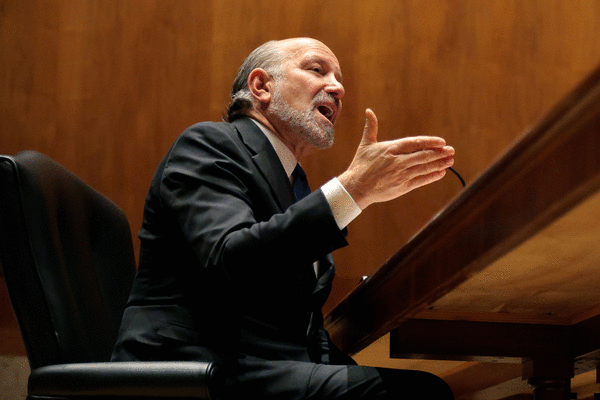
Last October, U.S. Commerce Secretary Howard Lutnick sold his multibillion-dollar ownership interest in Cantor Fitzgerald, the financial services company he led for more than three decades, to trusts benefiting his four children — a move designed to comply with federal ethics rules.
At about the same time, one of the trusts did something unusual. “Dynasty Trust A,” which benefits all four children, borrowed an undisclosed sum from Tether, the stablecoin issuer. Tether has helped Cantor Fitzgerald’s assets skyrocket to new heights on the strength of a 2024 investment, and its foreign owners have sought more favorable U.S. regulatory policies for cryptocurrencies.
A spokesman for Cantor Fitzgerald and the Lutnick children declined to discuss the size of the loan or whether it was used to finance any part of the asset sale. But spokesman Stan Neve said the acquisition “was funded through multiple sources, multiple companies and multiple trusts at market rates and market prices,” in keeping with Howard Lutnick’s federal ethics agreement. The loan hasn’t been reported on previously.
A credit document filed in New York state on Oct. 7 shows that the loan was secured by “all assets” held by the trust, including any it might acquire later. A Cantor executive familiar with the deal said the loan was specifically backed by a convertible bond that entitles the company to a 5% stake in Tether.
Dynasty Trust A’s assets include more than half the equity in Cantor Fitzgerald, according to a recent filing by the financial services company. But control of the firm, via a separate management entity, “is held entirely by the next generation of the Lutnick family and has never been pledged,” Neve said.
In selling his assets, Lutnick met requirements under federal rules that aim to allow presidential appointees to shed potential conflicts of interest. Yet ethics experts who reviewed documents about the transaction said that if the loan aided Lutnick’s sale to his children’s trusts, it undermines the spirit of federal divestiture requirements.
“This transaction is in theory supposed to eliminate a conflict of interest, but in reality it creates a new one,” said Kathleen Clark, a law professor at Washington University in St. Louis and a former ethics counsel for the District of Columbia. She said that if Tether’s loan helped Lutnick complete a transaction that “will ultimately benefit both him and his children, it’s yet another favor his family owes Tether. And yet another reason for concern that Howard Lutnick may use his government power to benefit Tether, and his children, rather than the public.”
The Cantor Fitzgerald executive who’s familiar with the matter disputed Clark’s assessment, saying the loan wouldn’t change the “already strong economic and strategic alignment of interests” between Tether and the firm. Representatives for Tether didn’t respond to requests for comment.
A Commerce Department spokesperson didn’t respond to a list of questions but sent a statement: “Secretary Lutnick has fully complied with the terms of his ethics agreement, including all divestiture and recusal requirements, and will continue to do so.”
The amount Tether loaned to the trust is unclear, as is the price that Lutnick’s children paid to buy out their father. But as chief executive officer and chairman, Lutnick owned the vast majority of a company whose valuation ballooned by billions of dollars on paper following its 2024 investment in Tether.
Tether’s main line of business is a stablecoin called USDT, a digital currency whose value is pegged to the U.S. dollar; the coins allow holders to transact instantly and with low fees outside traditional banking systems. For every USDT issued, Tether is supposed to hold in reserve high-quality, liquid assets to back it up. Last year, Tether reported that its reserves amounted to $192 billion, and since 2021, Cantor has earned fees for managing those funds. Tether’s business is immensely lucrative; it claimed to have $10 billion in profit last year and a 99% margin.
The stablecoin company’s success has come with controversy. Tether and related companies were fined about $60 million in 2021 after U.S. regulators alleged they made misleading statements about losses and their reserves. The companies didn’t admit to any wrongdoing. Tether had also been under investigation by the Justice Department in 2024, according to two people with knowledge of the matter, although the current status of the investigation is unclear.
Meanwhile, President Donald Trump’s administration has de-emphasized cryptocurrency enforcement, disbanding teams at the Justice Department and the Securities and Exchange Commission that looked into alleged crypto crimes. In 2024, a UN report called Tether the “preferred choice” of gangsters and money launderers in Southeast Asia. Tether responded at the time that it collaborates with law enforcement agencies around the world to provide “unparalleled monitoring” of its tokens.
Most U.S. banks avoided doing business with Tether until 2021, when it partnered with Cantor. Lutnick has said he personally negotiated a relationship with the company, reviewing its books to ensure it had all the assets it claimed. Tether’s executives convinced Lutnick that they would cooperate with law enforcement and take other steps to deter money laundering, he said during his Senate confirmation hearings.
Lutnick participated in negotiations for Cantor Fitzgerald to invest in Tether in April 2024. Bloomberg has reported that the investment took the form of a $600 million dollar convertible bond that entitles the financial services company to a 5% stake. The value of that stake has risen dramatically on paper and could reach $25 billion — greater than all the firm’s other assets combined — if Tether attains the valuation goal of $500 billion it has set during recent discussions with potential investors.
After Trump was re-elected in November 2024 and Lutnick helped lead his transition team, Cantor continued to work on deals alongside Tether. In December 2024, Cantor brokered an arrangement for Tether to invest $775 million in Rumble Inc., a money-losing video-sharing platform. In April 2025, Tether and Cantor partnered with SoftBank Group Corp. to announce the launch of Twenty One Capital Inc., a Bitcoin treasury company.
In July, Trump signed the so-called Genius Act, which was landmark legislation for the stablecoin business. The law contains provisions that benefit Tether, such as a three-year grace period before the company, headquartered in El Salvador, must comply with U.S. rules.
“The only special interest guiding the Trump administration’s decision-making is the best interest of the American people,” said White House spokesman Kush Desai, in response to questions about Lutnick’s divestiture and Tether’s loan. “And by securing historic trade and investment deals to level the playing field and create jobs for American workers, Secretary Lutnick has consistently put Americans and America First.”
In February 2025, Lutnick passed the chairman and chief executive roles at Cantor Fitzgerald to his 28-year-old son Brandon, who worked with Tether in Lugano, Switzerland, and recently described his “blossoming friendship” with Tether CEO Paolo Ardoino.
As a Wall Street billionaire, Lutnick faced a complicated task in divesting. His financial disclosure listed more than 800 assets, from stocks to apartment complexes and a satellite company. Lutnick owned stakes in so many subsidiaries and joint ventures that even the ethics lawyers who reviewed his divestiture agreement worried they might not be able to discern where all his financial interests were, according to one ethics officer who worked on the filing. The officer asked to speak anonymously to discuss the matter without authorization.
Lutnick tried to put those concerns to rest in January 2025, when he filed an ethics agreement that said he would seek to divest his interests and resign from leadership positions at his businesses. Because some of the transactions required regulatory approval that might take longer, Lutnick said he would not participate “personally and substantially in any particular matter” that might benefit the companies he was divesting from unless he received an ethics waiver.
Lutnick joined a crypto policy guidance panel in the administration’s early days, before he agreed in May to lock in the price of his assets and forgo any future appreciation. He received a limited ethics waiver on July 8 that allowed him to participate in “high-level strategy and implementation” discussions on topics that might have a “minimal effect” on the companies he was selling, but he was prohibited from taking part in matters that would affect them directly. He completed the sale of his Cantor assets in October.
Lutnick was one of a dozen people appointed to the president’s Working Group on Digital Asset Markets, whose members met more than 1,000 times with industry officials in late winter and spring last year. On July 30, it produced a 160-page report that outlined the administration’s plans. Three members of Lutnick’s staff at Commerce contributed to the document.
Among the group’s suggestions was to “promote the development and growth” of stablecoins — financial instruments for which Tether controls an estimated two-thirds of the market. “Policymakers should encourage their adoption to advance U.S. dollar dominance in the digital age,” the document said. The group praised the Genius Act, the subject of intense lobbying by both Cantor Fitzgerald and Tether.
Prior to his confirmation hearing, Lutnick was asked about his relationship with Tether and responded that he would “faithfully execute my duties consistent with applicable government ethics laws and regulations.”
On May 19, Cantor Fitzgerald and its affiliated companies announced they had reached agreements to sell the bulk of the businesses to the Lutnick children, heralding the move as a transition to the “next generation of the firm.”
The asset sales were completed on Oct. 6. Lutnick’s interest in Cantor Fitzgerald’s publicly traded affiliates — the commercial real estate company Newmark Group Inc. and brokerage BCG Group Inc. — were bought back by Cantor and those companies for a total of more than $350 million.
©2026 Bloomberg L.P. Visit bloomberg.com. Distributed by Tribune Content Agency, LLC.






Comments