Oil for repression: How Venezuela spent billions on a Cuban-backed security state
Published in News & Features
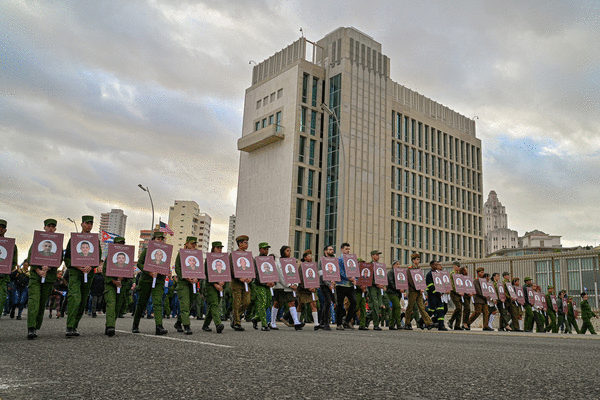
Venezuela’s vast oil wealth did more than sustain an ally in Havana. It helped finance a far-reaching intelligence and security apparatus — one tied to allegations of torture, political persecution and social control — that reshaped the country’s institutions from within, according to a new report.
The study, released by the Washington based nonprofit advocacy group Miranda Center for Democracy, estimates that Caracas transferred the equivalent of almost $64 billion to Cuba over the past two decades through subsidized oil shipments, debt relief and joint investments.
In exchange, Cuban advisers helped re-engineer Venezuela’s military and intelligence services, embedding a model focused on internal surveillance and regime protection. That system, the researchers argue, transformed agencies once tasked with public security into pillars of political control — and continues to define the balance of power even after the removal of strongman Nicolás Maduro by U.S. forces on Jan. 3.
At the heart of the report is a stark conclusion: Venezuela did not simply lose billions in oil revenue — it invested those resources in building the very machinery that allowed its leaders to stay in power.
A partnership beyond oil
The alliance between Caracas and Havana dates back to 2000, when Hugo Chávez and Fidel Castro signed a cooperation agreement that would become one of the most consequential geopolitical partnerships in the Western Hemisphere.
Under the deal, Venezuela committed to sending tens of thousands of barrels of oil per day to Cuba under highly preferential terms. In return, Cuba provided doctors, teachers and technical assistance — a relationship often framed as a model of South-South cooperation.
But the report argues that behind that public narrative was a deeper, less visible exchange.
Through loosely defined “services” agreements, Cuba provided intelligence, security training and strategic advisory roles that were difficult to quantify or independently verify.
Over time, that cooperation expanded well beyond social programs.
Oil shipments surged, at times exceeding 100,000 barrels per day, even as Venezuela’s own production capacity deteriorated. Despite the country’s economic collapse, shipments to Cuba continued — underscoring the alliance’s political importance.
By the report’s estimate, Venezuela transferred nearly $40 billion in oil alone, a figure that rises significantly when adjusted for inflation and combined with infrastructure investments and financial concessions.
The total: $63.8 billion.
Building a system of control
According to the report, those resources financed the construction of a sophisticated system of political control — one that reshaped Venezuela’s security institutions from the inside.
Central to that effort was the creation of the Group of Coordination and Liaison, or GRUCE, a little-known entity established through secret agreements in 2008 that embedded Cuban intelligence personnel within Venezuela’s military and security apparatus.
The timing was critical.
After Chávez suffered a major political setback in a 2007 constitutional referendum and faced signs of unrest within the armed forces, the government shifted its focus toward internal stability. Cuban advisers were brought in to design a system capable of detecting and neutralizing dissent before it could threaten the leadership.
They helped restructure military units, redesign intelligence priorities and train Venezuelan personnel in counterintelligence techniques modeled on Cuba’s own system.
Over time, this collaboration produced a tightly integrated security structure built around three key institutions:
•The military counterintelligence agency DGCIM, tasked with monitoring and controlling the armed forces.
•The civilian intelligence agency SEBIN, focused on political opponents and civil society, and
•GRUCE itself, which ensured coordination and alignment with Cuban doctrine across both systems.
Together, they formed what the analysts describe as a “hard triangle” of repression.
From public safety to regime protection
The transformation was not only structural but doctrinal.
In 2008, Venezuela replaced its traditional intelligence service, DISIP, with SEBIN — marking a shift away from crime prevention and toward political intelligence.
SEBIN adopted a centralized, vertical structure focused on surveillance, preemptive action and the protection of the “Bolivarian political process,” effectively equating national security with the survival of the ruling elite.
That same year, the government introduced a controversial intelligence law that sought to formalize a system of social surveillance, requiring citizens to provide information to authorities and integrating civilian and military intelligence under centralized control.
Although the law was later suspended amid public backlash, many of its principles persisted in practice.
Meanwhile, the military underwent its own transformation. In 2011, the Directorate of Military Intelligence was restructured into the DGCIM, adopting Cuban-style counterintelligence methods focused on internal monitoring, infiltration and control.
The result was a system designed not to defend the country from external threats, but to protect those in power from internal challenges.
The human toll
The consequences of that system have been documented by international organizations and human-rights groups.
The United Nations’ Independent Fact-Finding Mission on Venezuela has concluded that intelligence agencies such as SEBIN and DGCIM carried out illegal detentions, torture and other abuses as part of a coordinated strategy to suppress dissent.
Human-rights groups estimate that more than 18,000 people have been arrested for political reasons since 2014, with a surge in detentions following contested elections in recent years.
The report details patterns of abuse that include beatings, electric shocks, asphyxiation and sexual violence, often carried out in detention centers such as El Helicoide in Caracas.
In some cases, repression has taken more opaque forms.
Researchers describe so-called “white deaths,” in which detainees are denied medical care until they die, allowing authorities to avoid direct accountability while eliminating perceived threats.
Beyond individual cases, the report argues, the system has produced a broader climate of fear — one that affects not only political activists but ordinary citizens.
Enduring system
Recent events have exposed the depth of Cuban involvement in Venezuela’s security apparatus.
During the U.S. operation that led to Maduro’s capture, Cuban personnel were reportedly part of the inner security ring protecting the presidential compound. The report states that 32 Cuban agents were killed during the operation. Cuba itself has confirmed that number.
In the aftermath, some Cuban advisers have begun leaving Venezuela amid growing international pressure.
But analysts caution that personnel changes do not necessarily dismantle the system they helped build.
The structures, doctrines and networks developed over more than a decade remain embedded within Venezuela’s institutions — and continue to shape their behavior.
Unraveling network
But for the first time in years, parts of that system are beginning to show signs of strain.
For years, Cuban intelligence officers operated as the invisible scaffolding of Venezuela’s security state — embedded in military bases, shadowing generals and quietly monitoring communications across the country. That presence, long denied by both governments, is now beginning to recede.
In recent weeks, hundreds of Cuban security personnel — including intelligence agents, soldiers and presidential bodyguards — have started leaving Venezuela, intelligence sources and diplomatic officials told the Miami Herald. The withdrawals mark what could become the most significant rupture yet in the decades-long Caracas-Havana alliance that underpinned the country’s system of internal control.
The exodus follows the U.S. operation that led to Maduro’s capture, a moment that exposed how deeply Cuban personnel had been woven into the highest levels of Venezuela’s security apparatus.
For analysts, the departure of Cubans could have immediate consequences inside Venezuela’s armed forces.
“It essentially removes a layer of pressure,” said José Antonio Colina, a former Venezuelan military officer who has tracked Cuban influence for years. “Those constant watchful eyes that were present throughout all these years are no longer over them.”
Unit 105
At the center of that surveillance system was a little-known operation known as Unit 105, described in intelligence documents as the technological backbone of Venezuela’s counterintelligence network. Operating out of Fuerte Tiuna, the country’s largest military complex, the unit combined signals intelligence and human intelligence to intercept communications, monitor military officers and detect early signs of dissent.
The Jan. 3 operation dealt a significant blow to that system. According to intelligence reports, precision strikes destroyed Unit 105’s central hub, killing dozens of Cuban technical personnel and crippling its nationwide monitoring capability.
But the network was not entirely dismantled.
Surviving operators are believed to have relocated servers and sensitive data into civilian infrastructure, preserving fragments of a system that tracked political and military activity for years.
Even as Cuban personnel withdraw, remnants of the network are expected to endure. Intelligence sources warn that “sleeper cells” — younger operatives embedded in institutions and neighborhoods — remain in place, along with databases that could still be used for surveillance, blackmail or political leverage during Venezuela’s fragile transition.
For Venezuela’s interim leadership, the drawdown presents a delicate balancing act. While Washington is pressing for a complete break with Havana, Cuban advisers remain deeply intertwined with the country’s intelligence institutions.
The result is a partial unraveling rather than a clean break — a system weakened, but still capable of operating in the shadows.
Continuity under new leadership
That continuity is particularly evident under interim President Delcy Rodríguez.
A central figure in Venezuela’s political and economic leadership for years, Rodríguez has played a key role in maintaining the networks that sustain the government, including those tied to the country’s oil sector and financial operations.
She has also moved quickly to consolidate control over the security apparatus.
In January, Rodríguez appointed Gen. Gustavo González López, a former intelligence chief sanctioned for human-rights abuses, to lead both the presidential guard and military counterintelligence — reinforcing the role of institutions shaped by Cuban doctrine.
While her administration has taken steps to reduce the visible presence of Cuban personnel, the report argues that those moves do not amount to a structural break.
The system remains intact.
A broader regional impact
The implications of the unraveling Caracas-Havana alliance are now being felt most acutely in Cuba itself.
For years, subsidized Venezuelan oil served as a critical lifeline for the island’s economy, helping sustain its power grid, transportation system and basic services. That flow has now largely dried up following Maduro’s removal and a tightening U.S. oil blockade, plunging Cuba into the most severe crisis in the history of the revolution.
In recent months, the island has experienced repeated nationwide blackouts — including multiple major grid failures since December — leaving millions without electricity for extended periods. Hospitals have been forced to cancel surgeries, universities have reduced classes and ordinary Cubans struggle to keep food from spoiling amid daily outages.
Fuel shortages have compounded the crisis. With Venezuelan shipments halted and Washington threatening sanctions on countries supplying oil to Cuba, the government has been forced to rely on limited domestic energy sources that fall far short of demand. Public transportation has been cut, gasoline is tightly rationed and officials warn the health care system is under severe strain.
The economic pressure is unfolding alongside rising political tensions with the United States. The Trump administration has linked any easing of sanctions to demands for political reforms and the release of prisoners, while openly suggesting that Cuba’s current system may not survive the crisis — raising uncertainty about the island’s future as its longtime alliance with Venezuela weakens.
The challenge ahead
One of the report’s most striking conclusions is that Venezuela’s security institutions may be beyond reform.
Because their doctrine, training and operational culture are deeply rooted in Cuban models, the report argues, meaningful change would require dismantling and rebuilding them from the ground up.
As long as key figures associated with past abuses remain in positions of power, the system is likely to persist — regardless of political transitions or economic reforms.
That poses a fundamental challenge for Venezuela’s future.
Efforts to rebuild the economy, restore democratic institutions or attract international investment may ultimately depend on something far more difficult: dismantling the architecture of control built over two decades.
What began as an oil-backed alliance now leaves Venezuela confronting a deeper reckoning — not just how to recover, but how to undo the system that oil built.
©2026 Miami Herald. Visit at miamiherald.com. Distributed by Tribune Content Agency, LLC.




Comments