Epstein files show reach extended into Maryland, from soccer team to science
Published in News & Features
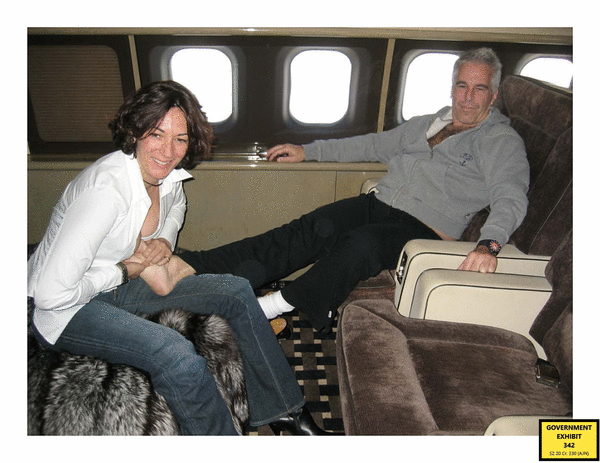
In addition to the specific revelations in the files released by the Department of Justice on the Jeffrey Epstein case, another takeaway emerges: the sheer breadth of the convicted sex offender’s reach.
The millions of documents released to date contain references to individuals and groups from seemingly everywhere, including Maryland, where some are as obscure as a girl’s soccer team in Crofton, and others as well-known as Johns Hopkins Medicine.
“Dear Ms. Maxwell,” began an email in the files to Epstein’s co-conspirator, Ghislaine Maxwell, who remains imprisoned for sex trafficking. “On behalf of the Freestate Shooters, U-15 Girls soccer team, I want to thank you for your most generous contribution of $10,000.00 toward our team’s continued growth and development.”
The email dates back to 2004, two years before Epstein was first arrested, for soliciting prostitution, in Palm Beach, and long before he was arrested in 2019 on the more widely known federal charges of sex trafficking of minors. The soccer team recently issued a statement saying it had no knowledge of any allegations or criminal activity at the time it received the money.
In the outcry over the scandalous case of Epstein, who died of suicide while awaiting trial, the DOJ has released some of its investigative files as required by a law passed in November. More than 3.5 million pages are publicly available online, but presented in a non-chronological way, without context, and with many documents repeated multiple times; as a result, the files are by turns revelatory and inscrutable.
While much of the attention and interest is on figures like President Donald Trump, Microsoft founder Bill Gates, former President Bill Clinton and other prominent elites who had relationships with Epstein, a search for any local connections buried within turns up a few that seem largely on the fringes, several degrees removed from the actual center of the sprawling case.
For example, there are references to Dr. Bert Vogelstein, a pioneering cancer researcher at Hopkins who told The Baltimore Sun he never met Epstein and only learned more of him beyond news accounts when a collaborator at Harvard landed “in trouble” for his connection to the disgraced financier.
In the files, there is a 2014 news release touting Epstein’s funding of colon cancer research at Hopkins and referring to Vogelstein’s work.
“He certainly never funded anything of mine at Hopkins,” Vogelstein said in an interview.
Nor that of others, according to a Hopkins spokesman.
“Johns Hopkins has never received any philanthropic support from Jeffrey E. Epstein or his foundation,” he said in a statement.
And indeed, while the headline on the Epstein news release refers to Hopkins’ research, the body of the document notes, “The research was conducted by Martin Nowak, Director of the Program for Evolutionary Dynamics.”
Vogelstein has collaborated over the years on research papers with Nowak, a Harvard mathematics and biology professor, whose program was funded by Epstein and had provided him with an office on campus. The program was shuttered by Harvard in 2021, two years after Epstein was arrested and imprisoned. Harvard put Nowak on leave last month in the wake of the latest release of DOJ files.
Epstein was known to seek connections with researchers, as well as political and business figures, with some speculating he was attempting to burnish his image after criminal and civil cases.
An assistant to Epstein reached out, for example, to a University of Maryland School of Public Health researcher in 2011, saying Epstein was interested in speaking with him and possibly funding his work. The two apparently spoke on the phone, with the researcher forwarding links to some of his research, but it is unclear from the files what, if anything, resulted from the conversation. The researcher has since left Maryland for another institution.
Also included in the files is an email that Michele Gelfand, then a Maryland psychology professor, sent to Epstein in 2014, inquiring if there was an application process for seeking funding from his foundation for her work “at the intersection of cultural neuroscience, conflict, and evolution.”
Gelfand, now at the Stanford Graduate School of Business, told The Sun she had been “casting a wide net” at the time to foundations and philanthropists known to support research in her field, and only knew of Epstein as a science funder.
She didn’t get a response, she said, adding, “Frankly, I had completely forgotten I’d even contacted him.”
Epstein may be notorious now, but it took years for his crimes to become more widely known. He had pleaded guilty in 2008 to soliciting prostitution from a minor, a much lesser charge than a multi-victim case police in Palm Beach had been pursuing. Epstein’s lawyers entered into a secret deal with the U.S. attorney’s office that allowed him to escape federal prosecution.
In the ensuing years, women who said they had been victimized by him began to emerge, with some filing lawsuits.
The case came into a wider spotlight in 2018, when the Miami Herald published an investigation saying more than 60 women were alleging abuse and containing details of the arrangement made with the U.S. attorney for southern Florida at the time, Alex Acosta. By then, Acosta was the labor secretary in President Donald Trump’s his first term, and amid heightened attention to the Epstein case, he eventually resigned.
The congressionally ordered release of the files reveals much of what was happening behind the scenes before the Epstein case became more widely known. As the science journal Nature recently wrote, for example, his ties to academia were much deeper than previously revealed.
In fact, that article was how Mark Mattson, an adjunct professor of neuroscience at Hopkins, said he first found out that the sponsor of a workshop he spoke at in 2016 had been funded by Epstein.
The workshop was sponsored by the Origins Project at Arizona State University, which was founded by theoretical physicist Lawrence Krauss and had received funds from Epstein. Krauss announced his resignation in 2018 after an ASU sexual harassment investigation found he had grabbed a woman’s chest.
The files, of course, contain far more than Epstein’s outreach to academics. The Crofton soccer team, for example, comes up for the donations it received from Epstein’s C.O.U.Q. Foundation.
In addition to the letter thanking Maxwell for a $10,000 donation, the files also contain documents showing the soccer club received $25,000 in 2005 and again in 2006.
The donations put them in quite diverse company: Harvard, Juilliard, the Michael J. Fox Foundation, the Palm Beach Police Department and American Ballet Theatre are among other recipients.
The team, now a part of what has been renamed Maryland United FC, issued a statement saying no players, staff or family members had contact with foundation representatives, and all correspondence was conducted through email.
“Our club stands with the victims,” the statement said, “and joins the many other charitable organizations in expressing our profound sympathy for those impacted by this criminal behavior.”
_____
©2026 Baltimore Sun. Visit baltimoresun.com. Distributed by Tribune Content Agency, LLC.




Comments