Rancor among Florida Republicans doomed property tax plan
Published in News & Features
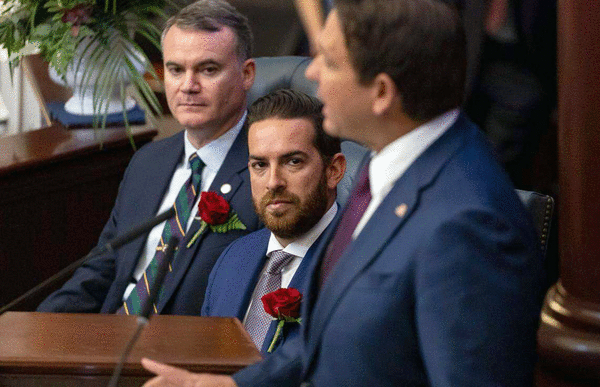
TALLAHASSEE, Fla. — With only 60 days to pass a full plate of bills and a balanced budget, the Florida Legislature’s grand plans to add property tax cuts to their crowded calendar never had a chance.
Lawmakers did not even get a budget out before the close of business Friday, the end of the regular session, much less a complicated ballot measure that would ask voters in November to cut property taxes.
So now they will have to return to Tallahassee after Easter and Passover for special sessions to finish approving a budget, which by law must be done by June 30.
Senate President Ben Albritton, R-Wauchula said they will also return for a special session on property taxes, but he did not say when.
Asking voters to cut property taxes — first proposed last year by Gov. Ron DeSantis — was the one solution to the state’s affordability crisis that Republican leaders latched onto. But so far, they haven’t delivered.
That was not a surprise, given the open rancor between House and Senate leaders left over from last year’s session, which, despite the GOP’s control of both chambers, also failed to produce a budget on time and went an extra 45 days.
“I don’t think they were ever going to get a property tax bill out,” said former state Sen. Jeff Brandes, a Republican from St. Petersburg who left the legislature four years ago and started his own think tank called the Florida Policy Project.
“It was highly unrealistic to think we were going to,” agreed Bob Jarvis, a law professor at Nova Southeastern University.
Florida is too big a state, Jarvis said, and “property taxes is such a big subject, how could you ever get that done in the first session? They need years to chew on.”
Nonetheless, DeSantis has said he is determined to make that happen in time for the November ballot, despite the complexity of the topic and the obstacles. How he will do that as a lame duck in his final year as governor remains to be seen.
To date he has yet to give out any information on his proposal, and has shown nothing in writing, “not even back of the napkin calculations,” Brandes said.
DeSantis began campaigning for the Legislature to take action on property tax cuts a year ago. But the governor and Legislature don’t control property taxes, and the governor doesn’t have the authority to place a measure on the ballot himself.
Cities and counties levy those taxes to pay for local services including police and fire protection, schools and parks and other amenities in their communities. And voters would need to approve any changes to property tax laws.
DeSantis initially called for a ballot measure to ask voters to eliminate property taxes altogether, but he was forced to pivot several times, as cities and counties pushed back, asking how the state would make up for a potential loss of $15 to $18 billion in revenue.
Tax cut supporters also worried that such a radical change would not garner the 60% approval needed to pass a constitutional amendment cutting property taxes.
DeSantis scaled back his vision, suggesting Florida eliminate only homesteaded property taxes, which are levied on the primary residence of homeowners, and then agreeing to leave school taxes untouched.
This week, DeSantis pivoted a step further when he announced that he was planning “to give people a historic exemption for their primary residence” instead of eliminating taxes on those properties.
Brandes said he suspects things have played out this way, with DeSantis pivoting and delaying, because he “can’t figure out how to make the numbers work.”
The warring egos and hurt feelings left over from the 2025 session played into the inaction on property taxes this year, observers said.
Last year, Albritton reneged on a deal with House Speaker Daniel Perez, R-Miami, about a $2.8 billion tax cut. Those bruised feelings have been at the heart of the failure to close a $1.4 billion spending gap between the two chambers this year.
The Senate wants to spend more on Everglades restoration and transportation while the House wants to deliver a larger sales tax savings package.
The House took charge of the property tax discussion early on, after Perez appointed a special committee to come up with several options. The House then approved a ballot amendment to eliminate homesteaded properties, but the Senate never took it up, and it died when the session ended Friday.
“The only body that has passed anything with property taxes, that has had a committee, that has had a robust debate is the House,” Perez said.
DeSantis — who has also been feuding with Perez — never endorsed the House plans, and at one point called them “milquetoast,” not serious and “total half measures.”
He also stated near the beginning of the session — and reiterated at a news conference Thursday — his preference to have a special session on property taxes because it was “better to do it right than do it quick.”
But while he has called for a special session in April on redistricting congressional seats, DeSantis has not called for a special session on property taxes.
DeSantis never intended to support a legislative plan, Jarvis said. He wants to put forth a plan of his own to burnish his image for a presidential run in 2028, he said.
Sen. Don Gaetz, R-Niceville, a former Senate president who returned to the Legislature in 2024 after an eight-year absence, agreed, adding he was confident there will be a property tax solution.
“I believe it will be the governor’s solution,” Gaetz said.
The governor has said a special session could be held some time this summer.
DeSantis has not revealed details of the plan to Gaetz, but they have spoken about it over dinner.
“I think he is trying to get a property tax reduction, and I think he is working on it very personally, and what you are going to see is a product he fully believes is a serious product and has a great chance of passing,” Gaetz said.
©2026 Orlando Sentinel. Visit orlandosentinel.com. Distributed by Tribune Content Agency, LLC.





Comments