Florida Legislature stalls over budget disagreements. Again.
Published in News & Features
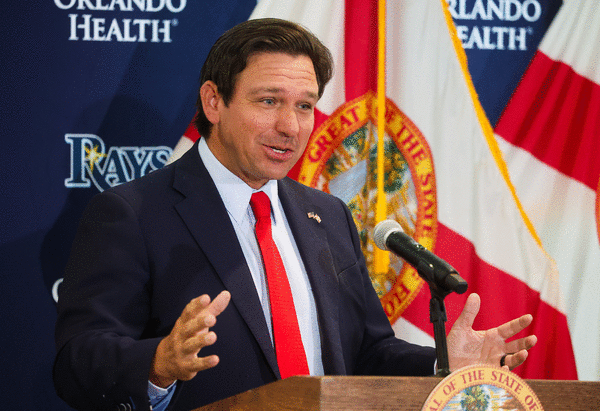
TALLAHASSEE – With five days left in its regular 60-day session, the Florida Legislature has yet to do the one thing required by the state constitution — pass a balanced budget. Missing deadline will mean the Legislature will go into extra innings as it did last year.
And it looks like the atmosphere of distrust created over last year’s budget disagreements is still evident, as some of the top items being pushed by legislative leaders and Gov. Ron DeSantis — all Republicans — seem unlikely to cross the finish line.
The Legislature is bogged down in a bottleneck of bills, and even key GOP priorities like finding a way to cut property taxes haven’t cleared both chambers.
To get a budget approved by Friday, both chambers have to agree on a spending plan by Tuesday to allow for a required 72-hour cooling-off period before they can take a final vote.
“We are not getting close enough, and it is looking tough for us to end on time,” House Speaker Daniel Perez, R-Miami, told reporters this week. The two chambers “have a fundamental disagreement on what the budget should look like for the state of Florida,” Perez said.
After looking at the state’s somber three-year financial outlook, Perez said he wants to ensure that future legislatures have the same flexibility he has had “to make the right decisions to give the largest tax cut in state history.” That won’t be possible unless they tighten their belts now, he said.
State economists predict a $3.7 surplus this year but deficits of $8.1 billion over the next two years. “I don’t think I am very flexible on wanting to spend more money,” Perez said.
Senate President Ben Albritton, R-Wauchula, has said he believes he has a good relationship with Perez and felt confident about a budget agreement. Yet two of his top priorities – funding for struggling rural counties and money for school vouchers – appear dead as Perez has no intention of taking up those items.
The House has proposed a $113.6 billion budget while the Senate has proposed a $115 billion budget.
The impasse is puzzling considering those opening offers are only $1.4 billion apart, said Aubrey Jewett, a political science professor at University of Central Florida.
“That’s less than a 1% difference,” Jewett said, but unless both sides are willing to compromise it may as well be larger.
State law requires them to eventually come to an agreement. They can’t begin to parse out the funding for each state department and line item until they can agree on the bottom line, and those budget decisions can also prompt disagreements.
“Fast is not on the menu this session,” Perez said.
Last year, the Legislature didn’t finalize its budget until two weeks before the annual budget cycle ended because the House and Senate quarreled over how to close a $4 billion spending gap. Perez thought he reached a compromise with Albritton over sales taxes, but Albritton backed out of the deal several days later.
That spending plan was signed by DeSantis on June 30, the last day of the budget year.
“Right now the odds of holding a special session on the budget are pretty high,” Jewett said.
The budget isn’t the only issue that splits the House and Senate.
The House moved quickly on DeSantis’ request to come up with a property tax reduction plan to present to voters in November. The House plan would, with voter approval, wipe out all but education-related homestead taxes.
Albritton has said he wanted to take a measured and cautious approach to the complicated topic of property taxes. But the Senate has never unveiled a plan of its own, and it also has not taken up the House plan.
DeSantis has hinted at a special session on property taxes, saying there is no reason to rush something that won’t come before voters until November.
Meanwhile, the Legislature has moved slowly on many bills, with some debated at length and progressing through one chamber only to be stalled in the other. With only 43 bills out of 1,895 filed this year approved by both chambers, the Legislature is off last year’s pace, when 295 bills out of 1,950 were approved.
Lawmakers recently spent hours arguing over measures to preempt local governments from funding activities that fall under a vague and broad definition of diversity, equality and inclusion, stop them from restricting greenhouse gases, and prevent them from regulating urban sprawl. They also entertained a proposal that would place new restrictions on voting and a measure that would make it even more difficult for teachers unions to recertify their membership.
As of Friday, those bills were still moving between the two chambers.
Bills in limbo include one that aims to prohibit developers from charging “forever fees” on community amenities like pools, tennis courts and club houses, a measure to restore the Ocklawaha River to its natural state, and an amendment that would put severe limits on the ability of counties to control large-scale development in counties’ rural boundaries.
Among the bills that are nearly dead are the governor’s push for regulating AI at the state level and a bill to make it easier for parents to get vaccine exemptions for school children. While those bills cleared the Senate they have not been heard in the House and likely won’t be, Perez said.
And a bill passed in the House to lower the age to buy guns from 21 to 18 hasn’t moved in the Senate and seems unlikely to get new life in the last week.
House Democratic Leader Fentrice Driskell, D-Tampa, called it a wasted session that did nothing to solve the problems that Floridians care about the most — affordable housing and property insurance. Bills filed by Democrats to address those issues did not advance.
“They certainly have a lot of dysfunction going on right now,” she said of the GOP.
_____
©2026 Orlando Sentinel. Visit orlandosentinel.com. Distributed by Tribune Content Agency, LLC.





Comments