As Operation Metro Surge recedes, concern grows over tactics of Twin Cities bounty hunters
Published in News & Features
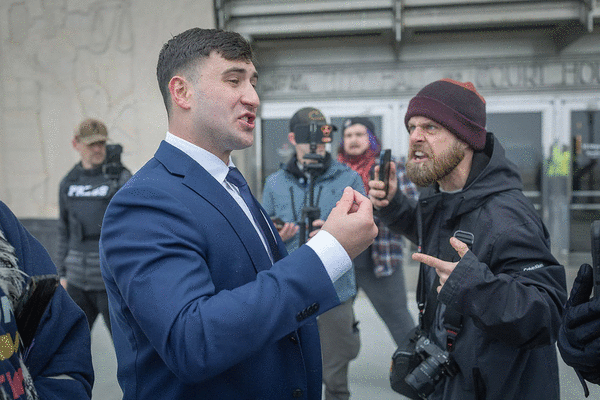
MINNEAPOLIS — Outside City Hall in downtown Minneapolis on Tuesday, March 3, a small group of protesters chanted as armed men escorted what some said was an immigration enforcement target into the Hennepin County jail.
In a video of the encounter, as two protesters blocked their van — labeled with “Midwest Plumbing” decals advertising a disconnected phone number — the driver opened his door, leaned over the windshield and pointed a pistol at them. Another man in a bulletproof vest and carrying a long gun walked outside the vehicle. One of the armed men shot pepperballs into the crowd.
The incident echoed encounters between federal agents and Twin Cities residents during Operation Metro Surge. But this time, the men were bail enforcement agents, or bounty hunters — contractors responsible for apprehending fugitives who post bail through a bond agency and then fail to appear in court.
Although bounty hunters have long operated in the Twin Cities, they can bear a resemblance to Immigration and Customs Enforcement (ICE) agents — in both how they appear and operate.
And while there was no confirmation the bounty hunters seen in the downtown encounter were deputized by the federal government, their actions, mixed with the continued vigilance of community members seeking to observe and protest Operation Metro Surge, have raised alarms over the lack of state oversight.
That same day, the same armed men appeared in another video widely shared on social media in which they detained a man in south Minneapolis. As observers blew whistles and asked to see a warrant, the men hurled curses and threats. When a car drove near their van, one of the men pointed a gun at it and screamed at the driver to back up.
The federal Department of Homeland Security (DHS) told the Minnesota Star Tribune that allegations of ICE using private contractors, including bounty hunters or bail bond agencies, to carry out immigration enforcement were false and part of a smear campaign.
But a member of Congress and an attorney representing detained immigrants in U.S. District Court have countered that claim.
The licensing process for bail bond agencies and agents requires approval through Minnesota’s State Court Administrator’s Office, Department of Commerce and Bureau of Criminal Apprehension. Minnesota records show more than 200 active and approved bail bond agents operate in the state. Different from bounty hunters, bail bond agents are authorized to issue bonds in Minnesota’s district courts.
The agencies and agents then subcontract with bounty hunters to apprehend people who have skipped bail. Minnesota legal statutes have no requirements to operate as a bounty hunter — or, as they are referred to in professional circles, a fugitive recovery agent. However, they are bound by state law that applies to all citizens.
Teschone Shannon, owner of Minneapolis Criminal Apprehension Taskforce, is a former military police officer who has worked as a bounty hunter in Minnesota for more than a decade. While bounty hunters can take different approaches, Shannon said, his agency’s teams are equipped only with less-lethal weapons aside from one person with a gun who has a permit to carry.
He said the actions of the armed men shown in the viral videos went against the core of the profession.
“You’re not a peace officer,” Shannon said. “There’s a lot of rules when it comes to bounty hunting in the state of Minnesota. Pulling guns on people is one of them. That’s against the law.”
The Hennepin County Sheriff’s Office said it was investigating the incidents involving the bounty hunters in south Minneapolis and downtown.
Brian Feintech, a spokesman for the city of Minneapolis, said in a statement that the downtown encounter was concerning.
“Minnesota does not mandate bounty hunter training or licensing,” Feintech said. “But they must operate within state laws.”
‘Acting as agents of ICE’
While the DHS denies contracting with bounty hunters, last year, in a request for information first reported by The Intercept, the department conducted market research with skip tracing vendors, another term for bail bond agencies.
The document states that ICE had an “immediate need” for skip tracing and process serving to “verify alien address information, investigate alternative alien address information, confirm the new location of aliens, and delivery materials/documents to aliens as appropriate.”
In January, U.S. Rep. Raja Krishnamoorthi of Illinois introduced the “No Private Bounty Hunters for Immigration Enforcement Act” after he learned about the “department’s recent initiatives.”
That same month a habeas petition filed in U.S. District Court of Minnesota cast allegations against “bounty hunters acting as agents of ICE” who, on Jan. 15, detained several Venezuelan citizens who had sought asylum in the United States and were living in a home in St. Paul.
“They stormed the house with guns drawn, without notice or presentation of a warrant to justify the search or seizures, and without regard for the 12-year-old and 3-month-old minor children present,” the petition read.
Six people were detained at gunpoint, arrested and taken to detention facilities around the country. The federal government later returned all six to Minnesota, released them and acknowledged they had been unlawfully detained.
Claire Glenn, the attorney with the Climate Defense Project who filed that petition, said she has heard of others who were detained by people who “identified themselves as ICE bounty hunters.”
“One client in particular reported that these self-identified bounty hunters spent the drive mocking my client and bragging about how much money they were being paid to arrest ‘stupid’ immigrants, indicating that the more people they arrested the more they would be paid,” Glenn said.
For Erika Zurawski, a co-founder of the immigrant rights group MIRAC, the actions of the bounty hunters in the Twin Cities raise fears that anyone could disguise themselves and begin detaining people in Minnesota.
She viewed the tactics in the video of the bounty hunters in Minneapolis this week as excessive use of force, which she believes should lead to arrests and charges.
“Are we allowed to just go out in the street and point a gun at someone? That’s what those videos look like, and it’s terrifying,” Zurawski said. “You could pretend you’re a bounty hunter or an ICE agent. What’s stopping anyone?”
The DHS said any allegation of bounty hunters working as federal agents “are designed to demonize and villainize our brave ICE law enforcement.” It added that ICE agents clearly identify themselves and wear masks to protect themselves from gangs, criminal rings, murderers, and rapists.
Right-wing provocateur rides along on bounty hunt
On the same day of the incidents recorded in Minneapolis, Jan. 6 rioter Jake Lang posted a video to his social media account that he was “BOUNTY HUNTING” in Minnesota.
Lang, who spent four years in prison for his role in the 2021 attack on the U.S. Capitol before he was pardoned by President Donald Trump, has coordinated several social media stunts in the Twin Cities during Operation Metro Surge. He was in town for a court hearing on felony property damage for knocking down an ice sculpture of the words “Prosecute ICE” outside the State Capitol.
In the Tuesday video, Lang sits in the back seat of the moving vehicle, filming as two bounty hunters in the front sit in silence wearing tactical vests that read “bail enforcement agent,” sunglasses, badges, and partial face coverings.
“Guys, we’re on the chase right now for some illegals that have jumped bond,” Lang explains. “I’m with the bail bondsmen bounty hunters here, right now. We’re going to catch some Somalis today.”
He then takes a video of himself, noting that they’re trying to capture defendant Abdulahi Mohamed Omar because he failed to appear in court after getting out of jail on a $110,000 bond. One of the bounty hunters holds up a booking photo of Omar posted to the Instagram page “MinneapolisMugshots” at Lang’s request.
Omar is currently wanted in Hennepin County District Court for missing court dates over several charges, including drug possession, fleeing police, domestic assault, threats of violence and motor vehicle theft. The 27-year-old twice posted bail last November, once for $35,000 and once for $75,000. He was released with several conditions, including that he return for court appearances.
His initial bail was posted by Bail Bonds Doctor, a prominent bail bondsman in downtown Minneapolis next to the county jail. The company declined interview requests but did say it does not conduct its own bounty hunt, but instead subcontracts that work to other companies.
Shannon, the longtime Minnesota bounty hunter, said having a social media influencer come for a ride-along to detain someone “did not sound normal ... that’s stretching their reach a little too far.”
Lang told the Star Tribune the bounty hunters reached out to him on social media about the collaboration.
“They’re patriots,” Lang said. “They do the job to make sure that criminals … are arrested and brought to justice.”
Omar’s immigration status is unknown, and that most Somali residents of Minnesota arrived here legally or were born here. Lang later noted that they did not find Omar.
Zurawski, however, said she is alarmed by the notion of influencers going on ride-alongs to showcase bounty hunters and thinks it encourages illegal actions.
“Now right-wing vigilantes get to drive around to terrorize people and it’s considered legal?” she said.
Bonds and bounties
Kim Voorhees, who works at Goldberg Bail Bonds in downtown Minneapolis, said almost every bail bond agency subcontracts for bounty hunting.
“No bounty hunter works for an agency because they’re a dime a dozen,” she said.
Vorhees explained that the Commerce Department mandates that for a criminal defendant to be released on bail, 10% of the total bail needs to be put up in cash, which the criminal defendant pays. The bail bond agency guarantees the rest but keeps the initial 10%, regardless of whether the defendant is proved innocent or guilty.
But if the client fails to return to court, the bail bond agency has a maximum of 90 days to find its client and have them appear before a judge or it has to pay the full bail amount. If it doesn’t, the bonding agency can lose its license.
Vorhees said they don’t even bother retaining bounty hunters when trying to collect on low bail amounts like $1,000.
But when larger financial stakes are involved, the bounty hunter comes in.
“I typically run a four to five man team,” Shannon said. To catch a defendant, he charges a fee that’s a percentage of the initial 10% payment to the bail bond agency. He said they find most defendants within 30 days. “We all do carry bulletproof vests, that’s one thing in this industry because you’re walking into unknowns where you don’t know their mental state.”
His company uses publicly available court records, public databases and information from the bond company to track down people who skip bail. He said he likes to catch people outside of a house because if you enter a home you open yourself up to potential lawsuits.
He also said that his agency calls 911 dispatch in whatever city they are going to be operating in and lets local law enforcement know the general area where they are trying to locate someone.
Minneapolis police confirmed that Bail Bond Doctor notified 911 dispatchers that bounty hunters would be working in south Minneapolis on Tuesday, although it is not confirmed that they were the operators captured on bystander video.
Minnesota legal statutes show that a bonding agent can have a bounty hunter “arrest or have another person or the sheriff arrest” any defendant who they believe is about to flee, not appear before the court or not perform conditions of release.
In early 2025, there were more than 20,000 active warrants in Hennepin County.
The bounty hunter or the bond agent has the ability to bring the defendant before a judge, but they typically hand them off to the county sheriff who verifies the warrant and takes them into custody. The Hennepin County Sherriff’s Office said its only relationship with bounty hunters is dealing with that handoff.
Shannon said there are only a handful of bounty hunting companies in Minnesota, and they like to keep a low profile, unlike the recent situations that have gone viral on social media.
“Bounty hunting is a very discreet job because once your face is plastered, and everybody knows who you are, you can’t walk up to a person in disguise or quietly say, ‘You’re under arrest. You have a warrant. Let’s not make a scene.’”
———
(Sarah Nelson of the Minnesota Star Tribune contributed to this story.)
———
©2026 The Minnesota Star Tribune. Visit startribune.com. Distributed by Tribune Content Agency, LLC





Comments