Close to 650 federal agents remain in Minnesota weeks after border czar announced end of operation
Published in News & Features
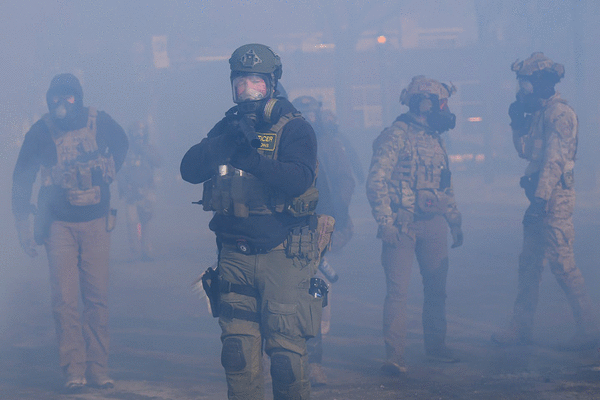
MINNEAPOLIS — Nearly three weeks after federal officials announced that Operation Metro Surge was over, close to 650 federal agents remain in Minnesota, Department of Homeland Security Secretary Kristi Noem testified at a Senate Judiciary hearing Tuesday.
It’s a figure higher than the estimates in two declarations filed Feb. 23 by DHS officials as part of a lawsuit by the ACLU, which estimated just under 600 agents remain in the state.
On Feb. 20, White House border czar Tom Homan said in a CNN interview that the Department of Homeland Security would return to its “regular footprint” of 150 agents by the end of last week, after the government sent 4,000 additional agents at its peak into Minnesota. Homan’s CNN interview came a week after he announced on Feb. 12 that Operation Metro Surge was ending.
Noem gave the figure of fewer than 650 agents remaining in the state under questioning by Sen. Amy Klobuchar, who also asked: “When are you going to get down to the original footprint as promised to us?”
“We’re continuing to work at that,” Noem responded, adding that additional investigators are in the state to look into allegations of fraud in Minnesota. Homan noted on CNN that a “small team of security forces were staying in Minnesota to back up ICE agents in case things get out of hand.”
Caveats to remove those “security forces,” he said, include cooperation from local law enforcement and completion of the investigation into fraud.
The announcement promising a full drawdown was met with skepticism from many Minnesota residents and activist groups, who say arrests have continued daily, particularly in the suburbs. The estimates in Noem’s testimony and the recent declarations show the state still has roughly four times the number Homan promised.
Erika Zurawski, a co-founder of the group Minnesota Immigrant Rights Action Committee, said she was not surprised by the discrepancies in the numbers provided by Homan and Noem.
“Were we not surprised to find that the Trump administration lied? Absolutely not,” Zurawski said. “It’s not just that we weren’t surprised. It’s exactly what we expected.”
DHS declined to answer questions from The Minnesota Star Tribune about discrepancies in Homan’s statements.
“For operational security we do not disclose resources or numbers of personnel on the ground,” a DHS spokesperson said in an email.
The federal court filings that estimated nearly 600 agents remaining in Minnesota by March were submitted as part of a lawsuit against Noem by the ACLU of Minnesota, which alleges agents racially profiled Somali and Latino people when they made detainments as part of the operation.
The declarations came after District Judge Eric C. Tostrud ordered the government in mid-February to file an affidavit or declaration regarding the drawdown.
ICE’s St. Paul field office director, Sam Olson, wrote in his declaration that roughly 407 DHS officers and agents would remain in Minnesota in March. That is on top of 190 officers Olson said are normally assigned to St. Paul’s ICE field office and cover the five-state area of Minnesota, North and South Dakota, Nebraska and Iowa.
Another declaration from Marty Raybon Sr., Customs and Border Protection’s lead field coordinator for Operation Metro Surge, said that it would “demobilize” its remaining 67 CBP officers here for the federal operation by Feb. 23.
At its peak, the operation had roughly 4,000 federal agents and officers assigned to Minnesota for the operation, the declarations show. In both filings, the federal officials offer no timeline about whether there will be a full drawdown to the 190 federal officers normally in the region.
Homan warned in a February Fox News TV interview that if the government decides it’s necessary to send additional agents back into Minnesota, it will.
“There’s over 800 flights a day landing in St. Paul, Minnesota; if we need to come back, we’ll come back,” he said.
Catherine Ahlin-Halverson, an attorney with the ACLU of Minnesota, said the continued increase of agents in the state, combined with Homan’s warning, raises “grave concern for the constitutional rights and safety of people in Minnesota.”
Activists doubt that the drawdown will fully happen but are hoping that it does. Zurawski said the only change she thinks will bring justice to Minnesota is if all ICE agents are removed from the state.
“In our 20 years as an organization, we have never asked for pieces of justice — we are asking for the whole darn pie,” she said. “We are demanding, and the only thing that will really bring justice to the state is a complete sanctuary state.”
_____
©2026 The Minnesota Star Tribune. Visit startribune.com. Distributed by Tribune Content Agency, LLC





Comments