Cuba's 'dictatorship will end' this year, top US diplomat in Havana says
Published in News & Features
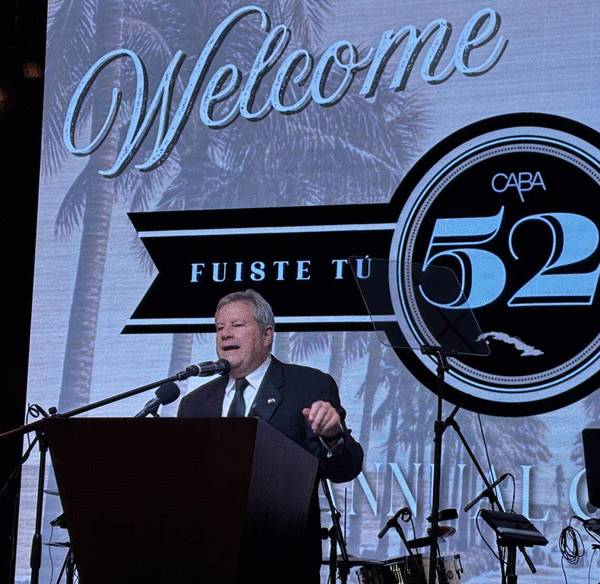
MIAMI — Mike Hammer, a career U.S. ambassador and currently the highest diplomat at the U.S. Embassy in Havana, said he believes a change in government in Cuba will happen this year, adding to the string of voices predicting regime change on the island.
“We believe change is coming. It is coming in 2026,” Hammer said in remarks in English after receiving the Cuban American Bar Association’s first Humanitarian Award at the organization’s annual gala in Miami.
“La dictadura se va a acabar” — the dictatorship will end — Hammer said at the event on Saturday.
When he arrived in Havana, at the end of the Biden administration, Hammer said, “There was no hope. But today, as I have traveled to all provinces on the island, there is not only hope but an expectation that there will be change — so let’s make it so.”
The Trump administration has halted oil supplies from Venezuela and Mexico to Cuba to press Cuban leaders to make a deal with the United States, following the capture by the U.S. military of the island’s closest ally, Venezuelan strongman Nicolás Maduro. Secretary of State Marco Rubio has said the U.S. government is not expecting changes overnight on the island, but would like to see Cuban leaders make “dramatic” economic changes to their centrally planned socialist economy.
President Donald Trump floated Friday a possible “friendly takeover of Cuba,” hinting at progress in his administration's back-channel negotiations with Raúl Castro’s grandson, Raúl Guillermo Rodriguez Castro.
A tweet by MAGA activist Laura Loomer and a piece in The Atlantic magazine claiming “Cuba is next” have kept the buzz going.
“High-level source tells me the United States will be assuming economic management authority of Cuba within 30 days,” Loomer published on X.
On Feb. 25, Rubio’s team met with Rodriguez Castro in Saint Kitts, during the annual CARICOM conference of Caribbean leaders, to discuss a gradual easing of U.S. sanctions in exchange for reforms on the island, multiple sources told the Miami Herald.
Rodriguez Castro has no official government role or position in the Communist Party but he is his grandfather’s closest aide and bodyguard, and U.S. officials see him as a direct channel to Castro, Cuba’s ultimate ruler, who is 94.
Cuba’s formal government seemed to have been blindsided by those talks at first. Cuba’s handpicked president, Miguel Díaz-Canel, has vowed to resist U.S. pressure and send the island’s foreign minister as his special envoy — a title rarely used in Cuba — on a diplomatic tour to China, Vietnam, Russia and Spain to secure support and humanitarian aid.
Foreign Minister Bruno Rodríguez also sought the Vatican’s mediation on a trip to Rome last week, when he and Hammer happened to be in Italy at the same time. Pope Leo XIV had called for a dialogue between the United States and Cuba last month, expressing concern about the humanitarian situation and the suffering of the Cuban people.
Hammer met with Archbishop Paul Richard Gallagher, the Vatican’s secretary for relations with states and international organizations, and Cardinal Pietro Parolin, the Vatican’s secretary of state, with whom he discussed “human rights and political freedom in Cuba,” the U.S. Embassy to the Holy See said on X.
The pope met with the Cuban foreign minister on Saturday, but Italian news agency Agenzia Nova reported that the Vatican signaled limits to its ability to mediate with the United States due to its difficult relationship with the Trump administration.
Increasing isolation
Cuba observers have called attention to how little Cuba’s government seemed to have understood the changing geopolitical landscape, and how that has left the island’s communist government more isolated and vulnerable to U.S. increased pressure.
While several governments have promised humanitarian assistance, Cuba’s traditional allies, including Russia and China, have also signaled they would not directly confront the Trump administration on the Cuba issue. Russia reportedly sent oil aboard a “dark fleet” tanker bound for Cuba, but the ship, closely monitored by U.S. warships in the Caribbean, diverted its course once it was near the island, the Reuters news agency reported.
Still, many officials in the Cuban government are ideological hard-liners and “need to see a credible threat for them to negotiate,” said Armando Chaguaceda, a Cuban historian and political scientist who is a researcher at GAPAC, a Mexican think tank. “We know there are contacts, which means they feel threatened. But they are hard-liners and that’s not what they are betting on; they are betting on Trump’s political burnout in the midterms.”
U.S. officials, Trump administration insiders and Cuban Americans with businesses on the island do not believe the Cuban government will be able to stall on the negotiations until the midterms, with its economy almost completely paralyzed and the population suffering worsening hardships by the day.
A U.S. official dismissed the idea of a stall in negotiations till the November midterm elections at as a possibility: “They won’t fool Marco Rubio,” a U.S. official said, adding that the administration was aware Cuba leaders would try to delay any substantial reforms.
“The economic consequences will be too dire,” a Cuban American entrepreneur said. “Every day that passes without oil, factories are not producing, they are not exporting tobacco or rum, goods are rotting at the port.”
On Saturday, the U.S. and Israel attacked Iran, another Cuba ally, and killed several members of its top leadership, including the country’s supreme leader, Ayatollah Ali Khamenei.
On Tuesday, U.S. Rep. Carlos Giménez, a Florida Republican, told Fox News he hopes Cuban leaders are paying attention to what is unfolding in Iran.
“They should take heed of what president Trump said to Iran, ‘Hey, you need to come to the negotiating table.’ He said the same thing about Cuba,” he said. “If I were the Cuban leaders, I’d take notice. This is a president of action, not just of words.”
Youth want change ‘at any price’
On the island, Cubans have been following events with “an immense amount of uncertainty,” said Katrin Hansing, a U.S. professor of Anthropology at City University of New York who recently returned from the island.
“Nobody knows what’s going to happen, and that has produced a lot of anxiety, a lot of fear, but also a lot of a sense of fatalism on the part of many who feel completely powerless,” she said.
But Hansing also noted high expectations that something will change on the island.
“That is particularly the case among young people who were born after the 1990s, who have only lived in crisis and are exhausted and want change now at any price. And then there are those who are a little older, who also want change, but are not willing to have change at any price,” she added. “The main issue there is sovereignty and obviously national independence.”
But with a humanitarian crisis rapidly worsening, Hansing said, many Cubans “don’t have the luxury to think about these things. They are so consumed with the act of survival that they are on the sidelines of what’s happening, because they are just trying to get by every day.”
“That is a group that we cannot forget about,” she added, “because that’s the majority of Cubans.”
_____
©2026 Miami Herald. Visit miamiherald.com. Distributed by Tribune Content Agency, LLC.





Comments