How the new leader of Minnesota's most scrutinized agency aims to tackle fraud
Published in News & Features
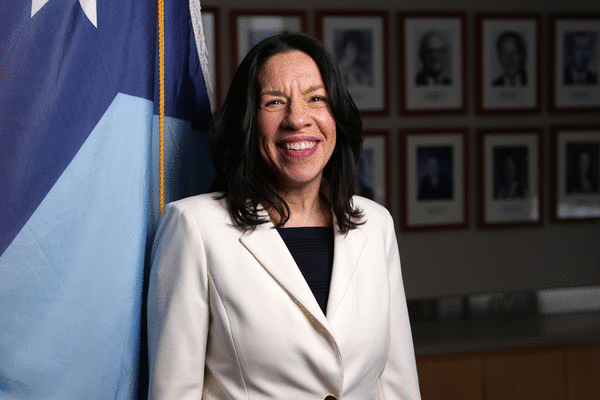
For the bulk of her tenure with the Minnesota Department of Human Services, Shireen Gandhi found comfort in being a less visible part of its engine, working under the hood to keep the massive state agency running.
She did not expect to become top boss within eight years of joining the department, which is now at the center of national controversy over fraud in Minnesota’s social services programs.
“It was not a goal of mine,” Gandhi, 58, recently told the Minnesota Star Tribune. “People have a lot of opinions about whether we’re getting it right or not. I pray every morning and every night that I am making the best decision that I can with the information I have in hand at the moment.”
On Monday, Feb. 23, more than a year after Gandhi took over the department in a temporary capacity following the abrupt departure of Jodi Harpstead, Gov. Tim Walz officially named her as commissioner, positioning her to lead the agency through the end of his term next January.
In the past year, federal authorities have untangled a far-reaching criminal web aimed at defrauding Minnesota’s Medicaid programs. Their investigations have put the Human Services Department’s practices under intense scrutiny and confronted Walz and the agency with a deluge of criticism from Republican lawmakers and the public.
The department, which has a $25 billion annual budget and roughly 2,300 employees, primarily oversees health care programs and services for people with disabilities, older adults and others in need. Though Gandhi’s responsibilities extend beyond fraud issues, the governor has made it clear that her primary directive as commissioner is to root out fraud and restore faith in Minnesota’s social services programs.
Gandhi, the daughter of a nurse and a former public relations professional, is seen by many as an apolitical and analytical problem solver. She is also described as a cool-headed leader, open to others’ opinions and battle-tested for crisis.
While some have raised concerns about elevating Gandhi — given her role overseeing compliance and then budgeting during the period when fraud proliferated in state programs — several former colleagues said she is uniquely qualified for the new job.
To show how proactive she is to find solutions, Chuck Johnson, a retired deputy commissioner with more than 30 years at Human Services, points to Gandhi’s decision to hire Optum, the Minnesota-based health services business, to help identify vulnerabilities in state programs.
He said she can also handle herself in whatever room she finds herself, whether it’s facing a group of reporters or a appearing before panel of lawmakers.
“She’s a very calm leader,” said Johnson, who called Gandhi “uniquely prepared” to address the state’s fraud concerns. “It’s needed when you’re in this type of moment.”
Growing up, Gandhi looked up to her mother, who spent 40 years as a bedside nurse in a Southern California hospital, and aspired to become a doctor.
She also learned firsthand the benefits of caring for those with disabilities. Her younger brother is on the autism spectrum, she said, and received “quite a bit of support” beginning in preschool, including a year of residential care.
“That really catapulted him into being much, much more high functioning, understanding social interactions, being able to work with people better. And he’s just really remarkable,” Gandhi said.
Those formative experiences helped shape her perspective and set her on course for a career in health care.
Before getting her college degree, she moved to New York, where she met her first husband. The pair then moved to Minnesota, his home state, where Gandhi earned a bachelor’s degree in journalism and mass communications from the University of Minnesota.
Early in her career, Gandhi found herself at the forefront of a controversial matter facing the state’s hospitals.
At the time, she was working for the Minnesota Hospital Association, the state’s hospital trade group, as scrutiny was building over horrific mistakes nicknamed “never events” — like forgetting surgical tools inside a patient or removing the wrong body part.
Gandhi brought a disciplined approach to developing a policy aimed at analyzing the root causes of those mistakes, said Mary Krinkie, a longtime lobbyist with the hospital group who worked alongside her.
“She’s no-nonsense. She’s hardworking. She’s competent,” Krinkie said. “And she’s very low drama.”
The hospitals association, at Gandhi’s direction, formed a plan to adopt a reporting requirement that would enable doctors to learn from each others’ mistakes. Minnesota’s Adverse Health Care Events Reporting Law took effect in 2003.
“Shireen was really the architect of that standard,” Krinkie said.
In 2005, Gandhi left the hospitals association to join the public relations firm Weber Shandwick. She worked in the health care group at the firm, in its heyday the largest in the state, said Walt Parker, a former colleague at the firm.
“In some ways, her whole career prepared her for what she’s in now,” Parker said. “She could sit with CEOs and surgeons and leaders and hold her own. And stay calm. Even in difficult, sensitive situations.”
Parker said he was impressed to see Gandhi juggle her work at Weber Shandwick while co-parenting two children as a single mother and attending Hamline University School of Law. “I think that says something about her determination and personal vision,” he said.
At Hamline, Gandhi studied at the Health Law Institute, run at the time by Lucinda Jesson, who went on to become Minnesota’s human services commissioner and later a state appellate judge.
Gandhi also worked as a research assistant alongside Amy Joy Holzman. And after their graduation, they started JurisHealth, a private firm helping health care providers navigate regulatory sea changes.
One of the firm’s clients was the Department of Human Services, which laid the track for Gandhi’s move from a lawyer in private practice to state government official.
Holzman said Gandhi will take no half measures and “do absolutely everything she can to make a positive difference.”
“Shireen doesn’t do things for the spotlight,” she said. “She does things because it’s the right thing to do.”
In January, before the current Legislature opened, Gandhi sat before lawmakers and ticked down the list of fraud prevention efforts initiated during her 12-month run as temporary human services commissioner.
Among the highlights: She hired as inspector general James Clark, a former Medicaid fraud prosecutor in the state Attorney General’s Office; she expanded oversight of more than a dozen programs vulnerable to fraud, and launched a process of previewing the state’s direct payments to health care providers.
The department also developed a corrective action plan in response to a federal funding freeze that could amount to more than $2 billion a year.
Gandhi walks a tightrope as lawmakers across the political spectrum call for a hard-line approach to protecting taxpayer dollars without hurting those who need services.
Along with responding to fraud concerns, she has been navigating a massive reorganization that split the human services agency into three departments. She is also grappling with the fallout of sweeping Medicaid changes under the Trump administration’s “Big Beautiful Bill.”
Gandhi has attracted her share of critics, especially among state Republicans. After Walz announced her appointment, House Leader Harry Niska, R-Anoka, said Gandhi’s time leading the department came “as Minnesota’s fraud epidemic has made international news.”
“Promoting her sends the wrong message at a time when Minnesotans are demanding real accountability,” he said.
But she has also managed to develop credibility with some Republican lawmakers. Rep. Joe Schomacker of Luverne, a department oversight committee chair, said recently: “I get the impression the department is taking fraud and whistleblowers and responses more seriously now than what we’ve see in the past.”
“There are of, course, other things that are still faltering along the way, but it’s a heavy lift and she’s not ignoring it,” he said.
Gandhi said the department is taking a hard look at itself as it aspires to flip its story to become known as a national leader in fraud prevention. And solutions, she said, will require bipartisan buy-in from lawmakers and “everyone rolling up their sleeves” to harden programs against fraud and ensure Minnesotans receive services they depend on.
“If the spotlight needs to be on in order for us to do that, I’m OK with that,” she said. “And I want people to raise their hand and work with us to make it better.”
_____
(Nathaniel Minor of the Minnesota Star Tribune contributed to this story.)
_____
©2026 The Minnesota Star Tribune. Visit startribune.com. Distributed by Tribune Content Agency, LLC






Comments