Maryland lawmakers look to control ICE detention facilities
Published in News & Features
BALTIMORE — Maryland lawmakers are attempting to regulate and restrict incoming immigration detention facilities, as the U.S. Department of Homeland Security (DHS) and other private owners try to add more centers in the state.
The Maryland House of Delegates is set to vote on two bills later this week, one to attempt to restrict the opening of privately owned immigration detention facilities and another to regulate the conditions of the facilities.
“The detention facilities operate in Maryland, they must meet clear standards for care, safety and transparency and that human dignity doesn’t stop at the door,” Del. Melissa Wells, a Baltimore City Democrat, said while explaining the bills at a news conference Tuesday. “Private immigration detention centers can’t operate in the shadows… if they do exist, then they must be explicitly approved under local zoning, no loopholes and no backdoor deals.”
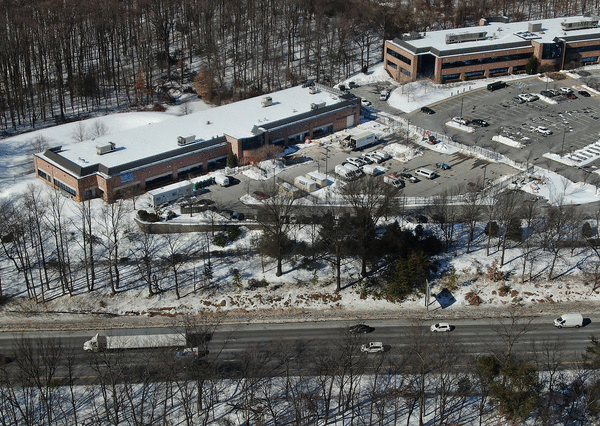
In January, the DHS purchased a warehouse in Washington County to be used as an Immigration and Customs Enforcement (ICE) detention facility, housing up to 1,500 detainees. Maryland Attorney General Anthony Brown filed a lawsuit Monday to block that center, despite the Washington County Board of County Commissioners having backed it.
Another facility that was slated to open in Howard County by a private owner was blocked by The Howard County Council earlier this month when it passed emergency legislation.
The Baltimore County Council also voted on Feb. 17 to ban private immigration detention centers in the county. The ICE processing facility in Baltimore City has been to subject of tours by Democratic Reps. April McClain Delaney and Jamie Raskin after a viral video showing cramped conditions of the facility.
Local Zoning Bill
HB 1017, sponsored by Wells, would prohibit the operation of or governmental approval of a private immigration detention facility without a specific zoning allowance for that purpose. The attempted facility in Howard County, she said, is an example of why the bill is needed.
The measure would require local government oversight of any private buildings currently operating as or planning to operate as private immigration detention facilities by requiring the local government to explicitly zone an area for the purpose of immigration detention. Operating the facility without the correct zoning approvals could lead to a fine of up to $10,000 per day.
“It’s a decision that should be made at the at the local level,” Wells said in an interview with The Sun.
Howard County Executive Calvin Ball testified in support of the bill earlier this month, arguing that the legislation would require that the bill would require that these facilities cannot be approved without “proper zoning review, accountability and transparency.”
“Private detention facilities raise serious concerns that go beyond traditional land uses,” Ball said to a Senate Judicial Proceedings Committee. “As leaders, it is our responsibility to make land use decisions that are not only right for our community, but uphold human dignity together, we must stand united, not just in words, but in action to protect our community, uphold the law and defend the dignity of every person who calls our great state of Maryland home.”
Republican Del. Mike Griffith, representing Cecil and Harford counties, said on the House of Delegates floor Wednesday that the policy would go against the supremacy of the federal government.
Wells said in an interview with The Sun that the policy would not impact the federal government and only impact private entities.
Regulatory standards
While the Howard County facility would have been prevented by HB 1017, because it would be privately owned, the Washington County facility cannot be stopped by the state or local government because the property is now federal land.
The second bill, HB 1018, would implement minimum mandatory standards for conditions and care, including an emergency operations plan and functioning heat and air conditioning, in immigration detention facilities and all correctional facilities in the state. The bill would also require health care workers and security guards to report violations.
The legislation would put immigration detention centers under the duties of the Maryland Commission on Correctional Standards.
Del. Vaughn Stewart, the Montgomery County Democrat sponsoring the bill, said the potential Washington County facility could cause financial strain for Marylanders, adding that the measure would help the state regulate large facilities that could put tension on the power grid and healthcare system.
“This is not a symbolic bill,” Stewart said. “It’s just a risk management framework, and we want to make sure that we force documentation and infrastructure readiness before emergencies happen.”
A confidential letter from the Maryland Attorney General’s Office shared with The Sun by the House Republican Caucus said that the bill is “not clearly unconstitutional, but there is a significant chance that at least portions of it could not be enforced against immigration detention facilities, especially facilities run by ICE, not a private operator.”
The office’s letter notes that the main problem with the legislation’s constitutionality is the requirement for facilities to close or cease operations.
Still, Stewart said that because the legislation would impact all detention facilities, not just federal facilities, the bill does not violate the supremacy clause.
Republican Chris Tomlinson who serves on the committee that approved the bills on Feb. 20 said he isn’t sure that the state has the authority to regulate a federal government facility. Tomlinson, who voted against the legislation in committee, said in an interview with the Sun that the legislation is not legal, given that federal laws outweigh state laws.
Law professors who spoke to The Baltimore Sun said there are legal arguments for and against the bill’s constitutionality.
The state government cannot specifically regulate the federal activities, because of the Supremacy Clause, David Super, a law professor at Georgetown University said. However, Super said he could not find anything in the bill that only impacted the federal government and could therefore be argued as a “general health and safety rule, rather than an effort to restrict the federal government specifically.”
“This is, I’m sure, likely to be challenged if it’s enacted,” Super said. “It’s not clear whether or not it would prevail.”
Mark Graber, a regents professor at the University of Maryland Law School, said he could see a court ruling for and against the zoning bill. A court’s decision, he said, would be up to what a judge interprets as the law’s intention.
The State Senate
While both bills appear to be steadily moving through the House of Delegates, the State Senate has not yet scheduled a hearing on either bill.
State Senate President Bill Ferguson, a Baltimore City Democrat has not specifically endorsed the bills. When asked by The Sun during a roundtable discussion on Tuesday, he said that he believes there will be legislation passed by both chambers this session addressing immigration detention facilities.
“We do believe that there are tools that exist at a state level, particularly around health and safety standards, that are not implicated by the Supremacy Clause,” Ferguson said. “We do think that there is an avenue for some legislating here, and we anticipate moving forward with something in conjunction with the House.”
________
©2026 The Baltimore Sun. Visit at baltimoresun.com. Distributed by Tribune Content Agency, LLC.






Comments