Trump declares US richer and stronger, defending his economy
Published in News & Features
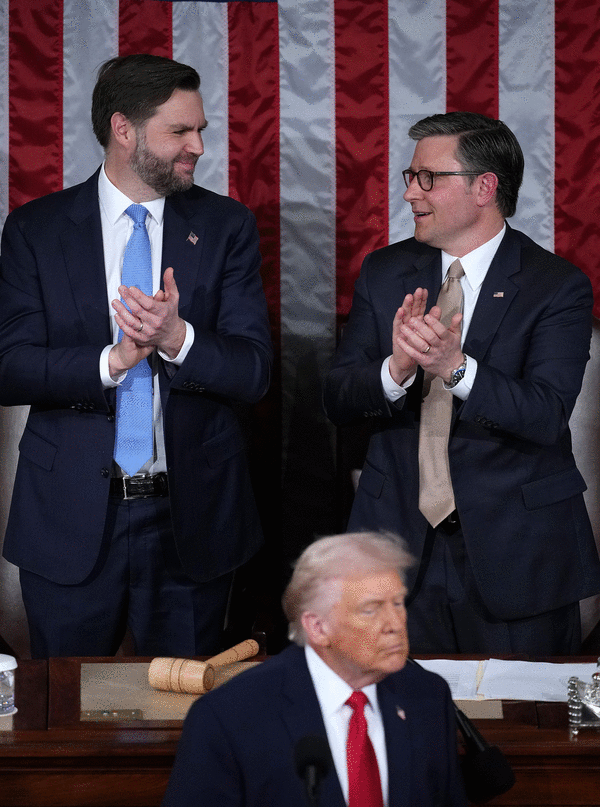
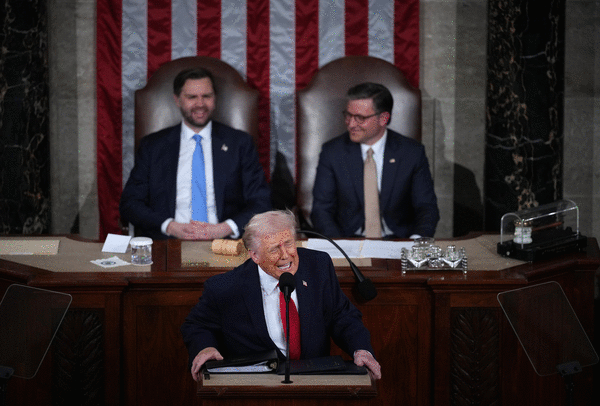
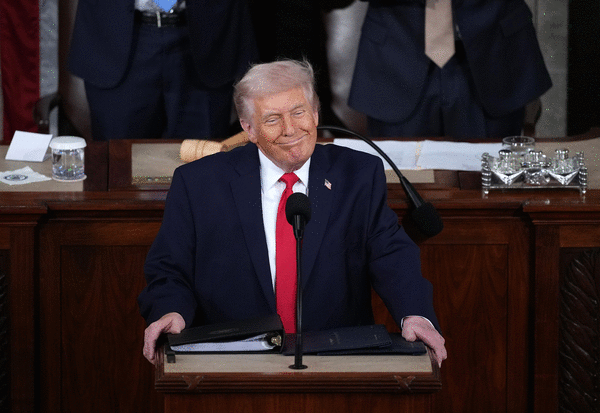
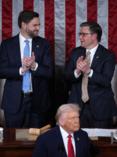
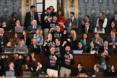
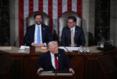
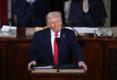
WASHINGTON — President Donald Trump offered a defiant defense of his policies and economic record, declaring the nation is “back bigger, better, richer and stronger than ever before” in Tuesday’s State of the Union address.
The president staged his version of a pep rally for a beleaguered nation, celebrating athletic victories and military heroism while pledging better fortunes for the public. The goal for Trump is to reverse voter sentiment, with polls showing Americans anxious about the economy and skeptical of his policies ahead of November’s midterm elections.
“You’ve seen nothing yet,” he continued. “We’re going to do better and better and better. This is the Golden Age of America.”
The speech comes at a pivotal moment for Trump’s presidency as he grasps for a broad reset. The president is confronting falling approval ratings, a number of foreign policy flash points — including the threat of military action against Iran — and a setback to his signature tariff policy, which was struck down by the U.S. Supreme Court.
“Today, our border is secure, our spirit is restored. Inflation is plummeting, incomes are rising fast,” Trump said. “The roaring economy is roaring like never before, and our enemies are scared. Our military and police are stacked, and America is respected again, perhaps like never before.”
Trump peppered policy announcements throughout his speech, including a pledge that the federal government would match as much as $1,000 in retirement savings for workers without access to 401(k)s, starting next year. He also called on Congress to pass laws banning members and their families from purchasing individual, publicly traded stocks and said he wanted lawmakers to ban the issuance of commercial drivers licenses to undocumented migrants.
The president didn’t say how he would fund the retirement match, or explain why he was backing a stock trading ban for Congress that he previously opposed.
Trump on multiple occasions sought to taunt and bait Democrats in the chamber, seeking to put his opponents on the defensive with moments of dramatic, televised confrontation.
The president used his stock-ban push to taunt former House Speaker Nancy Pelosi, who opposed such legislation. Some Democrats responded by calling the president corrupt. He said the high cost of health care was “caused by you,” pointing to the Democratic side of the aisle.
Trump similarly drew jeers from Democrats when he accused Somali migrants of billions of dollars of fraud in Minnesota, the rationale he used for his migrant crackdown in the state that drew widespread backlash after the killing of two American citizens. When Trump asked members to stand if they agreed that the government’s “first duty” was to protect U.S. citizens and “not illegal aliens,” Representative Ilhan Omar, a Democrat who represents the Minnesota district at the heart of the controversy, responded by shouting that Trump has “killed Americans.”
Trump demanded that Democrats restore full operations at the Department of Homeland Security, from which they are withholding funds in a bid to force reforms to the president’s immigration policies.
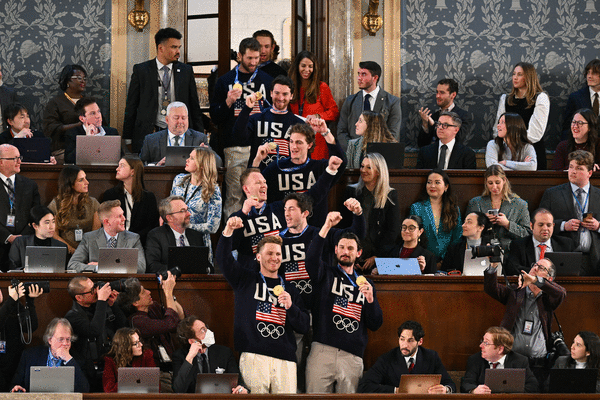
The exchanges were a marked departure from earlier in the speech, when Trump sought to project a unifying theme by celebrating the Olympic champion U.S. men’s hockey team enter the House chamber wearing their gold medals. He also paid tribute to George “Buddy” Taggart, a World War II veteran who will turn 100 years old this year.
Many Americans are dour about the president’s stewardship of the country. Some 60% of Americans disapproved of Trump’s job performance in a Washington Post-ABC News-Ipsos poll released on Sunday. The president’s approval rating hit a new low of 26% among independents according to a new CNN survey.
Trump repeatedly sought to blame political opponents and the establishment for his political troubles, including in a critique of the Supreme Court for striking down his global tariffs. As Trump assailed the court’s decision, half of the justices who ruled against him sat in the audience, silently watching.
Still, he gave no indication he would change course, saying he would move ahead with restoring his broad import taxes through other authorities. He expressed confidence foreign countries would honor their trade agreements and even predicted that the U.S. would take in so much revenue that it would “substantially replace the modern-day system of income tax.”
Tariff revenue pales in comparison to income taxes and is paid by importers and often passed along to U.S. consumers.
There has some encouraging economic data lately. Last month saw inflation come in below forecasts – though it’s still high enough to keep the Federal Reserve worried – while jobs beat expectations. But prices for groceries and many essentials have risen, and last year was a historically weak one for the jobs market. Only 181,000 positions were added in what economists dubbed a “low-hire, low-fire” labor market.
Trump’s remarks, and the Democratic response, offer to set the tone for the midterm elections, which threaten to sweep away Republicans’ grip on both chambers of Congress. Rival Democrats have been buoyed as voters’ views of Trump’s handling of the economy slide, fueled by anxiety over high prices and his tariffs.
To reverse that narrative, the president highlighted efforts to boost jobs, draw trillions in foreign and private investment pledges and his efforts to lower costs, including on prescription drugs, as well as his Trump accounts for young people.
Trump has also urged Republicans to campaign on last year’s tax-and-spending package — and on Tuesday cited numerous measures, including the provisions for no taxes on tips, overtime pay and Social Security, as well as making the interest on auto loans tax deductible.
The president also touted an effort to press tech companies to shoulder more of the burden for energy costs and to prevent the boom in artificial intelligence from raising utility costs for U.S. households.
“We’re telling the major tech companies that they have the obligation to provide for their own power needs,” Trump said. “They can build their own power plants as part of their factory so that no one’s prices will go up, and in many cases, prices of electricity will go down for the community and very substantially down.”
He also championed interventions in the Western Hemisphere following a series of military strikes on alleged narco-trafficking boats and the capture of Venezuelan strongman Nicolas Maduro. Trump hailed the new government in Venezuela as a partner and said the U.S. had received 80 million barrels of oil from Caracas.
Trump in recent weeks has revealed frustration over his polling numbers and the focus on affordability — claiming last week that he had already “won” on that issue, messaging that has unnerved some allies. He’s also increasingly been at odds with elements of his own party and with those who will help determine his legacy, assailing the Supreme Court justices — in particular two he nominated — who voted against his tariffs. Four justices attended Tuesday’s address — Chief Justice John Roberts and Justices Elena Kagan, Brett Kavanaugh and Amy Coney Barrett.
Roberts, Kagan and Barrett were among the justices who struck down the tariffs. Since that ruling on Friday, the administration has scrambled to enact a patchwork of replacement levies, leaving major trading partners bristling over the chaotic approach.
_____
(With assistance from Derek Wallbank and Mark Niquette.)
_____
©2026 Bloomberg L.P. Visit bloomberg.com. Distributed by Tribune Content Agency, LLC.




Comments