California Gov. Gavin Newsom and Trump have vowed to crack down on corporate homebuying. A new bill aims to curb it
Published in News & Features
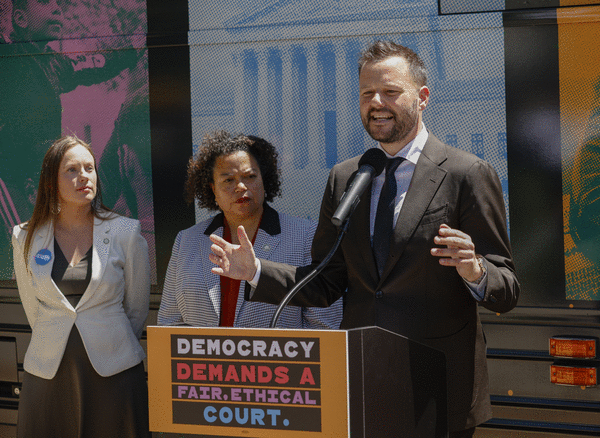
LOS ANGELES — In a rare moment of political alignment last month, Gov. Gavin Newsom and President Donald Trump vowed to crack down on corporate homebuying. Now, a new bill aims to make it a reality.
AB 1611, introduced by Assemblymember Matt Haney, D-San Francisco, in January, would eliminate a "tax loophole" that Haney says corporate landlords and investment firms use to buy up single-family homes across the state.
"It's shocking to me that by design, our tax system lets large firms take advantage of tax breaks in order to outbid California families when buying homes," Haney said. "They're able to use a tax loophole to give themselves an upper hand."
The so-called loophole takes the form of a 1031 exchange — a tax-filing strategy that allows real estate owners to defer capital gains taxes when they sell an investment property, such as a single-family home, as long as they buy a similar "like-kind" property within 180 days. Essentially, it allows investors to replace one investment property with another, avoiding taxes in the process.
The bill would ban companies that own 50 or more single-family homes from taking advantage of the tax break. It would apply to sales completed after Jan. 1, 2026.
California has the second-lowest homeownership rate in the country at 56%, and Haney said corporations shouldn't be shirking real estate taxes in the midst of a housing crisis. The California Department of Finance estimated that during the current fiscal year, the state lost $1.2 billion in revenue due to like-kind exchanges.
Lenny Goodman, the policy director for the California Tax Reform Assn., worked with Haney to develop the bill. He said he has viewed like-kind exchanges as a rip-off for years, but it's an ongoing issue with a powerful lobby behind it.
"They're called like-kind exchanges, but they're not actually like-kind," he said. "You can exchange an office building for a hotel, or an apartment building for a single-family home."
He added that corporate investors aren't buying up high-end neighborhoods; it's mostly working-class or middle-class areas, where the affordability crisis is more acute.
Goodman said the ban would help in two ways. First, it would result in more tax dollars being paid by corporations. And second, it would stop allowing corporations to dominate bidding wars for homes.
Currently, corporate owners can afford to bid more on a home than an individual, knowing that when they eventually sell it, they can avoid the capital gains tax by buying a different property, making it a more valuable asset. If they didn't have access to that benefit, that advantage would be gone.
He sees it as a modest proposal; a more ambitious effort would be to eliminate like-kind exchanges altogether. But this is a good place to start, and it still lets mom-and-pop landlords or investors who own less than 50 properties to take advantage of the tax break, he said.
The corporate homebuying trend became a focal point during the pandemic, when low interest rates sent the housing market into a frenzy, and first-time homebuyers competed with investors viewing the house as an asset, not a home. During the second quarter of 2021, 23% of home sales in L.A. County went to investors rather than someone wanting to live there.
But data show that corporate ownership still makes up a much smaller share of the overall market. Analysis from the California Research Bureau showed that 2.8% of single-family homes in the Golden State are owned by companies that own at least 10 properties.
The biggest chunk of that appears to be smaller mom-and-pop landlords rather than giant corporations. Companies with more than 50 properties own roughly 110,000 homes in California, whereas companies with 10-49 properties, which would be exempt from the ban, own roughly 235,000 properties.
Haney said now is the right time for the bill, given the momentum provided by Newsom and Trump last month.
Newsom vowed to take a tougher stance on corporate homebuying in his final state of the State speech, saying that "it's shameful that we allow private equity firms in Manhattan to become some of the biggest landlords in many of our cities."
It's unclear which form the crackdown will take; Newsom said it means more oversight and enforcement, and potentially changing the tax code.
A few weeks prior, Trump announced immediate steps to ban institutional investors from buying single-family homes, but no specific actions have been announced.
Haney said it's also timely in the aftermath of the Palisades and Eaton fires, since data show that investors are flooding the market for burned-out lots, replacing longtime locals. A recent Redfin report said at least 40% of lot sales in fire-damaged areas went to investors in the third quarter of 2025.
"It shows you that this shouldn't be a partisan issue. Whatever your political leaning, you should want regular families to have access to homeownership," Haney said. "Maybe this is one of the rare issues where there's broad agreement across political stripes, and we can actually solve a problem."
A different bill addressing institutional investors, AB 1240, took a different approach. Introduced by Assemblymember Alex Lee, it looked to ban investors that own at least 1,000 single-family properties from buying more homes in order to rent them out.
Nine companies own more than 1,000 single-family homes in California. The largest is Invitation Homes, which owns more than 11,000 homes in the state and has faced a litany of lawsuits related to unpermitted renovations, unfair eviction practices and withheld security deposits.
Lee's bill passed the state Assembly last year but stalled after fierce opposition from real estate agents and the California Apartment Assn. It awaits a Senate committee hearing.
©2026 Los Angeles Times. Visit at latimes.com. Distributed by Tribune Content Agency, LLC.






Comments