Pentagon will 'accelerate' Navy fighter despite early reluctance
Published in News & Features
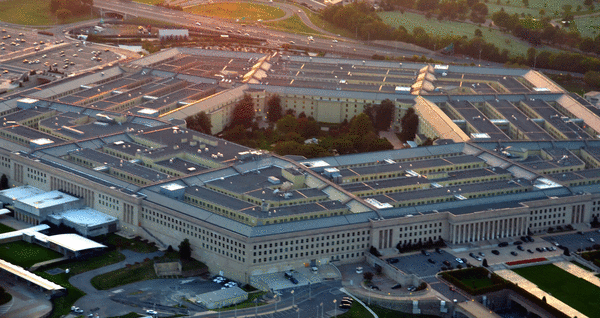
WASHINGTON — The Pentagon will accelerate development of a next-generation stealth fighter jet for the Navy after previously pushing back — a move that could benefit either Boeing Co. or Northrop Grumman Corp., which are competing to build the aircraft.
The White House has now green-lit a Pentagon plan to move forward with the Navy jet program known as the “F/A-XX,” according to a Pentagon document sent to Congress recently that was obtained by Bloomberg Government.
That’s despite Defense Secretary Pete Hegseth’s reluctance over concerns the defense industrial base couldn’t handle developing two so-called sixth-generation fighter jets simultaneously, with Boeing already developing the new stealth F-47 jet for the Air Force.
After the Pentagon previously slow-walked the Navy jet program, the Defense Department sent an 85-page document to Congress spelling out how it plans to allocate almost $152 billion for fiscal 2026 passed in last year’s massive tax-and-spending package, known as reconciliation.
That’s separate from the formal $893 billion fiscal 2026 defense spending measure Congress finally passed in January, in which the Navy requested just $74 million for the Navy jet, down from the $454 million it sought a year earlier.
The Pentagon told Congress it was directing $750 million earmarked in the bill “to accelerate the F/A-XX aircraft.” The funds will be in “support of the F/A-XX milestone decision,” that calls for selecting one of the companies to proceed into full development and production.
The funds “will support critical design, risk reduction, and technology maturation efforts toward meeting operational requirements,” according to the document.
Separately, the Defense Department intends to spend more than $24 billion for missile defense and President Donald Trump’s so-called Golden Dome shield.
According to the spending plan sent to lawmakers, that money would help to “develop and restore critical missile defense infrastructure while also assessing and deploying system level capabilities in support of Golden Dome and the services’ priorities.”
The funding allocation includes $5.6 billion to develop, buy and field space-based and boost-phase interceptors, $2.55 billion for military missile defense capabilities, $2.2 billion to accelerate the development and fielding of hypersonic defense systems and $1.975 billion for improved ground-based missile defense radars.
____
(With assistance from John Harney and Courtney McBride.)
©2026 Bloomberg L.P. Visit bloomberg.com. Distributed by Tribune Content Agency, LLC.






Comments