Florida plan to verify citizenship could snare lawful registered voters in bureaucratic morass
Published in News & Features
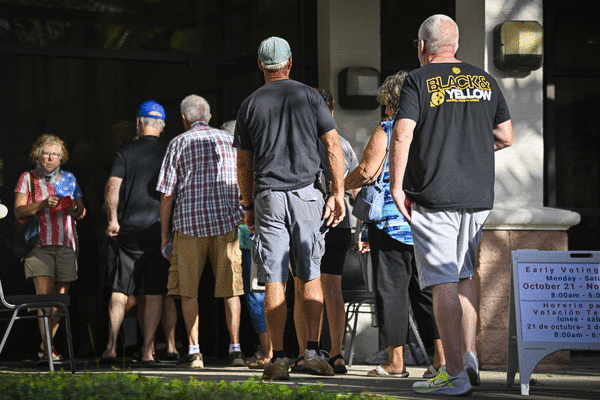
FORT LAUDERDALE, Fla. — An effort in the Florida Legislature sounds simple and straightforward: ensure that only U.S. citizens vote in state elections.
Republicans who control the state Senate and House of Representatives are advancing legislation they say would do just that, brushing aside warnings that they are about to create a logistical and bureaucratic morass — that could result in thousands of citizens losing their ability to vote.
They envision a far-reaching effort, with two central components. Registered voters who change their party affiliation; their address; or their name after marriage, divorce or some other reason would have to produce documentation proving their citizenship to a county elections office.
All existing registered voters would be checked against the state’s driver license database to flag anyone who hasn’t previously produced proof of citizenship, a process that depends on the technology working — even though sponsors aren’t allocating money for tech upgrades.
The final details haven’t been worked out between lawmakers in the House and Senate. One version, approved by two legislative committees, would require implementation of new citizenship verification requirements this summer, just weeks before the August primary and months before the November general election.
And it may all be a solution in search of a problem. Voting rights advocates, including those who are independent and aren’t tied to one political side or the other, said there is so little evidence of non-citizens voting that it’s infinitesimally small — if it’s even a problem at all.
Democratic legislators who oppose the rush to new procedures and voting rights activists who have testified before multiple House and Senate committees have warned that some registered voters in Florida, who are in fact U.S. citizens, would be turned away.
“What you’re going to create is chaos and people not being able to vote,” said state Sen. Tina Polsky, a Broward-Palm Beach county Democrat. “We’re going to have databases not speaking to each other. We’re going to have mistakes. People are going to be flagged.”
Amy Keith, executive director of Common Cause Florida, had a more dire warning: “It’s going to kick thousands of U.S. citizens off the rolls.”
Keith said the newly envisioned system has many places where errors could happen.
“If you are a U.S. citizen registered to vote in Florida (and) you don’t have a driver’s license or a state ID, they’re going to say there isn’t enough evidence of citizenship on file for you. You’re going to get a notice in the mail. And if you don’t respond to that notice in 30 days, you’re going to be kicked off the rolls even if you’ve been voting for years. You won’t be able to vote until you submit a birth certificate or a passport,” Keith said. “If you can’t afford those documents or it’s impossible to get them too bad, you don’t get to vote.”
Karen Jaroch of Heritage Action for America pointed to the 2020 election, when 80% of Florida voters approved an amendment to the state constitution restricting voting to citizens only. “Florida still does not require proof of citizenship in order to vote. So a law without enforcement is merely a suggestion,” she told lawmakers.
Non-citizen voting was, and remains, illegal. Heritage Action is a sibling organization to the Heritage Foundation, which was responsible for Project 2025, the blueprint of policies that guided much of the first year of President Donald Trump’s second term.
And state Sen. Erin Grall, a Republican, the chief Senate sponsor, rejected the criticisms.
The legislation “is being called all of the names in the parade of horribles when we’re talking about trying to use the systems that we have more efficiently,” Grall said. “It’s just disingenuous and it’s so frustrating that that is what we let this process be and the name calling and everything else that goes with it.”
The notion that non-citizens are voting and changing the outcome of elections has become an article of faith among many Republicans after years of claims by Trump that droves of non-citizens have been voting as part of a scheme by Democrats to improperly win elections.
The president and others who support that notion say it often — but haven’t offered evidence to support their claims.
“Multiple reviews, audits, and investigations across the country, including in states run by both Republicans and Democrats, have found noncitizen voting to be exceedingly rare — to the point of being almost nonexistent,” Michael McNulty, policy director of Issue One, a national nonpartisan organization that tracks election issues, said via email.
“We haven’t heard of one instance of a non-citizen voting that’s the basis for this bill,” Polsky said, rejecting “this kind of grandiose idea that non-citizens are voting all over the place and we have to make sure that they’re not, because it’s not true.”
Citing research published in 2024 by the Brennan Center for Justice that more than 9% of American citizens of voting age don’t have readily available proof of citizenship, Polsky said it would translate into a large number of the state’s 13.3 million registered voters.
The chief House sponsor, state Rep. Jenna Persons-Mulicka, a Republican, pointed to what a state report about 2025 election investigations described as 198 “likely noncitizens who illegally registered and/or voted in Florida.” That works out to less than 1 possible noncitizen for every 70,000 registered voters.
McNulty said the cure is much worse than the purported problem.
“The question is whether putting in place new requirements of documentary proof of citizenship solve a real problem or create new, much worse problems. The answer is that it clearly would create significant problems,” he said.
If the Florida legislation becomes law, analysts, advocates and Democrats warned of negative, disproportionate consequences.
Race: Rampant racism from the Jim Crow era could make it difficult or impossible for some to prove citizenship. “A lot of elder Black voters who do not have birth certificates because of racism,” said state Rep. Ashley Gantt, a Democrat.
“Jim Crow had Black hospitals and white hospitals, and when Black families did not have access to the nearest hospital, which was a white hospital, they had their babies at home,” Gantt said.
She said her aunt, a retired federal employee and longtime voter who was born in 1950s South Carolina, was never issued a birth certificate. “Why is that relevant? Because I have gone through hell over the last year … trying to get a birth certificate.”
Gender: Voting advocates said women would run into compliance problems far more than men, because women are more likely to change their names when they get married and divorced. One divorced woman who testified before a Senate committee said she didn’t even know how she could document her current name. Other advocates said hyphenated last names, used by some married people, can increase database matching issues.
“It’s sexist, especially for women that have more than one name, i.e. LaVon Bracy Davis,” said state Sen. LaVon Bracy Davis, a Democrat.
Housing: Advocates and lawmakers said some people — such as lower-income people who rent — move more often and therefore would have to get verified more often. College students living on campus may not have required documents readily available. And people who are homeless are allowed to vote but may not have driver’s licenses or other documents.
Disasters: Although rare, other circumstances can prevent people from having easy access to documents. Jonathan Webber, Florida policy director of the Southern Poverty Law Center, told legislators that he once lost his home, all his documents and had to move because of a fire.
“Rebuilding my life took time,” he said. “This bill will infringe on the right to vote. My story is about a house fire. Florida is a state of hurricanes.”
Some sought to remind legislators of previous state data system failures, including voter registration system outages. Testifying before a Senate committee, Julie Kent said she’s worked on computer system integration for 40 years. “It’s expensive. It is time-consuming, and it is not foolproof,” she said. “These systems don’t integrate easily.”
The cumulative effect, Issue One’s McNulty said, is that “documentary proof of citizenship bills won’t improve election security; they would end up blocking large numbers of eligible voters, distract attention away from other election security issues, and make election administration more difficult.”
And Polsky said a state action that requires some voters to spend money to procure documents such as birth certificates or passports so they can vote would amount to an unconstitutional poll tax.
Republicans in the U.S. House of Representatives passed national citizenship verification on Feb. 11, but they don’t have enough voters for passage in the U.S. Senate.
Persons-Mulicka said Florida needs to pass state-level citizenship verification.
“Floridians overwhelmingly support ensuring that only U.S. citizens vote in our elections,” she said. “While the important debate over the Save America Act happens on the national stage, we can and must continue to lead in Florida as the gold standard in election integrity.”
Sponsors of the Florida legislation said the issues raised by opponents were overwrought. “I don’t think any bill that is moving through the House is going to take away the ability of U.S. citizens being able to vote,” GOP House Speaker Daniel Perez told reporters on Tuesday.
The sponsors said the vast majority of Floridians would have their citizenship checked seamlessly by matching the voter registration database with REAL ID records maintained by the Department of Highway Safety and Motor Vehicles, the state driver license agency.
Grall, the Senate sponsor, said more than 99% of people with Florida driver’s licenses or state identification cards have already presented documentation that makes them comply with federal REAL ID requirements.
Grall also said she did not know how many citizens of voting age don’t have REAL ID.
Someone with REAL ID — needed for airplane travel — doesn’t have to be a citizen, but the documentation people provided with their license or ID renewals contained in state records is supposed to show if citizenship has been proven.
(Another provision of the legislation would require future driver’s licenses to contain an identifying marking that shows if a person is a citizen).
Secretary of State Cord Byrd, who was appointed by Gov. Ron DeSantis, said last year he was working on plans to impose a citizenship verification requirement.
Although neither Byrd nor agency representatives appeared as witnesses to offer their views and answer questions at legislative committees, he was present during the first House committee hearing on the legislation on Feb. 5. He sat in the audience a few rows behind the sponsors as they presented the proposals.
On Wednesday, Grall told her colleagues she didn’t know his position on the legislation.
“I’m sure the secretary has opinions on the bill, and I’m sure the secretary has other things that he would like in the bill and maybe there’s some things that he does not like.”
During several committee hearings on the legislation, sponsors didn’t have specific, concrete answers when some colleagues pressed them for details.
Asked repeatedly if people would have to make in-person visits with documents to supervisors of elections offices or if they could email copies, Persons-Mulicka said the measure “doesn’t proscribe how the supervisors take in or review the documentary proof.”
Grall said “I don’t think” submitting documents via the mail would be prohibited.
Democrats expressed frustration that state agencies — the Secretary of State’s Office, which oversees elections, and the Department of Highway Safety and Motor Vehicles, which oversees driver’s licenses — under DeSantis’ control haven’t had representatives testify at hearings on the legislation to explain how it would be implemented.
Sponsors still need to work out some significant differences between House Bill 991 and Senate Bill 1334, including when the proposed law would take effect and other election law changes that don’t involve the citizenship requirement.
“I’m not saying it’s perfect yet,” Grall said.
So far, the measures have been approved by two House and two Senate committees, in a process that frustrated opponents. So many people wanted to testify that committee chairs allowed people 30 seconds to one minute before they were told their time was up. (In a Senate committee on Wednesday, more than 100 people signed up to either testify or record their public opposition compared to about five supporters.)
Michael Montenegro, of Miami, said the legislation was unnecessary and ran counter to American ideals.
“Voter fraud is historically very rare,” he said, “My parents fled Cuba and Nicaragua, where they’re not afforded free and fair elections. A vote for this bill is anti-democratic.”
Cindy Skarda, who also testified before lawmakers, said the legislation “will make sure that my vote as a legal American citizen is not diluted, that I, as an American citizen, am not disenfranchised. Every unlawful vote by somebody who is not an American citizen cancels out the vote of a lawful citizen voter.”
©2026 South Florida Sun-Sentinel. Visit sun-sentinel.com. Distributed by Tribune Content Agency, LLC.



Comments