High-tax Massachusetts loses 182,000 people to other states in last 5 years
Published in News & Features
BOSTON —People are fleeing high-tax Massachusetts at a much higher rate than those moving to the Bay State, resulting in a net domestic out-migration of 182,145 over the past five years, according to a new watchdog report.
The Pioneer Institute has released a report detailing the state’s persistent challenge with losing educated working residents to other states, which it says is “hollowing out Massachusetts’ workforce and economy.”
Out-migration from April 2020 to July 2025 has been “masked,” but not offset by the influx of international migrants arriving in Massachusetts. From 2022 to 2024, the state took in a net gain of 230,000 of those new immigrants, the report states.
“The net loss of 182,000 residents to domestic outmigration is like losing one-and-a-half Cambridges,” Pioneer Institute Executive Director Jim Stergios said in a statement. “When you pair that with the loss of private-sector jobs — particularly in professional, scientific, and technical fields — it’s clear we have serious work to do to reverse a flagging economy.”
Massachusetts is one of four states that has yet to recover its pre-2020 private sector employment. Over the same period, the number of workers and firms have grown dramatically in competitor states like Florida, Texas and North Carolina, the report states.
The report flags federal policies from the Trump administration’s immigration crackdown as a threat to the state’s recent labor force growth, which it says was driven by a net gain in international migrants that softened domestic out-migration.
The civilian labor force grew to roughly 3.9 million workers in 2024, which Pioneer said is the largest year-over-year increase since 2018.
“The 2024 labor force rebound was the largest single-year increase in several years,” Aidan Enright, author of the “Massachusetts Labor Force: Now and Beyond,” said in a statement. “But it was driven by a surge in international immigration. With a low birth rate, an aging workforce, and tighter immigration policies, Massachusetts faces serious headwinds ahead.”
While the report sounds the alarm on what an immigration slowdown driven by federal policy could do to the Massachusetts labor force and economy, it doesn’t really explain why residents are fleeing for other states at such a high rate.
But Stergios, Pioneer’s executive director, places the blame on the state’s high taxes in an op-ed he co-wrote for the Washington Post that was published on Monday.
“Census data released last month brought bad news for the high-cost states of Massachusetts, New Jersey, New York, Illinois and California, which all led the nation in net out-migration in 2024,” he says in the op-ed co-written with Christopher Anderson, president of the Massachusetts High Technology Council.
“Taxpayers fled these high-tax states and piled into low-cost, low-tax states such as Texas, Florida, and North Carolina, where they can keep more of their money, and, in many cases, retire their shovels,” Stergios and Anderson wrote.
In October, the Tax Foundation’s 2026 State Tax Competitiveness Index ranked Massachusetts 43rd overall.
Stergios and Anderson wrote that while a decade ago, the Massachusetts economy was growing — to as high as 3.7% above the national average in 2016 — “high taxes coupled with rapidly growing state spending have eroded the state’s competitiveness.”
“Since 2018, the state budget has increased by more than 50%, far outpacing inflation or family income growth,” Stergios and Anderson wrote. “While a majority of states cut taxes after the pandemic, Massachusetts voters narrowly approved a 9% income tax rate on annual earnings over $1 million in 2022.
“Now the state is losing residents to more affordable states like New Hampshire and Florida,” the op-ed states. “In 2024, net out-migration was more than seven times larger than in 2010. From 2021 to 2024, more than 790,000 residents in total left Massachusetts — more than the entire population of Boston. Even accounting for people who moved in, the state still lost 164,000 residents.”
Many of the residents leaving drive the state’s economy, such as families, recent graduates and mid-career workers, leading to what Stergios and Anderson call a “brain drain” of “talented workers” that could further hamper competitiveness.
Stergios and Anderson made a pitch for Massachusetts voters to approve a potential ballot question this fall that would cut the state’s income tax from 5% to 4%, which they said would save taxpayers an average of $1,300 per year.
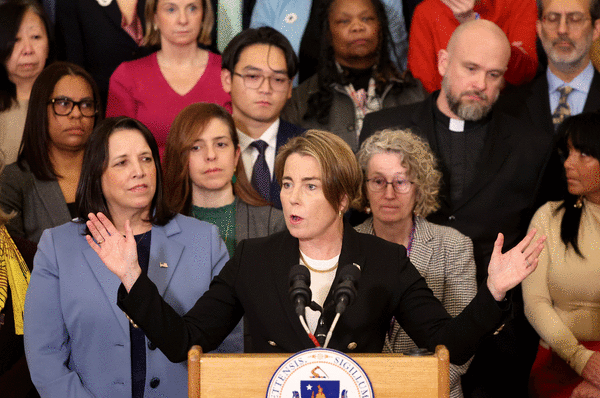
Gov. Maura Healey came out against the income tax cut in an interview with WCVB’s On the Record that aired on Sunday.
Healey said that if the ballot question were to be approved, it would result in a “huge cut” to the state budget that would effectively eliminate 65% of funding for education and significantly reduce state funding for cities and towns.
“It’s going to be very, very harmful, and that’s why it doesn’t make sense,” Healey said. “All the free school meals, the free community college, making financial aid larger for people in Massachusetts — all of these things are going to go away. That doesn’t make Massachusetts more affordable.”
©2026 MediaNews Group, Inc. Visit at bostonherald.com. Distributed by Tribune Content Agency, LLC.






Comments