Trump's Caribbean surge nears $3 billion price tag so far
Published in News & Features
When U.S. forces captured Venezuelan President Nicolas Maduro and his wife, Cilia Flores, early in the new year, the Trump administration heralded the operation as concise and deliberate: with overhead air support, about 60 special forces troops descended from helicopters into Caracas, fought off security guards, grabbed their quarry and were airlifted back to a U.S. warship 100 miles off the coast. Over and done in a matter of hours, at minimum cost to the American taxpayer.
But the U.S. military posture in the Caribbean is costing billions. Bloomberg calculations show the operational price tag of the ships deployed there hit more than $20 million a day at its peak from mid-November until mid-January. And although most of the costs are covered by defense funding that has already been allocated, combat operations — from flight hours to weapons fired to extra pay — add up on top of that.“There is no contingency fund in the DOD budget for unexpected operations,” said Mark Cancian of the Center for Strategic and International Studies, a bipartisan think tank. “Conflicts cost extra.”
Dozens of U.S. Navy ships, fighter jets, drones and logistics vessels began gathering around Latin America late last summer, part of a buildup dubbed Southern Spear. At its height, the deployment represented 20% of the Navy’s surface fleet, tying up critical assets even as crises were flaring elsewhere in the world.
The White House has said the operations around Venezuela didn’t cost taxpayers extra, because the forces involved are already deployed. A separate carrier strike group was sent to the Middle East amid a violent crackdown by Iran’s leadership against nationwide protests, and the USS Gerald R. Ford — the centerpiece of the Caribbean operation — was on Friday tasked with joining it.
“None of these troops sit in the dry dock waiting for action,” Secretary of State Marco Rubio said after a January briefing with lawmakers on the Maduro raid, Operation Absolute Resolve. “They’re deployed somewhere in the world. If they’re not here, they’re somewhere else.”
The Pentagon and the White House did not respond to Friday requests for comment.
Despite the Ford’s departure for the Middle East, the deployment does not have a clear end date. President Donald Trump has said the U.S. would “run the country until such time as we can do a safe, proper and judicious transition.”
Bloomberg analysis, using Pentagon information on operating costs, ship tracking data, satellite photos and public deployment announcements, shows how ships and aircraft were diverted to the Caribbean months before the operation, quietly consuming billions of dollars while potentially constraining U.S. power elsewhere.
By the numbers
Of the ships and vessels waiting in the waters off Venezuela before the raid, the Ford carrier was the biggest hitter, leading a strike group — a formation of U.S. Navy vessels that can include destroyers, cruisers and submarines.
The Ford is the world’s largest aircraft carrier, embarking more than 4,000 personnel and dozens of combat aircraft. The bill to have it there alongside its accompanying destroyers, submarines and guided missile cruisers came to $11.4 million a day, according to calculations based on data from the Congressional Budget Office, the U.S. defense budget, and CSIS.
There are at least two amphibious ready groups — U.S. Navy task forces for assaulting the shore from the sea. The presence of the USS Iwo Jima (where Maduro and Flores were taken after their capture), the USS Fort Lauderdale, the USS San Antonio and the 22nd Marine Expeditionary Unit came to a cost of $8.59 million a day.
Logistics vessels and support ships add about $1 million a day.
“We estimate that Operation Southern Spear, which includes Operation Absolute Resolve, has probably cost about $2 billion since August 2025,” said Elaine McCusker, a former comptroller for the Pentagon and now a senior fellow at the American Enterprise Institute. Those estimates rely on publicly available information and are “limited to the incremental costs of operating the ships, planes and remotely piloted platforms involved in the strikes and the replacement of likely ordnance used,” she added.
That estimate doesn’t cover intelligence or targeting, including cyber support and operational rehearsals, she added.
Because these costs were already in the Pentagon’s budget, they can’t be allocated elsewhere and don’t represent funds taken from other areas. But the expenses will exceed what was anticipated in the fiscal year 2026 budget, Cancian said. The deployed vessels have a higher level of operations than planned and personnel will receive additional benefits, like family separation allowances, Cancian said, estimating it would add about 10% to the budgeted cost.
Opportunity costs
A less-tangible cost is how the unavailability of those vessels and aircraft affect operations elsewhere.
The Ford was in the middle of a deployment in the Mediterranean Sea when it was ordered to the Caribbean and Venezuela in October 2025. The carrier had already participated in at least two naval exercises with NATO partners across the Ionian, Adriatic, North and Baltic Seas, with months to go before it was scheduled to return home.
The amphibious ready groups, including the Iwo Jima and two transport docks that travel with it, were scheduled to deploy to Europe when their orders diverted them to the Caribbean. The USS Stockdale, a guided-missile destroyer, was in the eastern Pacific off the coast of Central America when it was ordered to join the Caribbean buildup. A cruiser, the USS Gettysburg, was destined for operations along the U.S. East Coast when it too was told to head south.
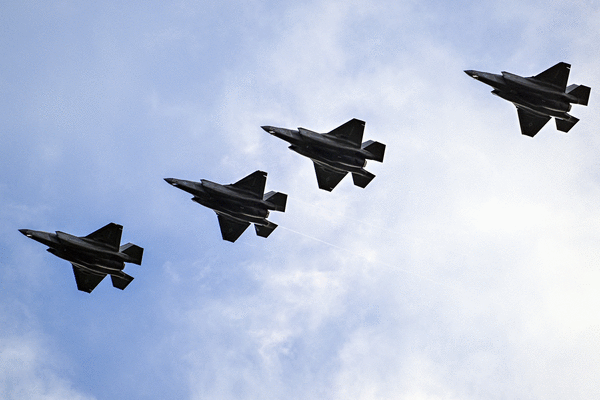
Since then, F-35 strike jets from the Vermont Air National Guard that were in Puerto Rico at the time of the raid have departed for the Azores with a stopover in the United Kingdom. They are now on their way to the Middle East to join the U.S. military buildup there.
Oversight
The Pentagon has not shared an official cost estimate. Senior lawmakers on appropriations and armed services committees have said they’ve not seen any numbers, nor been asked for additional funding.
“The cost is substantial, obviously, because of the disposition of all of the forces there,” said Sen. Jack Reed of Rhode Island, the senior Democrat on the Senate Armed Services Committee.
"They are very reluctant to provide specifics on anything," Reed told Bloomberg. "This is a very expensive proposition in terms of how we are conducting these operations."
Sen. Mike Rounds, a South Dakota Republican and senior member of the same committee, said that he was not aware of extra costs because of the deployment, and that it was too early to provide estimates.
"Whether they are there or they are in the Caribbean that cost remains pretty much the same,” he told Bloomberg. “The cost of the planning and so forth is a small part of it. The fact that the overwhelming force was laid out and all the resources were made available saved lives."
———
(With assistance from Adrienne Tong and Kyle Kim.)
©2026 Bloomberg L.P. Visit bloomberg.com. Distributed by Tribune Content Agency, LLC.






Comments