Sheriffs in Minnesota's biggest metro counties mum on whether they'll agree to ICE deal to end surge
Published in News & Features
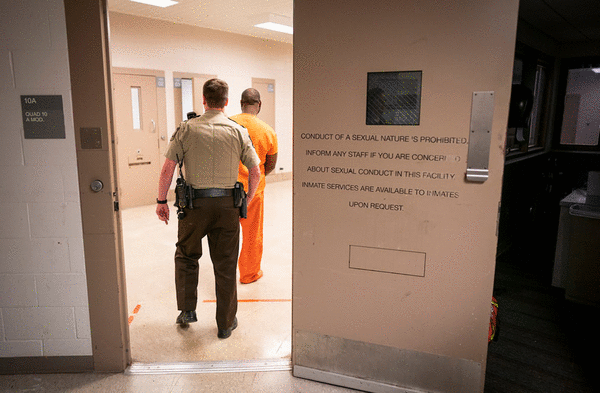
MINNEAPOLIS — The sheriffs overseeing some of Minnesota’s largest county jails aren’t saying whether they will go along with a plan to give immigration agents better access to the facilities.
Border czar Tom Homan said Wednesday that the Trump administration was immediately withdrawing 700 federal agents who have been part of the increased immigration enforcement effort called Operation Metro Surge but that continued cooperation was required for drawdown of the remaining 2,000 agents.
Hennepin County operates one of Minnesota’s largest jails and for roughly a decade has not cooperated with Immigration and Customs Enforcement requests to hold on to prisoners that would otherwise be released so agents can more easily arrest them. They also don’t require prisoners to reveal their immigration status or notify ICE when someone the agency wants is about to be released.
Hennepin County declined more requests from ICE since President Donald Trump returned to office than any other in the state, according to the latest data available from the Deportation Data Project.
“Our policy has not changed,” Sheriff Dawanna Witt said in a statement. “At this point, we are having conversations with local, state, and federal leaders about solutions that serve our community.”
Witt has maintained that her office complies with all state and federal laws and with all orders and warrants signed by a judge. She noted previously that state law limits how sheriffs can aid in federal immigration enforcement, which is often handled as a civil matter.
At issue are so-called ICE detainer requests, which the agency issues when it believes someone in the country illegally is being held by a local law enforcement agency.
A Minnesota Star Tribune analysis of data from the Deportation Data Project found ICE made 63% more detainer requests in Minnesota under the first nine months of the Trump administration than during the same time period in former President Joe Biden’s last year in office.
At least 300 ICE arrests last year appeared to be transfers from about 50 county jails across Minnesota, according to a Star Tribune analysis of the group’s records, with a couple hundred more coming from state or federal custody.
Most Minnesota counties try to honor those detainer requests. The data shows the majority of agencies refusing to are in the Twin Cities metro and not in greater Minnesota.
The issue is especially controversial in Hennepin and Ramsey counties, where other policies prohibit government workers from aiding in federal immigration enforcement. County sheriffs generally make the rules and policies for their jails, but their budgets are approved by the county board.
Commissioner Jeffrey Lunde, who leads the Hennepin County Board’s public safety committee, said he is confident Witt can find a compromise that will satisfy federal officials and won’t jeopardize community trust.
“We have got to get this at a different level so our residents are not living in fear,” Lunde said of Operation Metro Surge. “That’s going to take some compromise.”
Documents obtained by the Star Tribune show ICE wants “reasonable access to all detainees or inmates” for the purpose of interviews related to immigration enforcement.
Homan, the Minnesota Sheriffs’ Association and the Minnesota County Attorneys Association met Feb. 2 to discuss the possibility of allowing jails to hold immigration enforcement targets for up to 48 hours after their scheduled releases.
In a statement, Hennepin County Attorney Mary Moriarty questioned the legality of that proposal, saying it was outrageous and violates state law.
“Handing people to ICE before conviction strips our community of the accountability it deserves and harms victims by robbing them of a court process,” Moriarty said in a statement. “If a person is convicted, the prison system shares information with ICE.”
The Hennepin County jail in downtown Minneapolis once had a workspace for ICE agents. That close cooperation ended a decade ago due to resident opposition and because it could take days for agents to retrieve the immigrants they asked the jail to hold.
It’s a potential civil rights violation to detain someone beyond the duration of the criminal case or jail sentence. Nobles and Anoka counties were successfully sued by immigrants who were held after their cases were concluded.
Homan has suggested that the federal government may cover counties’ legal liability if they cooperate with ICE. But the legal ramifications are not the only reason Hennepin and Ramsey counties are hesitant to work with ICE.
In 2024, Hennepin County commissioners, Minneapolis City Council members and other local governments backed a bill to bar government agencies across the state from helping with immigration enforcement. The legislation failed to become law, and no Minnesota community has officially declared itself a sanctuary for immigrants.
However, local leaders argue that when police take a role in immigration matters some residents are less likely to report crimes and communities are less safe. They also say helping ICE puts a strain on limited resources.
_____
(Jeff Hargarten and Jeff Day of the Minnesota Star Tribune contributed to this story.)
_____
©2026 The Minnesota Star Tribune. Visit startribune.com. Distributed by Tribune Content Agency, LLC






Comments