Ford Marshall plant launches first automotive LFP batteries in US
Published in Business News
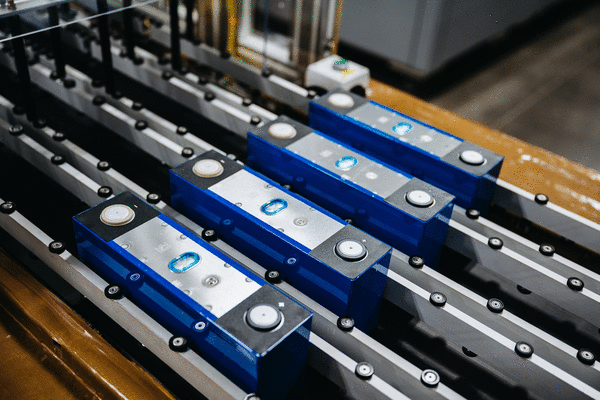
MARSHALL, Michigan — Ford Motor Co. launched production batteries here at the country's first lithium-iron-phosphate battery plant for automotive applications, and packs are being shipped for pre-production Fathom all-electric pickups on the road undergoing testing.
The $3 billion plant launched production on Oct. 10, and at full ramp-up, Ford expects BlueOval Battery Park Michigan will produce 40 battery cells per minute on each of the two lines. With batteries representing about 40% of the cost of an electric vehicle, the batteries built here using technology licensed from Chinese battery giant Contemporary Amperex Technology Co. Ltd. are key to unlocking affordable pricing for the $28,350 Fathom, whose deliveries will begin in the fourth quarter of 2027.
"The bottom line is that the cost of the product is lower," said Alan Clarke, vice president of advanced development projects, "and by doing that, we've given ourselves more opportunity to put more technology and capability into the vehicle that the customers will actually care about."
The Fathom is a midsize truck and the first vehicle Ford is launching off its new Universal Electric Vehicle Platform, the product of its originally separated, small "skunkworks" team charged five years ago with disrupting the now-123-year-old company to compete with low-cost Chinese EVs. The UEV is key to helping Ford turn around its money-losing Model e EV business by 2029.
"It's not an affordable, boring vehicle," said Charles Poon, vice president of vehicle hardware engineering, referencing features like autonomous driving and embedded maps. "When you step on it, it's going to peel away like a Mustang GT."
Many EVs, including many of Ford's first-generation EVs, on the road use lithium ion nickel-manganese-cobalt batteries that have a high energy density. But their materials also are more expensive than the LFP batteries built here. Additionally, LFP batteries have higher durability. So, while Ford executives expressed confidence that Fathom will offer the 300 miles of range many consumers look for, they also emphasized its capability to power a home during outages or peak-rate times, to charge to 100% compared to the recommended roughly 80% for NMC batteries that have less durability, and to last for a decade or more.
Ford manufacturing the batteries itself, known as vertical integration, also offers it cost-competitiveness in the United States without mark-ups, full control over technology and process advancements and the ability to take advantage of federal battery production tax credits as a result of efforts to find material sourcing from allied nations, executives said. It expects the facility can accommodate other chemistries in the future, as well, such as lithium manganese-rich. Poon said Ford is researching its second-generation of LMR batteries.
"Having domestic LFP cell production and also the full pack assembly here as well," said Sam Abuelsamid, vice president of market research for auto communications firm Telemetry Agency, "is key to bringing down the cost of the UEV architecture and getting it to the point where it's at a price point that's going to be attractive to consumer, but also at some point should be profitable for Ford, as well, as opposed to having to buy parts, buy batteries from a supplier."
The manufacturing process in the one-mile-long facility with hundreds of robots and machines starts on one side and ends at the other. A cell is made in six-and-a-half days, including a five-day aging process. Ford expects to have nearly 800 employees in Marshall by the end of the year of the 1,700 it has committed to employing at the plant.
Initially, the building is split into two areas for anode and cathode creation, the sides of the battery with negative and positive polarity, respectively. Their separation helps to reduce cross-contamination. Employees have to wear special jumpsuits, shoes or shoe coverings, hair nets and other personal protective equipment and go through air showers whose floor coverings are replaced four times a day between sections to reduce contaminants. Air moisture also is tightly monitored to protect quality.
Quality is critical because the battery cells aren't serviceable once they end up in a battery pack, which is the floor of the Fathom. There are multiple quality checks throughout the manufacturing process, and Ford has contracted CATL employees to be in the plant through ramp as it works to train operators and technicians on machines and achieve defects measured as parts-per-billion compared to a higher frequency of errors typically recorded in the auto space.
The decision to license from a Chinese company has received backlash from the Trump administration and other Republican legislators, but Clarke emphasized how Ford is using it to propel the domestic manufacturing industry.
"If we want to get to being able to produce affordable EVs in the United States," Clarke said, "we need to also do it the fastest way possible, and the fastest way possible is you go to a company that has made hundreds of gigawatt hours of factories, not tens. And CATL being the biggest in the world means that they're the best supplier to get us that technology and help us learn ourselves how to produce LFP cells."
At the start, materials are mixed in large vats to create anode and cathode slurry, a black, wet mixture that is spread onto both sides of foil — copper for anode and aluminum for cathode. After each side is coated, the foil goes through massive ovens heated to hundreds of degrees Fahrenheit to dry the anode to a matte finish and the cathode slurry to glossy. Once dried, the foil turns into almost-2,000-pound, 3,000-meter jumbo rolls that are transported by robots.
It next goes to a slitting and calendaring process, which separates the five lanes of coated foil into individual lanes and presses down the material, because the more surface area it covers, the greater the range. It's like applying the weight of four elephants on a postage stamp, said Austin Evans, process engineer. A visual system inspects for defects. Scrap is set aside for recycling, and Ford has a recycling facility on-site.
These now-smaller "whopper" rolls then go to tab formation, which uses lasers to cut out figure eight-shaped excess foil, leaving behind foil tabs like those in a binder. The coated foil then is rolled once again into roughly 500-pound "pancake" rolls.
At this point, the anode and cathode processes converge. Each foil is wound together with a ceramic separator material between to create a 4-to-5-pound "jelly roll." More than 300 jelly rolls can be made from a pancake roll. It's important that the tabs line up during winding, or else it can take longer for electrons to get where they need to go, which affects range and can be dangerous in the case of free currents. The jelly rolls are photographed, and X-rays check for proper winding inside.
Once passed, a jelly roll is paired with a second, and connectors are sonically welded to them to attach the jelly rolls. Lasers weld the top cap to the connector nodes and then the cell gets a mylar wrapping for additional protection and finally an aluminum can, which is laser welded to the cap. The cell is placed in an air-tight chamber with helium pumped into the cell to test for leakage. If there is, a separate welding rework can address the issue there nearby to avoid slowing down production.
Next, a baking process to remove any residual moisture before electrolyte is added to the cell, which allows it to be charged and discharged in a process called formation. It now goes through about five days of aging to check the voltage drop to ensure there's nothing wrong with the battery. Batteries are charged to 28% to comply with shipping regulations for under 30%.
After final quality checks, the cells then through a hole in the wall on a conveyor belt enter the packing plant. There is no door from the cell manufacturing plant into the packing plant, because Ford fully owns the packs, and CATL employees aren't allowed in that area.
A display of the Fathom pack and a busbar overlay of the cells showed a grid the size of 18 cells by six cells in a steel stamping to make up the pack. The pack also consists of an e-box, a consolidated power module that includes the 48-volt architecture to power electronics, has an inverter to support bidirectional charging and components for fast-charging. The e-box and charging equipment are accessible under the rear seats for service.
Abuelsamid noted the pack itself is simple in design compared to that of other EVs, especially those like General Motors Co.'s or Ford's current-generation EVs that use pouch cells over these new prismatic cells.
"They slice up the electrodes, and they stack the anodes and the cathodes and separators and put it together, and that's a little more complicated process and is a little more potentially trouble-prone, as we've seen with some of the recalls," Abuelsamid said of pouch cells, referencing the a major recall on the Chevrolet Bolt, Hyundai Kona EV and Porsche Taycan. He added about the simplification: "All of these things cascade to give you a cheaper overall cost."
Ford has about 170 Fathoms on the road being tested in all weather and road conditions, addressing issues that weren't caught in development or simulation like noise issues.
"I think it's normal at this phase of product development to have a lot of dirty laundry. The important part is to have the velocity to fix it," Clarke said. "We're giving ourselves the time to fix them if we find issues between now and then. We're not setting up a Hail Mary-delivery plan that has no chance of success. It's quite the opposite."
As the industry talks about "China speed," referencing the often-cited 18 months Chinese automakers say they are going from development to a new model, Clarke said that's a target for Ford now with the UEV in place. However, he emphasized some skepticism over some of the timetables in China depending when the companies start their clocks and noted its market of dozens of competitors emphasize spec wars and often small changes that flood the market and generate pricing wars that hinder profitability.
"We will take our time," Clarke said, "making sure we know that we can build less thing at higher volume versus many things at low volume."
©2026 www.detroitnews.com. Visit at detroitnews.com. Distributed by Tribune Content Agency, LLC.









Comments