US posts $1.99 trillion budget gap for 2026 on spending rise
Published in Business News
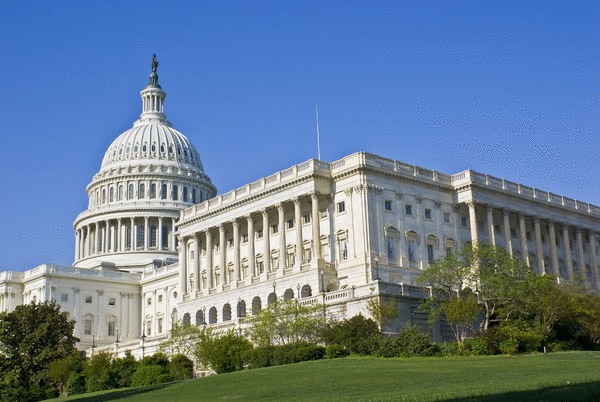
The U.S. federal budget deficit widened to nearly $2 trillion for the 2026 fiscal year, serving as a fresh reminder of the scale of government borrowing needs and leaving the nation on track for a record high debt burden in coming years.
For the fiscal year through September, the deficit widened to $1.99 trillion, Treasury Department figures showed on Friday. That marks about a 12% increase on the $1.78 trillion gap recorded for last year. Spending rose by about 6%, to $7.4 trillion, while receipts increased by 3%, to $5.4 trillion.
This year’s jump in U.S. Treasury yields, along with the ever-growing base of government debt, made interest payments a key contributor to the widening deficit for 2026. Net interest climbed by $81.4 billion, to total a record $1.05 trillion.
Debt-servicing costs are one of the top three expenses for the government. Social Security is the biggest item, with outlays on that entitlement program rising by $86.4 billion for the fiscal year, to $1.67 trillion. Medicare spending climbed $76 billion, to $1.07 trillion.
Treasury Secretary Scott Bessent has singled out tariff refunds as a key to the wider deficit, after he touted a narrowing in the gap for 2025. Those payments were tied to the Supreme Court’s February ruling invalidating the bulk of President Donald Trump’s tariff hikes in his second term. The administration is in the process of constructing a fresh tariff wall via other legislation.
Outsize deficit
This year marks the fourth straight with a deficit around $2 trillion. The figures suggest the gap was roughly 6% of gross domestic product — an unusually high figure at a time of relatively low unemployment. Officially, the gap narrowed last year, though that was thanks to an accounting measure — the 2025 Republican tax act tightened limits on student loans, and the Treasury booked that as a reduction in 2025 spending.
While Bessent has declared that the U.S. can bend the debt curve down quickly — thanks especially to a faster sustained economic growth rate as the artificial intelligence boom spurs American productivity — many economists, investors and even other senior public officials are skeptical.
International Monetary Fund Managing Director Kristalina Georgieva said Oct. 14 that “growth, of course, helps but it cannot deliver fast enough the necessary adjustments.” A counselor to Bessent, the recently appointed David Zervos, took issue with the assessment, saying in comments to CNBC that the IMF has had “messy” forecasts in the past.
Georgieva’s predecessor, current European Central Bank President Christine Lagarde, said the same day that the U.S. deficit “needs to be tackled by any country that is, you know, in that particular category.” Congressional Budget Office Director Phillip Swagel said on Oct. 8 that it wasn’t “plausible” for growth alone to stabilize U.S. debt levels.
The nonpartisan CBO warned in February that U.S. debt as a ratio of gross domestic product was on track to surpass the 106% record set in 1946, just after World War II, by 2030. One gauge of U.S. public debt outstanding surpassed a record $40 trillion last month.
Bessent has vowed to put forward a fiscal consolidation plan, potentially during the lame duck session of Congress if Republicans lose control of either the House or Senate.
Yet in the meantime, Trump keeps suggesting more outlays. He has called for a close to $500 billion increase in defense spending and has also promised $5,000 checks to every American if Republicans maintain control of both chambers of Congress in the midterm elections next month.
For the month of September, the U.S. spent $27 billion more than it brought in revenue.
Trump’s tax cut package of 2025 has also had an impact on the deficit. While revenue collected from individual taxes in 2026 increased by $189 billion, corporate income tax collection fell by more than $70 billion after the Trump administration’s signature 2025 tax bill extended many tax cuts and introduced new deductions for corporations.
©2026 Bloomberg L.P. Visit bloomberg.com. Distributed by Tribune Content Agency, LLC.








Comments