Rep. Ro Khanna in Minnesota: Regulate or risk 'losing human control'
Published in Business News
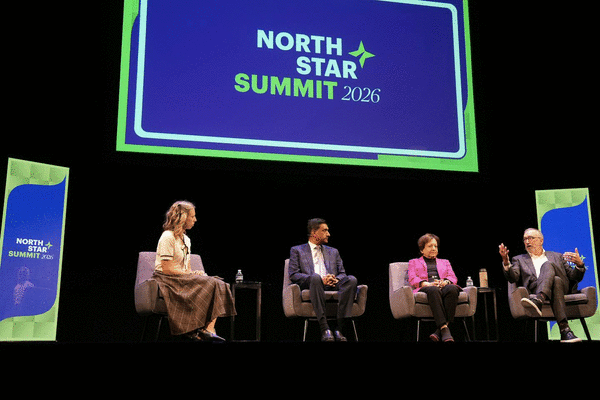
One of the nation’s leading political voices favoring stricter federal regulations on AI said the technology must be monitored by independent technical experts who have no industry ties.
The core tension on artificial intelligence — whether it offers more help or harm to humanity — and who benefits from its development spilled into plain view at the Minnesota Star Tribune’s North Star Summit on Tuesday.
U.S. Rep. Ro Khanna, a Democrat representing Silicon Valley, told the audience at the Guthrie Theater in Minneapolis that one-third of the nation’s wealth is concentrated in his congressional district.
“(AI) should not just be enriching the billionaires,” he said.
The economic windfall should spread across the country, including to workers who, Khanna said, “should have the bargaining ability to get equity in stock … and they should have a say in shorter work weeks or making sure AI isn’t replacing them.”
Fairview CEO James Hereford and Sri Zaheer, dean emerita of the University of Minnesota’s Carlson School of Management, joined Khanna on a panel that kicked off the summit.
Conversations about AI regulation have swelled in the last month as system breaches have highlighted the technology’s potential threat to humanity.
In early September, an Anthropic researcher shared in a social media thread that he was leaving the AI industry, writing that there will “soon be superhuman systems that can hack anything, revolutionize any field overnight and acquire real power and resources.”
Zaheer referenced a “kill switch” — a safety mechanism designed to shut down AI systems in the event of an emergency, including the recent hack of Hugging Face by autonomous AI agents created by OpenAI.
Other companies, including Google, have since disclosed similar breaches committed by their AI platforms.
Khanna is ranking member of the House Select Committee on Strategic Competition between the U.S. and the Chinese Communist Party. On Tuesday, he said he has convened an emergency virtual hearing tomorrow, as Chinese leader Xi Jinping visits the U.S., to push for an agreement between the two countries around AI.
Asked whether an “AI arms race” was inevitable, Khanna said there was “no point” in trying to win one. He argued that diplomacy, like during the nuclear arms race, needs to prevail.
AI could spread prosperity and opportunity, Zaheer said, but human judgment is needed.
Khanna is calling for a federal agency modeled on the Food and Drug Administration, staffed by independent technical experts who have no financial stake in its development.
Hereford, of Fairview, one of the state’s largest health systems, agreed that guardrails are needed but argued regulators should take a “light touch.”
Hereford, of Fairview, expressed skepticism in the federal government’s ability to effective regulate this fast-evolving technology.
“I have huge distrust in a polarized political environment, being able to be anticipatory and future-oriented enough to be able to come up with those schemes,” he said.
Hereford said it took from 1950 to 2000 to double the amount of known health care information. Now, that information doubles about every seven months, creating more material than any clinician can absorb, leading to the increasing specialization by medical professionals.
Training AI to absorb that vast amount of information improves care delivery, he said, but he cautioned against the argument that AI can replace doctors.
“The entire breadth of things that happen clinically, in a system like ours, or any system across the country, that wisdom, that compassion, that can’t be replaced,” Hereford said.
At a later session on information and trust in the AI age, Varun Shetty, vice president of media partnerships at OpenAI, said the disclosure of AI use relies on collaboration across organizations. He pointed to watermarking — embedding a visible or invisible identifier into AI-produced content — as one of the tools companies can adopt.
All three panelists, including Associated Press Executive Editor Julie Pace and Adam Winer of Spotify, agreed that part of the conversation revolves around what warrants disclosure because consumers have different comfort levels around AI.
“The complicated part of this is, I think it becomes a problem that multiple parties have to figure out how to attack together,” Shetty said. “Going to the polar extremes doesn’t really benefit anyone because there’s a lot of nuances and shades of gray around this.”
Some experts, when seeking to address the looming question of human jobs in the age of AI, have argued companies should provide training for employees who might lose their jobs to the technology.
Khanna rejected the idea that retraining alone will protect people whose jobs are disrupted by AI, pointing to the “hollowing out” of manufacturing communities in Pennsylvania and Michigan after earlier waves of technological change.
“(Retraining) wasn’t a sufficient answer 40 years ago,” he said.
Khanna suggested tax incentives, a federal civic-service jobs program for young people, profit-sharing and employee bargaining as ways to spread AI-driven productivity gains and give workers a voice in how the technology is adopted.
Khanna warned that self-improving AI systems carry a “risk of losing human control” and should be regulated.
Zaheer raised a similar concern about education, saying she worries less about machines becoming better than humans than about people voluntarily choosing to not challenge ideas, answers or systems.
“The greatest threat is really, as humans, we give up our willingness to think,” Zaheer said.
Richard Landers, professor of industrial-organizational psychology at the University of Minnesota, said in an interview last week this is already happening in companies everywhere. Managers are increasingly turning over their responsibilities to AI.
“They’re losing their own authority and their own developed wisdom that they would have by virtue of managing their organizations,” Landers said. “We may find that organizations are increasingly managed by AI without anyone really realizing it.”
©2026 The Minnesota Star Tribune. Visit at startribune.com. Distributed by Tribune Content Agency, LLC.







Comments