AI use is straining customer loyalty. It's playing out in a local grocery store
Published in Business News
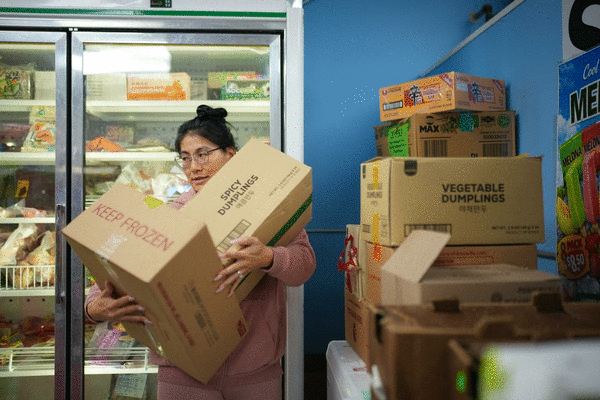
NORTH MANKATO, MINN. — Shantelle Colum, a 33-year-old artist, loved supporting small local businesses, especially Seoul Foods, the newly opened Asian grocery store near her.
Then this summer, Colum noticed Seoul Foods’ ads on Facebook weren’t showing real pictures of delicious dumplings or spicy ramen noodles. Instead, she saw computer-generated images made using ChatGPT.
“I loved their original photos of everything they posted, and then they started using AI,” said Colum, who hasn’t been back to Seoul Foods since those posts in June. “It was disappointing. I was really rooting for them.”
For some customers in southern Minnesota, the use of AI by small local businesses isn’t just controversial — it’s an ethical dilemma that’s driving them away. Such quandaries are likely to grow more common as AI-generated content becomes more prevalent in daily life, even as the technology grows more controversial.
But for small business owners like Brandon “Yella” Hensley, co-owner of Seoul Foods, AI isn’t a moral choice, it’s a matter of survival. Even as his ChatGPT-generated ads pitted his store against some of his customers, Hensley, 53, said he felt like AI was helping him stay afloat in rough economic seas.
“I’m trying to pay my bills and get my kid off to college and my daughter into school,” Hensley said in a recent interview. “They want to be mad because I saved some time taking pictures.”
The tension between customers who love small business but dislike their use of generative AI is one that’s increasing all across America.
More ads are using AI, with just about half of industry professionals generating images with it, according to a recent Harris Poll. Glossy AI-generated images are used for everything from food trucks to small-town festivals to garage sales.
But just 19% of Americans view ads positively when it looked like they were made with AI, a Gallup poll said in August. Some 78% of consumers believe AI makes ads “feel less authentic” and 63% would be less likely to buy from a brand that uses the technology, according to an article in Marketing Brew in June.
The Mankato and North Mankato area has a lot of people who go out of their way to support small businesses but have a low tolerance for AI, said Kat Baumann Hohenstein, a local artist.
She and others who spoke to the Minnesota Star Tribune echoed similar views: that the ads seemed lazy, inauthentic, error-filled and ugly. Hohenstein fears AI harms the environment and takes away jobs from artists like her. She said she recently canceled her subscription to a local plumbing service that paid a chatbot to respond to her call.
“I want my money to go to companies that are going to support my neighbors and the people in my city,” Hohenstein said. “If you can throw money at these companies owned by billionaires, then you can throw a little money toward human beings who live here and have to work.”
Local business owners defend their use of AI, saying they see the technology as a useful tool in an uncertain economy where large companies have so many advantages.
Jeremy Pickett, who runs a food truck in Mankato serving Chicago-style ribs and wings, said the appeal of AI tools was more than just saving some money and time on ads. AI helps him review contracts and translate the corporate jargon and “fancy words” that served as obstacles to small business owners like him, said Pickett, 37.
Hensley, at Seoul Foods, likened his subscription to ChatGPT to the slingshot given to the Biblical David, in his fight against corporate Goliaths like Wal-Mart.
Hensley and his wife Sook Nam, 42, opened Seoul Foods in 2025. He said AI helped them learn how to run a business during a turbulent first year.
He said he couldn’t find any mentors in the area, so he turned to ChatGPT to learn about contracts, grants and licenses. It was AI that translated conversations between Hensley and the Spanish-speaking workers ferrying foods for the Chinese-speaking grocery suppliers. The AI also scanned his inventory and gave him prices.
His ChatGPT-generated graphics were an attempt to draw fans and build word of mouth. “Nobody comes to a small business just to buy groceries,” Hensley said. “They also, for the most part, want a piece of you. Cause they could just go to Wal-Mart. You’re selling more than you’re selling.”
Across the country, small businesses are learning that while AI often helps behind the scenes, it makes it more difficult to build relationships with customers, said Linli Xu, a marketing professor at the University of Minnesota’s Carlson School of Management.
Customers are generally fine with companies using AI, as long as they don’t have to see it, Xu said. But the use of AI for jobs associated with emotion — especially involving creativity or forming relationships — is seen more negatively, she said.
“If you’re trying to establish this warm relationship with your customers, and then they see you are using [generative] AI, which is less human, that may create this conflicting feeling, and this will maybe damage the relationship that you’re trying to build,” Xu said.
So what are people against AI to do upon seeing their favorite cafe using it? Megan Wehrwein, a 36-year-old violinist in the Mankato Symphony, said she and others are still trying to figure out the answer.
Some said they won’t shop anywhere that uses AI. Others said they’ll try to help businesses hire local artists. Wehrwein said she doesn’t want local places to suffer, so she won’t boycott. But given the choice between two businesses, she’ll favor the one that doesn’t use AI, she said.
Michael Cimino, a 34-year-old St. Peter service technician and public artist, said supporting small businesses includes telling them that customers want ads that feel more human. Cimino was among dozens of customers in early September who commented and reacted negatively to an AI image from the Rapidan Dam Store, a local institution and family restaurant whose previous location was destroyed after severe flooding in 2024.
David Hruska, the store’s co-owner, said he “didn’t know people complained about that stuff.” The family will put out a new poster without AI soon, Hruska said.
Jeremy Pickett at Papapicketts BBQ said he also took note after customers criticized his AI ad over the summer. He’s since hired a person to post pictures of the food, but said he still uses AI behind the scenes to help with paperwork.
Hensley at Seoul Foods has also been posting fewer AI-generated images online these days. He said it’s because the store is struggling to survive, due to tariffs, inflation and the closure of a nearby bridge.
Hensley said he doesn’t even like AI. Like many critics of the technology, he distrusts the big tech companies and wants more regulations on them. But he worries more about the fate of his family’s business, and thinks it’s unfair customers want him to stop using AI in his fight to keep the store alive.
“I’m not oblivious to the world around me, but I’m also living in this broken world where AI exists,” Hensley said. “And I’ve got to compete in the world as it is.”
©2026 The Minnesota Star Tribune. Visit at startribune.com. Distributed by Tribune Content Agency, LLC.









Comments