Fed rate decision still hangs on inflation after jobs report
Published in Business News
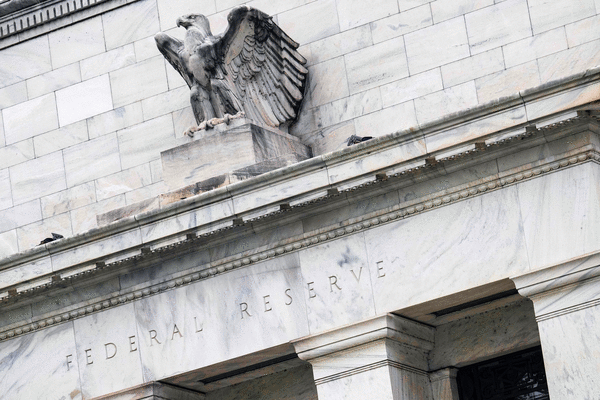
A surprise jump in U.S. hiring last month has bolstered the case for the Federal Reserve to raise interest rates when they meet later this month, but a hike is still not guaranteed.
Nonfarm payrolls in August topped all estimates in a Bloomberg survey, and the unemployment rate held steady at 4.1%. The latest report didn’t suggest the labor market is adding to price pressures, however, and analysts continue to expect the next Fed rate decision will hinge on inflation data due next week.
Meanwhile, President Donald Trump revived his pressure campaign on the U.S. central bank, demanding in a social media post Friday that the Fed lower rates — even as investors boosted bets that they will raise them this month.
“Today’s data lends support to the hawkish camp, but stops shy of making a definitive case for a rate hike on September 16,” Vail Hartman, a strategist at BMO Capital Markets, wrote in a note to clients. “While the market-implied probability of a rate hike this month has increased, the employment data will play a secondary role to inflation.”
The probability investors assigned to a rate increase this month, based on federal funds futures pricing, jumped to just above 60% from about 50%.
Coming price data
The jobs report showed nonfarm payrolls increased 162,000 last month and July’s job losses were revised away, suggesting the labor market has more momentum than previously thought.
Olu Sonola, head of U.S. economics at Fitch Rating called the jobs report “unequivocally strong,” reaffirming the stability of the labor market. But, he added, “The real event risk is next week’s CPI report. That is the print capable of moving the needle.”
The Bureau of Labor Statistics will release August data for the producer price index on Thursday, followed by the consumer price index on Friday.
With Fed officials concerned by persistently high inflation, but divided over how monetary policy should respond in the near term, new evidence of price pressures could tilt the Federal Open Market Committee into a rate hike. Cooler reports are likely to keep the Fed on hold, as it’s been through five previous meetings this year.
Those division came to the forefront at the July meeting. While most officials supported the decision to hold rates steady, three dissented in favor of a quarter-point hike. Two non-voting policymakers have also since revealed they sided with the dissenters.
“It’s all about the inflation data next week,” said Yelena Shulyatyeva, senior U.S. economist at the Conference Board.
She said a “big group” of officials are looking to next week’s data for evidence that inflation is moving sustainably back toward the central bank’s 2% goal. “If it doesn’t happen, then I think they will hike.”
The president’s post on Truth Social, however, adds politics to the mix — a variable Fed officials have long tried to exclude from their deliberations. He also aimed his message directly at the new Fed Chairman Kevin Warsh, without naming him.
“Lower the interest rates because the U.S.A. is a much stronger credit than it was just a short time ago!” Trump said. “The Fed Board, with its great new leader, must get smart - BE PATRIOTS for a change.”
Warsh hints
Trump, who regularly lashed out at the previous chair, Jerome Powell, for holding rates too high, appointed Warsh to his post earlier this year. So far, the new Fed chief has talked tough on inflation, but pointedly avoided any specific hints that he favored a rate increase in the coming months.
He came closest to that, however, when he spoke last week at the Fed’s annual conference in Jackson Hole, Wyoming.
In those remarks he described the labor market as stable and made clear his focus was on inflation. He added that policymakers must be confident inflation is meaningfully slowing, otherwise they had “work to do.”
Since then, two key members of the Fed’s policy making panel have offered their views on the economy. Governor Christopher Waller said he’s inclined to hold rates steady, unless inflation figures next week come in “hot.”
New York Fed President John Williams said the latest inflation data was “encouraging” and showed evidence price pressures are slowing.
Today’s jobs report corrected some of the previous weakness in the employment data, particularly in sectors like public schools, said Mark Spindel, chief investment officer at Potomac River Capital LLC.
“As strong as today’s data was, I don’t think anyone will be triggered to tighten on today’s data alone,” he said. “Next week’s inflation report will be determinative.”
(With assistance from Catarina Saraiva and Andrew Ackerman.)
©2026 Bloomberg L.P. Visit bloomberg.com. Distributed by Tribune Content Agency, LLC.







Comments