UWM's $2 billion lifeline boosts lender's liquidity but carries risks
Published in Business News
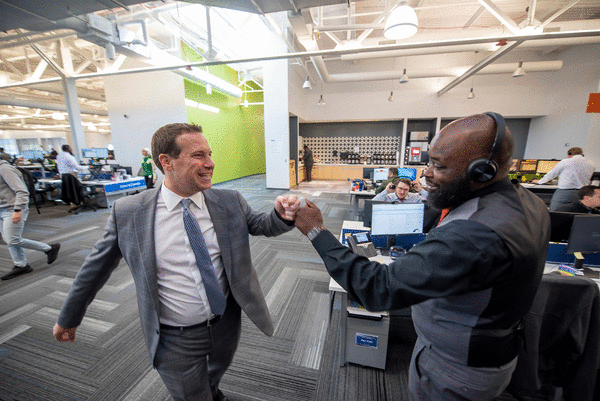
United Wholesale Mortgage's recent deal with a distressed-company investment firm to secure a more than $2 billion lifeline could equip the mortgage lender with better financial tools, but it might also require spending cuts and stronger checks and balances.
UWM Holdings Corp. CEO and Chairman Mat Ishbia grew the small brokerage his father founded in 1986 into a mortgage empire based in Pontiac, Michigan. He took UWM public in 2021 via the largest Special Purpose Acquisition Company deal on record at the time, outpaced Detroit mortgage mogul Dan Gilbert's Rocket Mortgage in mortgage-origination value and purchased the Phoenix Suns NBA franchise and its WNBA sister.
But stubbornly high interest rates and dividend allocations that fattened Ishbia's pocket landed the company in a poor capital position, analysts say. And a bad bet worsened its condition.
"He's a great leader in terms of growing the company and getting them to getting where they are now," said Bose George, investment banking firm Keefe, Bruyette & Woods Inc. "You could argue on the capital management side there could be more checks and balances, but I think his leadership has obviously taken them where they are now. That's a huge accomplishment driven by who he is."
The lender announced the deal in early August with California-based Oaktree Capital Management. The partnership infused UWM with $1.65 billion through preferred shares to address near-term funding needs, while Oaktree gets two seats on the board, at least $600 million in guaranteed returns, warrants for additional shares, the right to block changes to UWM's senior management and corporate bylaws, and the ability to have UWM to buy out Oaktree's stake after seven years. The deal provides UWM $3 billion in equity, up from $1 billion.
UWM paused for the first time since going public its 10-cent-per-quarter dividend, including to Ishbia, who has received billions of dollars since the company went public in 2021 and alongside his family holds 79% of the company's voting power through a special class of stock. If UWM can't keep its commitment to make hundreds of millions of dollars in payments to Oaktree, it'll face penalties, and the investor could have the power to appoint a majority of the board, effectively taking over the company.
That outcome is unlikely, UWM and analysts said, now that the company has the capital it needs, and the prospect of an Oaktree takeover is an impetus to activate the board to prevent that and protect Oaktree's investment. But UWM's biggest challenges are macroeconomic-related and out of its control.
"The company’s future performance is in the hands of the interest rate gods,” said Todd Baker, managing principal at Broadmoor Consulting LLC and a former banking executive and law firm partner.
Still, there remains great admiration for what Ishbia has accomplished and confidence in his ability to pilot the company moving forward.
"I think he is crucial to continuing to lead the company," George said. "A lot of the company is the culture he sets. Oaktree, they’ll have a couple of board seats that may put more checks and balances on the capital side and risk management, which could be helpful, as well. That combination can make the company stronger and better positioned for the future."
A statement emailed by UWM spokesperson Nicole Roberts echoed that the agreement positions the lender for a brighter future: "The strategic capital partnership with Oaktree and the Ishbia family’s investment was specifically designed to further strengthen UWM’s balance sheet, enhance liquidity and support long-term growth."
How UWM got here
UWM reported a second-quarter $451.9 million net loss. It had hoped interest rates would fall and spur demand for loans. Instead, rates rose, challenging the origination market. According to Freddie Mac, the average 30-year mortgage rate climbed from 6.15% at the end of 2025 to 6.66% as of Aug. 27.
Meanwhile, UWM's 10-cent regular dividend was costing the lender about $600 million per year. Capital was running thin, analysts said.
"The problem was they had paid out more dividends than was prudent, which created the capital need," George said. "The confluence of that and what happened this year, where rates have been higher, has made mortgage origination more challenging. It's harder to earn their way out of it. That combination is what created that capital need."
Then UWM's attempt to acquire Minnesota real estate investment firm Two Harbors Investment Corp. fell apart. The companies agreed in December to a $1.3 billion all-stock deal. But in March, Ohio lender CrossCountry Mortgage LLC stepped in with a superior, all-cash proposal of $12 per share. UWM countered with a revised proposal of $12.50 per share, but it was rejected.
That was costly for UWM. The lender had bet interest rates would fall when it took a derivative position against its portfolio of mortgages. But the hedge it took included not only the value of its own mortgage servicing books, but also Two Harbors' in anticipation of losses from inheriting the Minnesota firm's mortgage servicing business. The value of those books goes down when interest rates drop, as borrowers are more likely to refinance their mortgages. Those declines appear as losses in quarterly earnings filings.
Instead, interest rates rose, and although UWM lost the Two Harbors deal, it still was on the hook for the interest rate hedge position. That "overhedged" bet put it at a $603 million interest rate derivatives loss from the maneuver.
"UWM has opportunistically hedged its mortgage servicing rights portfolio for years," the UWM statement said. "It is a standard industry practice for buyers of mortgage servicing rights to factor anticipated acquisitions into their hedging decisions before a transaction closes, as waiting until closing can limit the effectiveness of the hedge."
The statement added: "As with any investment position, exiting a hedge is not as simple as immediately closing it upon a change in circumstances, as doing so can lock in losses at a specific point in time. UWM ultimately chose to exit the position when it determined the risk-reward profile no longer supported maintaining it."
Nonetheless, "The Two Harbors issue exacerbated the issue a little bit, but it didn’t cause it," George said regarding UWM's need for capital.
UWM is suing Two Harbors in federal court, seeking $500 million for an alleged breach of contract and fraud. Two Harbors called the lawsuit "baseless" and "frivolous" last month in a statement posted online.
UWM's derivative loss "highlights the dire condition of its balance sheet, liquidity and also casts doubt on its risk management and other governance practices," Two Harbors said.
It noted UWM's stock price was falling earlier this year, making the stock-for-stock acquisition less lucrative. It also questioned UWM's explanation for the derivatives position, saying Two Harbors already had hedged its mortgage servicing book for interest rate changes. It said the size of UWM's derivatives position was about 13 times the potential interest rate exposure of the servicing book if it wasn't hedged.
"Two Harbors' statement is a litigation-driven attempt to deflect from the allegations set forth in UWM's lawsuit against them," the UWM statement said, adding the "13 times" claim "is based on a fundamentally flawed comparison between Two Harbors market cap and UWM’s derivatives position. The anticipated Two Harbors portfolio and UWM's existing mortgage servicing rights portfolio together represented an MSR asset base valued at more than $8 billion, and the derivative position was sized accordingly."
The statement added: "For further context, UWM had a derivatives position of approximately $13 billion as of June 30 to partially hedge its $5.3 billion position at that time."
Impact of the Oaktree deal
UWM's share price plunged after it reported its over-hedged position and the Oaktree deal. Its stock closed Aug. 28 at $1.49 per share, down 64% from a year ago.
Following the report, bond rating agency Fitch Ratings downgraded UWM one level to B+, going from "speculative" to "highly speculative" with a stable outlook. KBRA also downgraded United Wholesale Mortgage LLC to BB+.
"We believe the investment should be properly viewed as equity, not debt, as it does not have a maturity date, nor are there any creditor’s rights attached to it," the UWM statement said. "It is undeniable that this investment has significantly fortified UWM’s balance sheet and has certainly not made it weaker."
The Oaktree funding helps UWM to secure a stronger capital position and address its derivatives position loss. There's an option for more share purchases — called a "rights offering" — this fall for an additional $400 million investment in UWM that's backstopped by Oaktree and the Ishbia family if equity investors forgo the opportunity.
Ishbia also emphasized that the partnership gives the company access to Oaktree's expertise in the mortgage sector. UWM, as the largest mortgage lender by dollar amount, has proven its strength in attracting clients and serving customers, but Oaktree has experience on the Wall Street side of mortgages in addressing servicing, hedging, wholesale and unsecuritized loans. That expertise is where Oaktree especially can support UWM, according to a person familiar with the deal who wasn't permitted to speak publicly on the agreement.
Details of what influence Oaktree will have aren't clear. But analysts said UWM will likely also need to make cost reductions to improve its market share profitably, which could include artificial intelligence tools and not replacing employees who leave. Ishbia has publicly committed that UWM has never and will never lay off an employee.
"If interest rates rise, causing home purchasers to pull back and loan origination volume to fall," Baker said, "the company will be challenged to remain profitable and will likely need to cut its operations back sharply."
Remarks made Aug, 28 by Fed Chair Kevin Warsh have led many investors to expect the central bank to raise rates at its next meeting Sept. 15-16.
In 2020, prior to going public, UWM had received a smaller investment from Oaktree for capital, said the person familiar with the deal, which was confirmed by UWM. UWM paid it off quickly amid a refinancing boom, and it was a positive partnership, the source added.
Deals like the most recent partnership between UWM and Oaktree aren't very common, George noted. But Oaktree has experience in investments into companies that need a cash infusion. Florida-based lender Onity Group Inc. struck a deal with Oaktree to reduce debt and secure a better capital structure in 2024. A year later, Oaktree increased its shareholding within the company.
"I feel like they’ve been a good partner," George said. "They know the mortgage market well. They are a useful partner and a knowledgeable partner."
UWM, however, he noted, is a much larger company than Onity.
Ishbia also has skin in the game. His family's holding firm is providing $150 million as part of the Oaktree agreement, with the rest of the $1.65 billion coming from the investment firm. He could contribute more through the $400 million rights offering in the fall. The Ishbia family holding firm will receive interest rate payments alongside Oaktree's 10%.
The company's board can vote to reinstate dividends for common stockholders. George said he doesn't expect the regular dividend to be reinstated anytime soon, potentially for another four years.
"That’s going to take a big effort," he said of UWM's commitments to Oaktree. "They'll pay that off hopefully in the next few years."
The extent of control Ishbia and his family have on the company also may be why Oaktree proves beneficial, analysts said. In addition to the chairman, UWM's board includes Ishbia's father, Jeff, and his brother Justin. Hall-of-Fame basketball player Isiah Thomas, a childhood hero of Ishbia’s, also sits on the board.
UWM also rents space from entities controlled by Ishbia and his father. The company last year paid those companies $21 million on long-term leases. In 2025, UWM also agreed to a $115 million sponsorship deal for 10 years to name the arena in Phoenix where the Ishbia-owned NBA and WNBA teams play. Those millions of dollars, however, are ultimately a fraction of the billions of dollars UWM works with annually.
The company also stopped taking analyst questions last year on its earnings calls. Instead, executives started answering questions prepared ahead of time.
Ishbia ownership of the Suns
The deal also raised questions of whether Ishbia's ownership of the Suns could be at risk, which the UWM statement said is a question that is "clearly ignoring the facts." Although a portion of Ishbia's loan collateral to purchase a majority share of the Suns and Mercury for $4 billion in 2023 consisted of publicly traded stock, a JPMorgan representative referred to a statement provided to Bloomberg that the bank didn't request additional collateral from Ishbia after the Aug. 5 selloff, which UWM confirmed. The company's statement also said Ishbia is finalizing an agreement to buy out the remaining Suns and Mercury shareholders to have the Ishbia family's total ownership total almost 99% of the team.
"As JPM has publicly stated," the UWM statement said, "they have performed and continue to perform as agreed and there is no concern that the presence of these standard liquidity facilities pose any risk to the ownership of the Phoenix Suns nor have they had any impact on Mat Ishbia’s interest in UWMC."
©2026 www.detroitnews.com. Visit at detroitnews.com. Distributed by Tribune Content Agency, LLC.





Comments