Boeing, SPEEA contract offers nearly 29% pay bump
Published in Business News
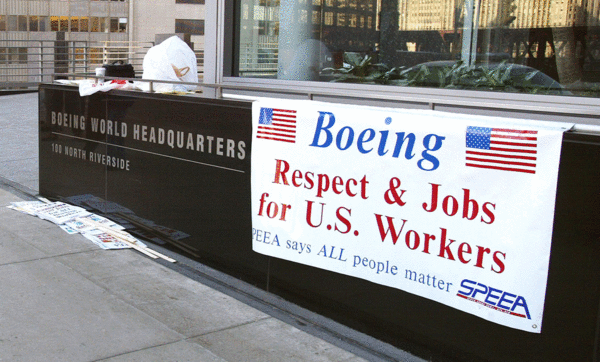
Boeing is offering its professional aerospace union workers a 28.5% wage increase over the length of the next four-year contract, according to details of the tentative agreement shared Wednesday.
Boeing began negotiations with its white-collar union — the Society of Professional Engineering Employees in Aerospace, or SPEEA — at the start of July and made its final offer to the union last week.
SPEEA's bargaining team endorsed the deal, but the process is far from complete. The tentative contract agreement now heads to a group of SPEEA representatives for a recommendation on whether to accept or reject the deal, and then to the membership for a vote.
The outcome of those negotiations affects about 17,000 engineers, technicians and other white-collar workers at Boeing facilities in Washington and nearby states.
Boeing and SPEEA made the details of the proposed contract public on Wednesday.
The offer includes a 3% general wage increase upon ratification, retroactive to Feb. 20, 2026, then a 7% increase to salary pools in March 2027, according to a summary of the agreement from SPEEA. Union members would then see a 5.5% increase each year through 2030.
Factoring in additional pay for performance bonuses and promotions, the total compounded salary increase could reach 31.9% over the life of the agreement. The proposed contract would also guarantee annual minimum wage increases tied to inflation, capped at 3%, according to the summary document.
The deal also aims to address two noneconomic concerns that have worried Boeing’s workforce: the threat of moving work outside of Washington and fear of retaliation for raising safety concerns.
The proposed contract will include a letter of understanding from Boeing executives “signaling commitment to the Pacific Northwest,” according to the union.
And, it would establish a committee of Boeing and union representatives to address safety concerns raised by employees. That committee is meant to serve as a way for union members “to raise safety issues without fear of reprisal,” the SPEEA document read.
Ben Nimmergut, vice president and functional chief engineer for production engineering and a member of Boeing's bargaining team, said in an interview Wednesday that the deal keeps Boeing's wages among the market leaders here in the region."
At the table, SPEEA's bargaining team said union members felt "they've lost ground over the last several years due to inflation," Nimmergut said.
Boeing worked to address that in its offer, he continued. "We went all in on our strongest offer to show the respect we have for our team and the work that they do."
Mike Berryhill, a production engineer and member of SPEEA's negotiating team, said in a statement Wednesday that the offer "addresses many of the longstanding issues affecting our members" and provides "security for future members to ensure that this isn't just a job, but a career."
Past contract extensions
The contract talks that began July 1 mark the first full negotiations between Boeing and SPEEA in nearly 14 years. SPEEA members had twice voted to extend 2013 collective bargaining agreements.
The negotiations will result in two agreements for SPEEA's two largest bargaining units. Its professional unit represents about 13,000 engineers and scientists, and the technical unit represents about 4,000 analysts, technicians, planners and specialists.
SPEEA represents workers at Boeing facilities and its subsidiaries in Washington, Oregon, Kansas, California and Utah. The majority of those workers are in the Puget Sound region, the union said.
Going into bargaining, SPEEA didn’t have a set of contract demands but instead outlined bargaining priorities, including improved compensation, benefits and workplace fairness, as well as more flexible work arrangements and investments in workforce development.
The union did not request a specific wage increase, but said it wants to “return to market-leading compensation.”
If approved, the proposed contract would create the highest wage pools for SPEEA in more than 40 years, the union's contract summary emphasized.
Following the union’s last full contract negotiations, SPEEA members in 2013 ratified a deal that offered annual 5% average pay increases through October 2016. The agreement did not increase medical costs but, in a loss for union members, it eliminated the traditional pension for new hires and replaced it with a 401(k)-style retirement-savings plan.
SPEEA’s professional unit voted then to accept the deal before the tech unit. Members from the tech side of the union first rejected the contract and voted to authorize a strike, before agreeing to the deal with minor changes that did not cost the company additional money.
In 2016, SPEEA members agreed to a six-year contract extension which guaranteed an average 5% annual increase in compensation.
The union voted again in 2020 to extend the existing contract for the next six years. That contract was the first to provide fixed-percentage salary pools and offered 5.5% total compensation increases in raises and bonuses for the first two years, 5% the next year and 4.5% for the next four years.
Heading into this year’s contract negotiations, union members are bound to look at other recent union deals within Boeing’s workforce. In 2024, following a 53-day strike, Boeing’s blue-collar Machinists union won a 38% general wage increase over the length of their four-year contract, which would compound to roughly 43% over the life of the agreement.
The Machinists union, which represents 33,000 workers in the Puget Sound area, had seen little wage increases in the 10 years leading up to those negotiations.
The Machinists "were coming off a 10-year contract that saw wage increases totaling 8% over those 10 years," Boeing's Nimmergut said. "Over that same time, SPEEA's wage pools saw increases about four times as much. This contract is starting at a different place."
In Wichita, Kan., SPEEA-represented Boeing employees ratified a new 4.8-year contract with Boeing in January. That contract included a 20% increase to wage pools over the length of the contract and a $6,000 ratification bonus.
What's on the table now
The economic offers on the table for SPEEA now, including the wage proposal, are conditional on SPEEA members ratifying the contract by Aug. 22, according to the contract summary.
The proposed contract also includes a change to the employee incentive plan and a onetime award of 40 restricted stock units, according to the contract summary. It would not significantly change the company’s healthcare plan.
Retirement savings benefits would remain largely the same for older employees, while union members under 40 years old would see a 1% bump in the amount of money Boeing automatically contributes to its 401(k) plan.
The deal would offer union members two extra vacation days, the first increase for all members since 1983, according to the document, and one additional floating holiday. Union members would also now receive three days annually for bereavement leave.
The contract would cap mandatory overtime at 112 hours per quarter, a decrease from 144 hours previously. For the professional unit, the document said the overtime premium would increase from $6.50 to $8.50, the first bump since 1989.
The contract would also eliminate “upper-level mandates banning virtual work,” according to the document. If a manager denied a request from an employee to work virtually, the manager must provide a “business justification,” it continued.
As part of the company’s “commitment to the Pacific Northwest,” the president of Boeing Commercial Airplanes and other Boeing leaders would meet with SPEEA representatives at least twice a year to “discuss workplace and market issues,” the proposed agreement read.
Related to raising safety concerns, Boeing is working to replicate a partnership it already has with its Machinists union, Nimmergut said. But the details are still being ironed out.
"What we put right now is the commitment to sit down and figure out the process," Nimmergut said. "The answer isn't put in place yet."
In a letter to the group of SPEEA representatives who are now evaluating the tentative contract agreement, SPEEA’s negotiating team said the “totality of the package” makes the proposed contract a “great offer.”
“Along with the quantifiable objective gains we can measure with dollars, hours and other trackable data, this offer contains some invaluable qualitative wins,” the letter read.
That group of representatives, known as the Bargaining Unit Councils, will likely issue a recommendation on whether union members should vote for or against the deal this week. That group could also call for a strike authorization vote. In this case, a strike would not begin until the current contract expires Oct. 6.
Nimmergut said Boeing took the money it would have spent on a strike contingency plan and baked it into its wage proposal, allowing it to offer a higher price point than it may have otherwise.
A strike would threaten the planemaker's ongoing recovery after a tumultuous few years, he continued. "Losing momentum now would set all of us back.
©2026 The Seattle Times. Visit seattletimes.com. Distributed by Tribune Content Agency, LLC.








Comments