How Nike insiders were charged with conspiring to steal millions of dollars' worth of sneakers
Published in Business News
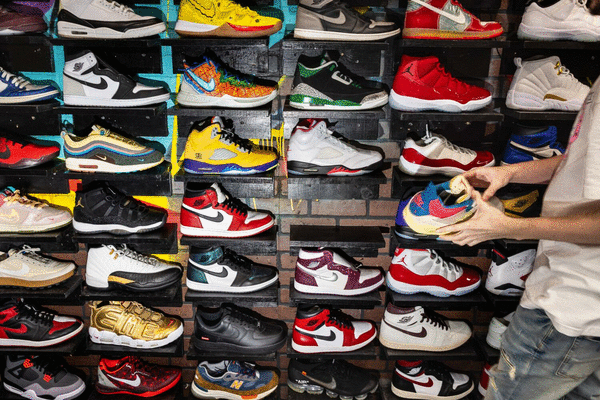
LOS ANGELES — One day last fall, Roy Lee Harvey got into a Lyft in Phoenix and headed across town. He and the driver started chatting, and authorities say Harvey told the man about his work buying high-end Nike sneakers from shoe companies and reselling them for a healthy profit.
The Lyft driver thought it sounded like a good business opportunity, so the two men exchanged numbers and later met up at an apartment in nearby Scottsdale, where, according to police investigators, Harvey showed him into a room strewn with different pairs of Nikes and their cardboard boxes.
The most coveted shoe models, which the company manufactures in limited runs, can fetch three or four times more than their retail value on the resale market. Reselling sneakers has become a multibillion-dollar global industry. Social media influencers generate hype through unboxing videos that draw millions of views.
Fashionistas known as sneakerheads scramble to buy and trade the latest styles, paying a premium for the rarest pairs. Some treat them as investments, never wearing their purchases in order to keep them in mint condition. Like a sports car or a fine wine, they say, the value of shoes can increase as they get older.
Harvey's collection was so vast that the Lyft driver became suspicious, according to a police search warrant affidavit reviewed by The Times. After leaving the apartment, police said, the driver googled Harvey and found that he faced multiple state felony charges in California for allegedly running an extensive sneaker theft ring.
Last week, federal authorities added another case against Harvey, unsealing an indictment that charged him and several major shoe resellers in Los Angeles, Chicago and Indiana with paying Nike employees to help steal hundreds of hard-to-find styles that they in turn flipped.
Harvey has pleaded not guilty. In his state court case, his attorney has accused police of overreaching, arguing there's no evidence his client knew the shoes were stolen and added that Nike didn't suffer a loss from shoes sold on the resale market.
Det. Marc Sternin of the Los Angeles Police Department's commercial crimes division testified in a September 2024 preliminary hearing that he first began investigating the alleged theft ring in January 2024 after being contacted by investigators from Nike, who had discovered some strangely labeled packages at one of their distribution centers in Memphis, Tenn.
The packages had UPS labels, but were found sitting in the back of a U.S. postal truck, Sternin testified. They were bound for private residences where Harvey lived or had access to in Hollywood, instead of a Nike retailer, the detective said.
An internal Nike investigation determined that the suspected thieves were covering up the original shipping labels with labels redirecting them to several addresses in the Hollywood area, a practice known as "ghost labeling," according to Sternin. Nike investigators, he said, found at least 28 such mislabeled boxes.
The investigation's inventory reads like a sneakerhead's Christmas wish list: Nike Dunk Low Off-Whites. Nike SB Dunk Low City of Loves. Nike 6 Protro, a.k.a. the Reverse Grinches. All in their original boxes, according to Sternin.
Working with Nike and the FBI, Sternin said LAPD investigators hatched a plan to insert GPS tracking devices into each of the 28 packages and allow them to be delivered.
An LAPD surveillance squad staked out the building before the scheduled delivery and saw Harvey and a woman retrieve the packages, Sternin testified. Police later pulled over a U-Haul truck that Harvey was driving with the same woman, and seized the packages, according to the detective's statements in court.
The two were brought back to the Hollywood station for questioning. Harvey told detectives that he'd been around the shoe business since he was 16 years old, but otherwise refused to answer their questions, Sternin testified.
Detectives obtained search warrants for Harvey's cellphone and his iCloud account, gaining access to his call records, notes, photographs, text messages and other data.
One number, with a 901 prefix from Shelby County, Tenn., jumped out, Sternin testified, because of the number of times that Harvey had contacted it. Nike personnel records revealed that the number belonged to Michael Reno Perkins, who worked as a supervisor on the floor of the company's roughly 1-million-square-foot Memphis distribution facility.
Perkins, according to the detective's testimony during the preliminary hearing, is suspected of recruiting a group of employees under his supervision into the alleged scheme. Harvey would act as a broker of sorts, police said, instructing Perkins and his co-conspirators on which shoes to steal based on demand from resellers.
On July 21, Perkins was indicted in federal court in Tennessee along with Harvey and 10 other people. Among the others charged was Bereket Abraham, the 39-year-old former co-owner of the famous sneaker retailer CoolKicks of L.A.
Abraham has not yet entered a plea, according to online records. His attorney, Bill Massey, declined to comment, saying his legal team was "busy reviewing the information made available thus far."
The defendants in the federal case are charged with conspiring to steal at least $2 million in Nike products between 2021 and 2024.
CoolKicks' other owner, Adeel Shams, was not among those named in the indictment. Shams was livestreaming in a CoolKicks warehouse when LAPD officers burst inside during a search warrant operation in October and detained him and other employees, accusing the company of buying stolen shoes. Shams was later released, without charges.
In a statement after the federal charges were announced, CoolKicks said that it had "terminated" Abraham's relationship with the company.
"While Mr. Abraham owns stock in CoolKicks, the indictment contains no allegations of wrongdoing by CoolKicks or anyone else associated with CoolKicks," the statement said.
Other indicted co-conspirators included Jorge Cuellar, 30, another popular online sneaker reseller and social media personality known as "horehead_sales." Attempts to reach Cuellar were unsuccessful.
Cuellar owns Horhead Investments, a shoe reseller in L.A. that sent wire transfers to a Memphis-based food truck company owned by co-defendant Keith Cannon for $696,700 between April 2023 and November 2023, according to Sternin's testimony. CoolKicks paid Cannon and Harvey $127,000 and $88,275, respectively, the detective said in court.
Sternin said in his court testimony that when investigators searched Harvey's phone data, they discovered a group thread between him and two sisters that appeared to show them coordinating how they would retrieve the "ghost label" packages that had been surreptitiously shipped from the Nike warehouse.
Harvey instructed the two women to go rent a U-Haul and meet the driver to collect the UPS packages at designated locations, which were also relayed to Cuellar, Sternin said in court.
Among shoe giants such as Nike, there has been a grudging tolerance of the resale market, according to Kelcie Slaton, a professor at the University of North Texas whose research has revolved around the question of why sneaker lovers are willing to spend many times more than market value for rare shoes.
Slaton told The Times that the secondhand market eats into Nike's profit margins, while at the same time creating soaring demand for their products.
"The consumers, they're not loyal to the resellers; they're loyal to the brand," Slaton said.
That cases such as Harvey's would lead back to L.A. is hardly surprising, authorities say, given the reputation the city has earned in recent years as the country's cargo theft capital.
Thieves have targeted seaports, train yards and other "chokepoints" along the domestic supply chain where shipments of electronics, clothing and other high-value items are held. Authorities say that their methods include hacking into emails and setting up fake trucking companies to schedule pickups — or simply breaking into shipping containers with bolt cutters.
Most stolen gear is offloaded through "fences" and ends up in consignment shops or online marketplaces, according to Los Angeles County Sheriff's Department Det. Kyle Crowley.
"The bad guys will steal, they'll flip it for 30%, then the next guy will flip it for 35%, the next guy flips it [and] it just goes from distributor to distributor," said Crowley, a member of the department's cargo theft unit. "The first line of buyers, they know the stuff's stolen; they don't care. The second and third and fourth, fifth, 10th line of buyers of that wholesale cargo, whether they know or care, it's hard to prove."
The LAPD's Nike case has been parsed in the online sneakerhead community, with questions raised about how much local dealers knew — or should have known — about the origins of their merchandise. Some commenters have dismissed the case as police overreach. Others pointed out that most major resellers have relationships with shoe company officials, or plugs, who occasionally offer them first dibs on a new release.
Among those resellers whose warehouses was raided was Project Blitz, whose owner Andre Ljustina has not been charged and has sued the city, alleging that the LAPD has refused to release his entire inventory.
Harvey initially came under investigation in early 2024 and authorities charge that he continued to pilfer shoes even after he knew that police were onto him.
Authorities have cited the Lyft incident in court filings asking a judge to revoke Harvey's bail. The ride-share driver contacted the LAPD after Harvey allegedly threatened to harm him, his wife, their son and their dog, according to court testimony by Sternin, the LAPD detective. Harvey has not been charged in that case.
At the time of his trip to Phoenix, according to a search warrant affidavit, Harvey was on pretrial release under conditions that ordered him to stop selling shoes and to not travel out of California without permission.
©2026 Los Angeles Times. Visit at latimes.com. Distributed by Tribune Content Agency, LLC.


Comments