Hormel's next CEO has dishwashing roots, and a corporate turnaround to accomplish
Published in Business News
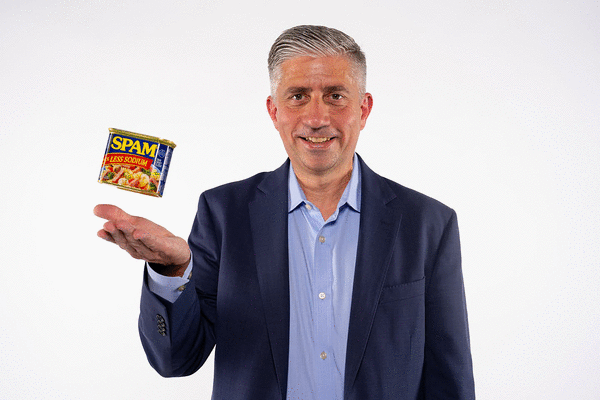
MINNEAPOLIS — When John Ghingo was 14, he started dishwashing at his hometown seafood restaurant in New York. Over eight years, he climbed the ranks to front-of-house manager.
The incoming CEO of Hormel Foods, now 53, met his wife there. Now, he encourages his children to work restaurant jobs.
“It’s hard work serving people food every day, whether you’re doing it in the packaged food industry or in a restaurant. But there’s an emotional payoff there that’s special,” Ghingo said in an interview prior to last week’s announcement that he would take the top job at Austin, Minn.-based Hormel.
The teenage job taught him the value of a diligent work ethic and the importance of putting customers and co-workers first, Ghingo said.
In naming Ghingo its next CEO, Hormel — with some $12 billion in annual sales — is counting on him to put those lessons to task and finish a turnaround plan after a few years of declining profits. Relentless inflation has caused pain at the company and its competitors, and the stock price is down about 45% over the past five years.
While the high cost of beef has recently lifted the company’s Jennie-O ground turkey business. inflation has also increased the cost of production. Operational challenges have created additional headaches.
To complete the company’s turnaround, Ghingo is betting Hormel can capitalize on a growing consumer appetite for protein and meet their expectations across budgets, from shoppers looking for affordable buys to those focused on premium options.
“I think we are headed to an era of consumers really wanting to learn more: wanting to understand more,” Ghingo said. “And as an industry and as a company, we have an opportunity to connect more deeply over the foods we deliver with transparency.”
Boosting the bottom line
Protein and meats are in with consumers, but Hormel, which has processed meats for more than a century, has seen adjusted profit decline annually since 2022.
Pooran Sharma, managing director of equity research for financial services firm Stephens, said the company’s issues have been in its “bottom line execution,” or the ability to turn sales into profit.
For investors, “I think there’s a little bit of hesitation to buy in until they can prove that they’re not this company that is going to have an operational blow-up around the corner,” Sharma said.
Those operational snags over the past few years have included a fire at a Skippy peanut butter plant in Arkansas as well as animal diseases such as bird flu and another affecting pigs that have increased production costs.
Under former CEO Jim Snee, the company launched a “Transform and Modernize” initiative in late 2023 to lift the company’s operating profit and use the savings to invest in growing core brands. The plan focused on transforming Hormel’s supply chain and simplifying the company’s portfolio of products.
“There is urgency across the organization to improve our business,” Snee said in November 2023.
Snee retired in July 2025. The company’s board replaced him in the interim with Jeff Ettinger, who was previously the chief executive during a period of growth from 2006 to 2016.
Ettinger and Ghingo, who rose to become the company’s president when the former CEO made his return, “inherited this commodity-cost mess, if you will, and had to immediately start making improvements to the business,” Sharma said.
In recent quarters, sales have increased, and Hormel in May posted adjusted profit growth for the first time since January 2024. What investors now want is more consistency, Sharma said.
“I think Jeff and and John have been able to turn things around,” the analyst said. “I still think ... if I was able to, I wouldn’t buy right now because there’s been several quarters of inconsistency.”
Now, eyes are on Ghingo to finish the job.
A career in food
Sharma said Ghingo has “great leadership capabilities” and was “the logical candidate of choice” for the CEO role. Hormel’s Chief Marketing Officer Jason Levine has worked with Ghingo at three companies and called him “a visionary.”
“He’s just so great at rallying an organization around a bold vision, a clear purpose and mission,” Levine said.
After his restaurant years, Ghingo got his bachelor’s degree in 1994 from Notre Dame then an MBA in 2000 from New York University before working for big food companies for years in marketing roles. He managed brands such as Oreo and Planters nuts before leading Mondelēz International’s North American confections business, making treats such as Sour Patch Kids.
He led Hormel subsidiary Applegate, maker of natural and organic meat, from 2016 to 2022. After he left, Ghingo was the CEO at healthy cheese snack company Whisps.
“Working in some smaller organizations,” Ghingo said he learned “the importance of speed and responding to the consumer quickly.”
By the time he returned to Hormel in 2024, Ghingo said he felt consumers had shifted in two ways: Inflation was weighing on them and interest in protein had ballooned.
“Now, consumers have a long list of benefits they associate with protein,” Ghingo said, “things you might expect, like muscles and strength, energy, but all the way down through immune health, gut health, satiety.”
Ghingo said it is important that Hormel’s portfolio meets consumers “evolving needs” for protein as commodity prices change. That means offering options such as chicken, turkey and pork when beef is expensive, as well as investing in lines of plant-based proteins such as peanuts.
“We need to make sure — with an increasingly strained consumer and aggressive competition — that we are being really, really disciplined to make sure we remain as affordable as we can,” Ghingo said, even as it also caters to consumers searching for premium options.
Ghingo has overseen a movement at Hormel away from a focus on selling whole animals like holiday hams to one focused on value-added brands. These products undergo processing such as grinding to allow Hormel to sell them at a higher price.
The company most notably sold its whole-bird Thanksgiving turkey business in April.
With less focus on commodities, Hormel appears to be hedging for the geopolitical uncertainty that has complicated business over the past few years. Ghingo said it is important to be consistent as a leader during these times and “lead people calmly with discipline.”
“Being able to adapt and adjust with the volatility is important, but also really knowing what you’re good at,” Ghingo said. “How do you make sure that, as those changes come, you actually come back to your strategic emphasis?”
©2026 The Minnesota Star Tribune. Visit at startribune.com. Distributed by Tribune Content Agency, LLC.





Comments