Qualcomm lands deal to power BMW's self-driving electric vehicles
Published in Business News
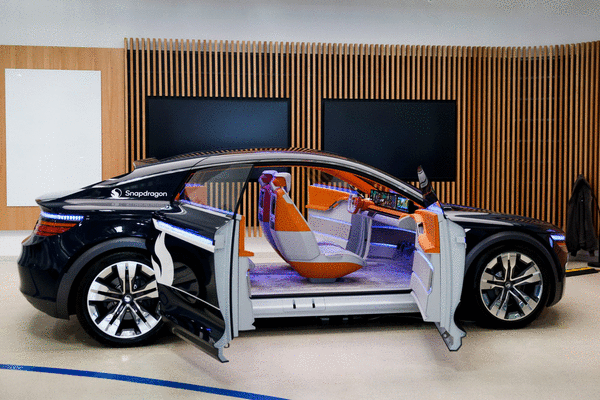
San Diego chipmaker Qualcomm announced Wednesday that BMW has chosen it as the lead chip supplier for the automaker’s next-generation vehicles, extending a partnership into the next decade.
The deal builds on a relationship that began in 2021, when BMW first selected Qualcomm’s Snapdragon Ride technology for its driver-assist and self-driving systems.
Terms of the deal were not disclosed.
Qualcomm’s newest silicon will power BMW’s digital cockpit, advanced driver assistance and automated driving. The Union-Tribune saw a demo of how these next-generation cars might operate in April.
The new vehicle is integrated with AI, and has the ability to recognize the driver, anticipate traffic, have music queued before you ask, and can take the wheel through highway traffic.
In November, Qualcomm and BMW gave the public a preview of this technology, when Qualcomm’s driver-assist system, Ride Pilot, debuted in the BMW iX3 — the first model in BMW’s new all-electric lineup.
Rather than driving the car fully on its own, the system is built to work alongside the driver, handling parts of the driving while keeping the person behind the wheel, who is expected to stay engaged throughout the drive.
Inside the car is what Qualcomm calls its Digital Chassis, essentially the company’s automotive computing platform. Qualcomm has developed each piece of that system — from the touchscreen and navigation to the driving-assist features — so they all work together as one connected system.
This chassis is what makes the car “smart.”
And these smart cars, Qualcomm executives say, will help replace the company’s large — and shrinking — mobile phone revenue. The first BMW models with the Qualcomm technology are expected in the next decade.
Handset revenue made up about 60% of Qualcomm’s chip business in its latest quarter, generating over $5 billion, down 20% year-over-year, the company said during its earnings call on Wednesday. Automotive makes up a much smaller portion, $1.59 billion, but is growing quickly, up 61% year-over-year, the company said.
Qualcomm says it plans to grow this segment to $8 billion in revenue by 2029, and Nakul Duggal, executive vice president of automotive, industrial and embedded IoT and robotics at Qualcomm, told the Union-Tribune in April the company is on track to do so.
“You plan at least three, sometimes even five years ahead of when you will actually launch a vehicle. So decisions that are made for what will happen next year or the year after were made two or three years in the past,” Duggal said. “So we have tremendous predictability in terms of what ’27 and ’28 will look like.”
Qualcomm is competing with chipmakers Nvidia and Mobileye in the automotive space. Mobileye has several partnerships with automakers. It’s currently working to integrate its advanced driver-assistance system (ADAS) technology with Volkswagen and Ford.
Nvidia’s ADAS and autonomous-driving partnerships include Mercedes-Benz, Jaguar Land Rover, Hyundai, Kia, BYD, Geely, Nissan and Isuzu.
But out of all the other advanced chip companies, Qualcomm says it is best positioned to profit from the move toward smart cars. “I think we probably have the most comprehensive solutions in terms of performance, in terms of tiering, in terms of features, in terms of the rate at which we refresh our technologies,” Duggal said.
On Wednesday, Qualcomm reported fiscal third-quarter 2026 results with $9.95 billion in revenue, down 4% from a year ago. Profit also dropped to $2 billion, down 25% year-over-year from $2.67 billion.
©2026 The San Diego Union-Tribune. Visit sandiegouniontribune.com. Distributed by Tribune Content Agency, LLC.










Comments