Liam Denning: A troubling glimpse into an AI Musktopia
Published in Business News
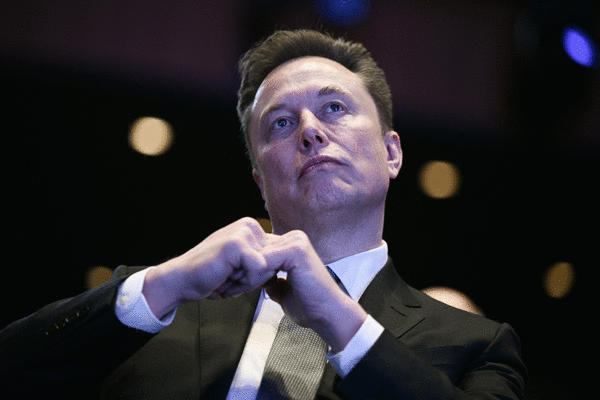
Elon Musk’s adoption of the title “Technoking” at Tesla Inc. looks less like a joke, in retrospect, and more like a manifesto. His recent interview with The Economist ranged widely, from the future of artificial intelligence to his infamous stint heading the Department of Government Efficiency to a coming civil war in the UK. The common thread, one that unites Musk’s sprawling business empire and political interests, is an unshakeable belief in his predictive skills: “My batting average is very high for a human,” he averred to Zanny Minton Beddoes, The Economist’s editor-in-chief.
It is a belief reinforced by Musk’s business successes and the adoration those have bred in capital markets. It finds expression in his tight control over the companies he runs, most notably Space Exploration Technologies Corp. but also Tesla. The risks of concentrated power at companies are well established. What should concern everyone, especially after watching this interview, is what happens when the Technoking steps beyond the C-suite to society as a whole.
In one of the more amusing exchanges, Minton Beddoes is dismissed for her “cloistered existence” by Musk, the world’s first trillionaire and no stranger to the inside of a Gulfstream. He was pushing back, in ad hominem fashion, on her quite reasonable prodding of his hellish characterization of the UK, where she lives and which he hasn’t visited in years. By the weekend, Musk had taken to X, his social media platform, to denounce Minton Beddoes as a “traitor to the West.”
Musk is known to bristle at pushback. Eight years ago, I was on a Tesla earnings call — a forum for Wall Street analysts to probe executives — when he took umbrage at some standard, if difficult, questions and cut them off for being “boneheaded.” Tesla changed its call to prioritize questions from retail investors, who tend to go easier on the Technoking.
Company founders, visionaries especially, need self-belief, of course. But criticism serves the useful purpose of helping to course-correct when needed. Musk is largely inured to this. His success with electric vehicles and rockets has conferred the aura of genius, which has come with sky-high valuations for his companies and a tolerance of setbacks and behavior that might end any other executive’s career.
Recent examples at Tesla include the debacle of the Cybertruck, which Musk insisted “looks like the future,” albeit one that few seem to want to buy, and the damage done to the company’s EV sales by his support of far-right provocateurs. His bizarre supposed buyout for Tesla in 2018, with “funding secured” that wasn’t actually secured, and the acquisition-cum-bailout of SolarCity Corp. in 2016 were other, earlier examples.
But Musk’s interests now span multiple sectors of critical importance, including rockets that NASA relies on, social media that sways public debate and the Starlink satellite network with its power to shape military operations in the war in Ukraine. Missteps from here don’t merely risk shareholder wealth but the welfare of society. Ground zero for this is artificial intelligence.
AI featured prominently in The Economist interview, and Musk was characteristically expansive on the topic. He envisages AI exceeding the intellectual capabilities of humanity within a decade. This, along with legions of thinking robots performing tasks tirelessly and efficiently, portends a potential future, in his telling, of “amazing abundance,” a phrase that has notably crept into recent communications by Tesla, which is developing humanoid robots.
It is a hopeful interpretation, whereby humanity seemingly becomes a global leisure class, our material needs met by unfathomably smart hardware and software. Musk only partly buys into that thesis, since he also questions why super-intelligent AI would take orders from comparatively dumb humans and still sees a chance that it just wipes us out instead.
The interesting aspect here isn’t so much the possibility of Terminator-style annihilation, but rather Musk’s thoughts on heading that off. He envisions the leading AI companies collectively policing each other, testing each other’s models for “harmful effects.” In a world where government officials often struggle to understand and regulate new technologies, perhaps this one most of all, the relative handful of AI pioneers can “keep each other honest.”
Feeling comforted at the thought of Musk, who bridles at being challenged and considers far-right politics as centrist, and other Silicon Valley types keeping honesty alive, while pursuing trillions, may require artificially intense faith in the man himself or human decency in general. Society has neither luxury.
A technology with the supposed potential to make us both served by and subject to the magnanimity of machines implies a mass extinction event for human agency. And that would begin by leaving the power to shape this technology to an effective oligarchy of AI leaders, who are used to operating with untrammeled power inside their own corporations, and reaping most of the rewards.
Yes, Musk foresees a generous universal basic income for those displaced by the robots, supported by “abundance” driving down the price of goods. How we negotiate the path toward that world where unemployment and deflation are somehow beneficial is less fleshed out; certainly, less tangible than the fortunes accruing today to a relative few. As Quinn Slobodian and Ben Tarnoff argue in their book "Muskism," unlike Henry Ford’s industrial paradigm of efficient mass production supporting mass consumption, the 21st-century model embodied by the likes of Musk concentrates rewards and power.
The widespread backlash against datacenters is a symptom of this underlying tension. Opposition is centered not just on concerns about the impact on resources, but also on a sense of having costs imposed on local communities without a clear share of the upside in return.
To state the obvious, Musk’s predictions could be wildly wrong. As much as he has achieved, his immodest batting average ignores his big misses, not least a decade of unmet pledges about self-driving cars being just around the corner. Tesla shed $168 billion in value over the past two trading sessions precisely because, as with Minton Beddoes at times, Musk was unable or unwilling during the latest earnings call to back up his claims with adequate detail. Indeed, Musk’s own AI efforts exist in the shadow of the likes of Anthropic PBC’s, meaning his views can hardly be considered the most important in the field.
It is good that he shared them, nonetheless. AI is impacting how we live and work already and holds enormous potential for disruption, both good and bad. It is no different, in that sense, from prior technological revolutions in energy, transportation and communications, among other fields, even if it is potentially of a different order of magnitude. As with those, AI will have to be incorporated into society in a way that preserves the essence of society, centering the agency of those who live in it. Think “No Technokings.”
©2026 Bloomberg L.P. Visit bloomberg.com/opinion. Distributed by Tribune Content Agency, LLC.








Comments