Gulf carrier Emirates says it won't take early Boeing 777Xs, adding to program's woes
Published in Business News
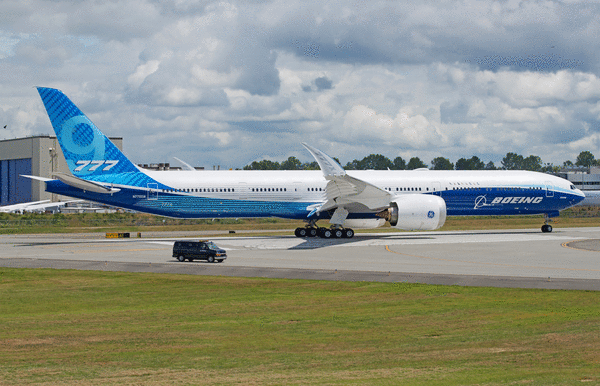
FARNBOROUGH, England — Boeing’s long-delayed 777X program faces another setback after one of its largest customers said it has concerns with the earliest-built planes.
Tim Clark, who runs Gulf carrier Emirates, said Tuesday the airline would not accept the first 10 777X planes slated for delivery due to the massive amount of repair work needed to incorporate design changes that have come up during the lengthy certification process.
The Federal Aviation Administration has still not certified the Everett-built 777X to carry passengers but Boeing leaders say the company is making progress. Boeing still expects first delivery in 2027, seven years later than originally intended.
Emirates has ordered more than 270 planes from the 777X family, which includes two passenger variants and a freighter. Emirates was one of the first carriers to place an order for the new widebodies.
Clark first told U.K.-based outlet The Telegraph that the airline would not take the early 777X planes, joking — somewhat — that those jets should instead be turned into baked bean tins. He reiterated that sentiment during a press briefing Tuesday at the Farnborough Airshow, the aerospace industry’s marquee trade event.
During the briefing, Clark opined that Boeing may have to write off those early jets, suggesting they may not be fit for delivery to any airline, adding another financial loss to the program. Boeing has already taken on nearly $15 billion in additional costs for the aircraft program, according to an estimate from analyst firm Agency Partners.
Still, Clark said he is confident in the 777X planes Boeing will build later.
Those will incorporate fixes for manufacturing concerns that have arisen during the certification process, including cracks in the engine’s thrust link and an engine durability issue that Boeing disclosed in January.
If the plane had been certified sooner, those problems would have come up in service, Clark said, “and we’d be having a conversation with them.”
He said Boeing’s new CEO Kelly Ortberg and new head of commercial airplanes Stephanie Pope, both appointed after a midair fuselage blowout in January 2024, have put the company back on track. As evidence, he pointed to the FAA’s decision to fully restore Boeing’s ability to self-certify its aircraft are safe to fly, an authority the regulator revoked after two fatal 737 Max crashes and manufacturing concerns with the 787 Dreamliner.
Boeing declined to comment on Clark’s remarks.
His comments come just after Boeing confirmed it had last year scrapped one of its early 777X planes. Speaking to reporters ahead of the airshow Sunday, Pope said Boeing was evaluating the work needed to bring all of its already-built 777X planes up to its latest design changes, a process called “change incorporation” that Boeing says is typical for new airplane programs.
As part of that, Boeing is “always looking at how much that change is going to cost and what will be the capability of the airplane and making sure we’re getting the right solution not only for Boeing but for our customer,” Pope said.
Boeing has about 30 777X planes already built and expects the change-incorporation work will take several years.
Emirates expects a 777-9 test plane will arrive in Dubai in September for additional engine durability testing, focused specifically on the hot, dry climate where the plane will operate, Clark said.
That additional testing has always been part of the plan, dating back to when the carrier first placed its 777X order, Clark added. Now, it’s a “final check” to be sure the aircraft “will do everything they say it will do.”
©2026 The Seattle Times. Visit seattletimes.com. Distributed by Tribune Content Agency, LLC.









Comments