Tennessee expects major payoff from Starbucks' Nashville office
Published in Business News
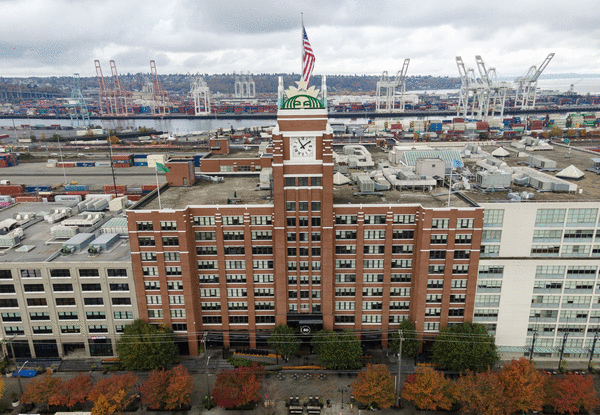
Just months after Starbucks announced plans for a 2,000-person office in Nashville, Tennessee, the city is already feeling the coffee giant's economic presence.
Real estate experts warned last month that Starbucks’ lease of an entire downtown Nashville building — the city's largest office lease since 2021 — will largely deplete the local supply of high-end office space and potentially delay the arrival of other big tenants, according to media reports.
It’s a problem brokers would be love to have in Seattle, Starbucks’ hometown, where more than a third of the office space is empty.
This is probably not the last time Seattle will look wistfully at what Starbucks is up to in Nashville.
Over the next five years, Starbucks has promised to bring around $250 million in annual salaries and $100 million in office leases, according to Tennessee’s economic and community development department.
The department also claims, as development agencies often do, that Starbucks' direct salaries will have a much larger impact via thousands of indirect and induced" jobs.
For many business leaders in and around Seattle, those projections reflect a major lost opportunity for Washington, and another sign of the failure by Seattle and Washington to make peace with the business community.
Critics say employers are increasingly looking out of state due to tax hikes and the antibusiness rhetoric of some politicians — especially in Seattle, whose new mayor, Katie Wilson, went viral for urging Seattleites to boycott Starbucks last fall. She later walked it back.
"These are the moments for our city leaders to be asking themselves why we’re losing jobs," said Jon Scholes, CEO of the Downtown Seattle Association, in a statement Thursday.
"The answers they’ll find are most likely grounded in the need for a more competitive operating environment, significantly better predictability and a tone or tenor that welcomes job creation,” Scholes added.
But Nashville's Starbucks windfall also offers a glimpse of the increasingly hardball competition among cities and states to land these big corporate offices.
In 2025, 164 public companies moved their headquarters, up from 96 in 2024, according to an analysis by commercial real estate firm CBRE. Of those, 69 were moves between states.
Nashville is one of several Sun Belt cities that have become magnets for relocations thanks to their "pro‑business environments, tax benefits, growing and diverse talent pools and supportive infrastructures," according to CBRE.
Tennessee is also fairly aggressive with the incentives. The state offered Starbucks $30 million in incentives for a commitment to bring jobs and investment, as part of a long-standing program that has reportedly paid out hundreds of millions dollars to woo hundreds of companies.
It's unclear how much Tennessee's $30 million sweetener mattered to Starbucks.
Starbucks has said repeatedly that Seattle “remains our North America and Global Support HQ.” The company says Nashville will serve as a regional base for a major retail expansion into parts of the country where it's not yet as popular.
The company has also cited Nashville's proximity to key suppliers and the presence of a skilled workforce — which also happens to come with a lower average wage than in Seattle.
But those strategic objectives, coupled with the sheer size of the Nashville office, whose eventual head count will be around two-thirds the size of Starbucks’ current headquarters in Seattle's Sodo neighborhood, puts the Tennessee expansion squarely within the rising trend in corporate relocations.
Companies pull up stakes for many reasons, but the second most common driver cited last year was to find a better “business climate,” which CBRE defined as lower living costs, bigger government incentives, and lower taxes.
By moving some of its operations to Tennessee, Starbucks will save tens of millions of dollars in Washington business taxes.
Nashville officials themselves say other factors, including the city's historic affordability and its Middle American culture, have been natural attractions to out-of-state executives and their workforce.
Many corporate executives who moved companies to Nashville say taxes and business climate played a role, but that a bigger "reason we're coming is because we see the future here, and by that we mean the future of the company and our own futures as well," said Bill Purcell, former mayor of the Metropolitan Government of Nashville and Davidson County.
Still, Tennessee officials weren't taking any chances.
They say lucrative incentive packages have long been part of the game, especially among the other Sun Belt states Tennessee is competing with for prizes like Starbucks.
Tennessee officials say Starbucks was looking at two other states before it selected Nashville. They wouldn’t disclose which other states, and Starbucks said it didn't "have anything to share" on the question.
But Starbucks insiders and members of the Seattle-area real estate community say the coffee company was considering locations in Texas.
And last year, the company was reportedly close to leasing an entire office building in downtown Bellevue, raising the possibility that the "other" state was Washington.
Assuming Starbucks delivers on its commitments — and the incentive agreement has “claw back” provisions requiring repayment if it doesn’t — state officials see the incentives as a great investment: for every dollar spent, Tennessee will get $15 in return.
Some Tennesseans aren't happy about the state's high-dollar recruitment, especially as the recruits add to congestion and affordability issues.
"In general, residents of (Nashville) would prefer to see investments made in local communities, in affordable housing and all the kind of local things that people value and less than trying to bring big corporations here," said John Geer, a professor of political science at Vanderbilt University in Nashville and co-director of the Vanderbilt Poll.
Some conservative Tennesseans, meanwhile, would rather the money not be spent at all, especially for a highly profitable company like Starbucks.
They think Tennessee's economy and business climate is already sufficiently attractive to companies and families from high-tax states.
The Nashville area already enjoys a net gain of around 24 households a month from Washington and around 100 from California, according an analysis by John Burns Research and Consulting.
“There’s no reason for the government to be in the job of incentivizing companies to come here with taxpayer dollars when we have an incredible climate for business and for families,” said Pamela Furr, with the Tennessee chapter Americans for Prosperity, a self-styled libertarian group that opposed the incentive, in an interview this week.
Some conservatives even worry that state-sponsored recruitment undermines the very fiscal restraint businesses actually value.
Columnist Cameron Smith recently argued in The (Nashville) Tennessean that booming low-tax states like Tennessee face a growing risk of "blue state" mistakes.
"Inevitably, politicians in those thriving states get arrogant," Smith writes. "They look at the swelling state coffers and decide it is time to build more government programs, pick winners and losers and micromanage the market."
And "when conservative politicians start acting like central planners," Smith warns, "the red state begins taking on a distinctly blue hue."
Back in Washington, meanwhile, Gov. Bob Ferguson is making what some might see as a red-state move.
His newly launched economic development council is heavily focused on attracting out-of-state businesses.
At a news conference last month introducing the council, Ferguson didn't offer up any tax cuts. But he did say he has had conversations about increased incentives for business recruitment in the next budget.
"I see what other states are offering," Ferguson said. "I'm confident that'll be something that's on the table.
©2026 The Seattle Times. Visit seattletimes.com. Distributed by Tribune Content Agency, LLC.








Comments