Zepbound craze fuels $1.3 billion windfall for religious causes
Published in Business News
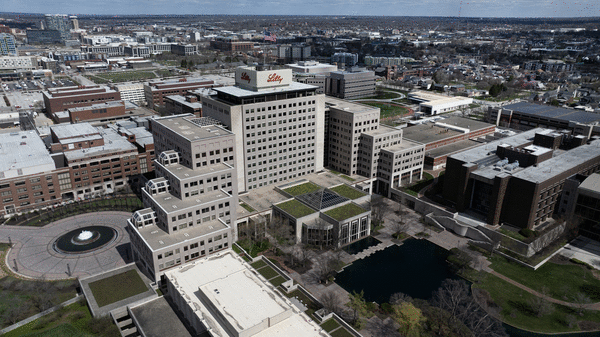
The blockbuster success of weight-loss drugs is fueling a wave of giving that’s boosting Christian ministries across the U.S. and Canada.
Eli Lilly & Co.’s largest shareholder, the independent Lilly Endowment, gave nearly $1.3 billion to religious causes in 2025, much of it specifically to Christian groups, according to its annual report released last week.
The donations have funded theological seminaries, religious displays in museums and an initiative meant to “tell compelling stories that portray the vibrancy and hope of Christian faith and life to inspire and help people from a wide variety of backgrounds to come to know and love God.”
Religious giving made up a third of the $3.85 billion the Lilly Endowment sent out the door in 2025, according to the report. Its other core focuses — education and community development — also exceeded $1 billion in gifts for the first time.
With a nearly 10% stake in the Zepbound creator, the endowment has been the biggest beneficiary of its 230% stock surge since the end of 2022.
It overtook the Gates Foundation as the country’s largest private foundation at the end of 2024 and became the first private foundation in the U.S. to cross $100 billion in assets last year. It finished 2025 with $105 billion and will have to deploy at least another $3.9 billion in 2026, according to its federal tax filing released in May.
FoundationMark CEO John Seitz, who tracks private foundation performance, said the endowment’s growth is “unprecedented.”
“To be the first to $100 billion is one thing,” he said. “To have growth and be 10x the size you were 10 years ago — they’re not rare, they’re unique in that.”
It’s unusual for a private foundation to give out more than $1 billion a year, Seitz said. Ford Foundation, the third largest in the country, gifted $840 million in 2024, according to its 2024 financial statement. Only the Gates Foundation surpasses the Lilly Endowment in money out the door, according to Seitz’s analysis of private foundation filings.
Religious Giving
The Lilly Endowment has kept a low profile despite its growing windfall. Started in 1937 from a stock gift by Lilly’s founding family, it has retained its original mission of investing in education, religion and the local community. It operates independently from the drugmaker, but its assets remain heavily concentrated in the company’s stock.
This has made the endowment a direct beneficiary of the weight-loss drug craze and forced it to ramp up spending to meet government-required distributions. Its giving has surged 385% since 2020 when it gave away more than $700 million. Last year’s $3.85 billion in disbursements was more than double the $1.5 billion deployed in 2023.
The majority of grants — 59% or $2.3 billion — were directed to groups based in Indiana, where the endowment is headquartered. Indiana Community Development Projects received $400 million to support a statewide community parks initiative and another $400 million went to Indiana Lifelong Learning Projects for a K-12 schools effort.
“Giving has kept up with asset growth as it needs to do, and they’ve been able to do with it without adding much in the way of staff or expenses, which is impressive,” Seitz said. “There aren’t that many foundations that give away $400 million, let alone to a single organization in a single year.”
Each gift would have represented nearly the all of the foundation’s giving in 2015, when the endowment donated a total of $450 million.
While the Lilly Endowment is ramping up its religious giving, overall donations to religious organizations were flat in 2025 when adjusting for inflation, according to a GivingUSA report released this week. It still remains the top category for philanthropy when taking into account other private sources of donations like individuals and corporations.
“With respect to religion specifically, a primary aim of our grantmaking is to deepen the religious lives of Christians in the United States, principally by supporting efforts that enhance the vitality of congregations,” Lilly Endowment spokesperson Judith Cebula said in an emailed statement, noting that it has supported a broad array of Christian traditions from Evangelical to Orthodox.
“However, we also work to foster public understanding about religion and seek to lift up the contributions that people of all religious faiths make to our greater civic well-being,” she added.
The Lilly Endowment has previously funded journalism initiatives to bolster reporting on religion, including in 2025. It spent nearly half a billion to fund theological schools across the U.S. and Canada last year. It also gave $235 million to groups as part of a national storytelling initiative around Christianity.
It’s also helping religion grapple with the rise of artificial intelligence. In December, the University of Notre Dame in Indiana announced it received a $50.8 million grant from the endowment to help develop a “faith-based ethical framework” around the use of AI.
©2026 Bloomberg L.P. Visit bloomberg.com. Distributed by Tribune Content Agency, LLC.








Comments