Jonathan Levin: Greenspan's stumbles hold lessons for Warsh's Fed
Published in Business News
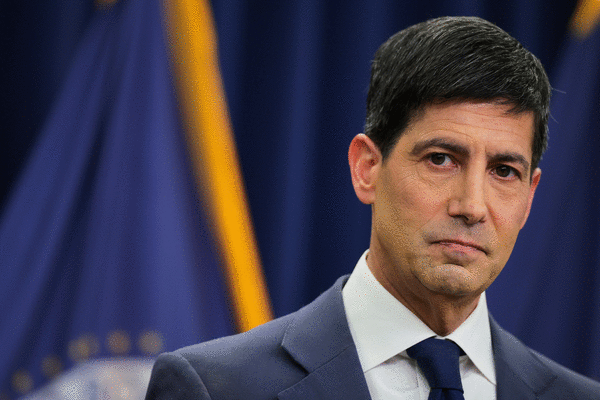
Alan Greenspan, the titan of global central banking who led the Federal Reserve during decades of prosperity, has died at 100, just when elements of his free-market philosophy are experiencing a renaissance.
Greenspan is best remembered by fans — including new Fed Chair Kevin Warsh — for his economic stewardship during a period known as the Great Moderation. Taking over after the inflation-plagued 1970s and early 1980s, Greenspan’s Fed delivered mostly stable prices, booming asset markets and steady economic growth. He came to be known as “the Maestro,” having gained a reputation for fine-tuning the economy during the technological changes of the internet era and keeping inflation relatively contained through it all.
Greenspan’s resume was burnished in the late 1990s, when he let the economy run a bit hotter than others might have preferred, betting that incipient productivity brought on by the spread of personal computers and the internet had increased the economy’s natural speed limit. He preserved his options and remained nimble by speaking to the public in a sort of coded mumbo jumbo that became known as “Fedspeak.”
Warsh, who inherits an economy adjusting to artificial intelligence, has evidently taken inspiration from both Greenspan’s call on productivity and his preference for keeping his cards close to his chest. The new Fed chair should be careful not to take the wrong lessons from Greenspan’s complex legacy.
First, the Great Moderation itself resulted not just from improved policymaking, but also from a good deal of economic and demographic luck, something Warsh can’t bet on today. In a world in which inflation psychology is largely self-fulfilling, Greenspan had the good fortune of inheriting the Fed chairmanship from the late Paul Volcker, who waged a brutal and politically challenging war on volatile prices. With a more benign backdrop already in place, Greenspan built on Volcker’s success by proactively raising interest rates in 1994, further locking in Fed credibility. He also benefited from low energy prices and disinflationary trends in healthcare through most of his tenure.
Even with all that, the financial crisis added a very large asterisk to Greenspan’s record. Although he retired in 2006, many observers now criticize his years of accommodative monetary policy and lax regulation for fostering the conditions that brought the financial system to its knees two years later.
Subsequent research has shown that periods of persistently loose monetary policy tend to incentivize the sort of excessive risk taking that we now associate with the real estate speculation of the 2000s. Discouraged by the low yields in safe assets, market participants go farther and farther out on the risk curve, using leverage to participate in hot and richly priced asset markets.
Asked why he didn’t do more to discourage irresponsible lending practices, Greenspan himself told the House Committee on Oversight and Government Reform in 2008 that he’d “found a flaw” in his minimal-regulation ideology and that he’d become “very distressed by that fact.”
It’s tempting to draw parallels between Greenspan’s good years and the age of AI, but there are also many, many differences. Warsh is taking the reins of the Fed after five years of above-target inflation — not exactly the virtuous cycle that Volcker created for Greenspan. The AI boom, at the moment, feels mostly like a demand shock that’s creating shortages and driving up prices for the components that go into data centers. The expected boost to productivity is still a medium-term story.
The world has also become a geopolitical tinderbox with two energy shocks in the past four years, very different from the Greenspan years during which the disinflationary forces of globalization built momentum. What’s more, the demographic tailwinds and global savings glut that kept interest rates and inflation low in recent decades may be shifting as Baby Boomers begin to spend down their ample retirement savings. As for medical care, the aging of the Boomers makes it a potential source of upward pressure on inflation, rather than the disinflationary force it was in the nineties. By no stretch of the imagination is this the Greenspan economy all over again.
As for communication, Warsh should be careful not to put the Fed’s transparency revolution in reverse. Policymaker opacity may preserve optionality, but it also runs the risk of exacerbating market volatility. Greenspan, with much luck on his side, managed to get away with that decades ago. Warsh is navigating a very different world — no matter the superficial similarities. The Maestro’s famous playbook may just add inflation and economic risk in the current environment.
____
This column reflects the personal views of the author and does not necessarily reflect the opinion of the editorial board or Bloomberg LP and its owners.
Jonathan Levin is a columnist focused on US markets and economics. Previously, he worked as a Bloomberg journalist in the US, Brazil and Mexico. He is a CFA charterholder.
©2026 Bloomberg L.P. Visit bloomberg.com/opinion. Distributed by Tribune Content Agency, LLC.






Comments