How Audi is navigating busy US ICE, EV and tariff morass
Published in Business News
SAN LUIS OBISPO, California — Audi is a canary in the coal mine.
The German luxury maker this week introduced the three-row Q7, the latest in a gas-fed, 2026 SUV assault on the U.S. market with three powerful new models including the entry-level Q3 subcompact SUV and a palatial, three-row flagship Q9, its first entry in the full-size segment.
The stampede of horsepower, however, masks the complicated international landscape that Audi, and other foreign brands, face as they navigate a U.S. market with low EV demand and high tariffs.
Its internal-combustion-engine push in the U.S. market comes after the luxury brand did a U-turn last year, reversing its goal to be all-electric by 2033. Citing a new mantra of “flexibility,” Audi now makes parallel ICE/EV lines in the United States — its second-largest foreign market — to be prepared for shifting consumer demand and government regulation. That’s in contrast to Audi’s largest foreign market, China, which is forcing manufacturers to sell EVs.
Further complicating its business model, none of Audi’s vehicles are made in the United States — unlike its chief German competitors, Mercedes and BMW, that decades ago moved production of volume models to the United States in response to 1980s import quotas. Audi’s sister, Volkswagen Group brand VW, manufactures in Chattanooga, Tennessee. Now, Audi’s lineup is exposed to significant tariffs in a repeat of late 20th-century protectionism.
“We will have a full portfolio of SUVs coming at the end of this year, and it starts with the Q3 entry point,” said Anthony Garbis, chief of production planning for Audi North America, at the SUV’s media test in California. “It'll go all the way to the flagship with the Q9.”
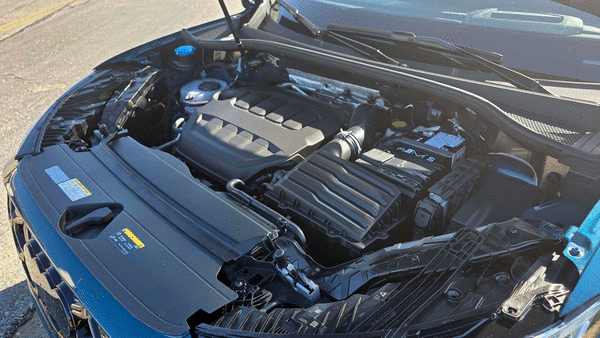
The Q3 also marks a major reinvestment in ICEs after Audi reversed its plans last year to develop only EVs. Debuting in showrooms in March, Q3 boasts an updated, 255-horsepower, 2.0-liter turbo-4-cylinder engine that gains 10% in power over the last-generation model.
Now comes the Q7, which defies the industry trend toward turbocharged, 4-cylinder engines in large SUVs with a standard 429-horse 2.9-liter V-6, while the SQ7 performance model ditches its V-6 for a mighty, all-new, 4.0-liter, twin-turbo V-8 making a beefy 591 horses.
It's pedal-to-the-metal on ICEs in the world's richest consumer market.
“Audi is launching ... a completely new line-up of internal combustion engine and plug-in hybrid vehicles, and that gives us complete flexibility for at least another seven, eight, maybe 10 years, and then we will see how our markets develop,” Audi CEO Gernot Döllner told Autocar last year. “We have already decided to extend the production beyond the communicated end dates of the past.”
Garbis said that Audi has a “well-rounded portfolio” of EV and ICE vehicles to cover all bases. The brand has fielded an electric e-tron model in volume segments: compact Q4 e-tron, compact Q6 e-tron SUVs, midsize A6 e-tron sedan, midsize Q8 e-tron SUV. The models mirror Q3, Q5, A6 and Q7 ICE models.
“For any of the German manufacturers, the U.S. market is going to be important, because we've got a huge chunk of wealthy people that can afford their products,” said Cox Automotive Senior Economist Charlie Chesbrough. “It's important for them to have a foothold in the U.S. market to tap into the trendsetters.”
However, Chesbrough said that as governments mandated EVs, German automakers now appear unprepared for the latest trend: gas-electric hybrids pushed by Japanese brands.
“That’s hurting all of the German manufacturers as the market's really shifting towards hybrids,” he said. Audi does not offer a gas-electric hybrid in its core Q3, Q5 and Q7 SUVs. “Toyota Prius-type (hybrid) vehicles are looking good (and) nearly all the other powertrain types are actually down. It's certainly damaging the Detroit Three by not having much to offer in traditional hybrids.”
Maintaining dual EV/ICE portfolios is expensive, especially as consumer demand has cooled. The Q8 e-tron has been dropped from Audi’s lineup as EV sales fell a whopping 90% in the first quarter of this year, according to Cox Automotive. That drop was coupled with a loss in EV market share from 2.1% to 0.3% as EV market giant Tesla proved resilient. Tesla gained 11 percentage points to 54.2% with a four-model EV lineup.
“The market is not accelerating like we thought,” said Garbis of the all-electric-by-2033 prediction.
Also expensive are tariffs: The Volkswagen Group as a whole was dealt a $1.38 billion tariff blow in 2025.
“Tariffs have impacted the Europeans probably more than anybody,” said Cox’s Chesbrough. “They’re in product segments that are really competitive, like luxury midsized SUVs that have a lot of players.”
Audi is particularly affected by its lack of U.S. manufacturing footprint. That means, for example, that the Europe-made Q3 is subject to over 25% tariffs while the Mexican-made Q5 is exposed to tariffs of more than 50%.
That’s in contrast to BMW and Mercedes. BMW has made products in Spartanburg, South Carolina, since 1992, including volume SUV sellers X3, X5, X6 and X7. Mercedes has assembled vehicles in its Tuscaloosa, Alabama, facility since 1997, including the GLE, GLE Coupe and GLS SUVs, Maybach GLS SUV and electric EQE and EQS.
“I just don't see a huge change in year-over-year (pricing) for Audi,” said Chesbrough. So “tariffs are not being passed along to the consumer.”
The German titans lost EV market share to Cadillac, which is chasing Tesla (and upstart U.S. EV brand Rivian) as an all-electric maker. Cadillac upped its share in the stalled EV market to 4.4% from 2.7% in the first quarter.
Audi sees opportunity in higher-volume ICE segments that Cadillac has abandoned. For example, the Q3 targets over 30,000-unit sales a year in the subcompact luxury segment and 20,000 sales with the three-row Q7. Cadillac left both segments with its ICE XT4 and XT6 models, respectively, last year.
“The Q3 is a better value than its BMW and Mercedes competitors and is a very powerful car: 255 horsepower and runs 0-60 in five-and-a-half seconds,” said Garbis. “Twenty years ago, that’s sports car territory.”
Like its Volkswagen Group peer, Porsche, Audi's growth plans in China have fallen short.
Sales slumped 5% in 2025. Audi has tried to win back customers with a new sister brand co-developed with state-owned Chinese carmaker SAIC. The all-electric E5 Sportback, which scrubs Audi’s famed four rings logo, fell short of expectations.
"We will have to find different answers across regions," said Audi CEO Döllner.
Cue ICE investment in the U.S. market, where Audi's lineup is not only gaining more gas power — but digital infotainment tech that debuted in the e-tron line.
“We call it the Audi digital stage. We brought that in with the Q6 e-tron and A6 e-tron,” said Garbis. “We have it on the (ICE) Q5 SUV for all the new cars. We brought that technology from the upper segment into our entry level segment, (so) you have this wonderful, panoramic display from the instrument cluster to your center screen, all behind the solid glass panel.”
©2026 www.detroitnews.com. Visit at detroitnews.com. Distributed by Tribune Content Agency, LLC.









Comments