FAA approves Boeing's next Max production increase, CEO Ortberg says
Published in Business News
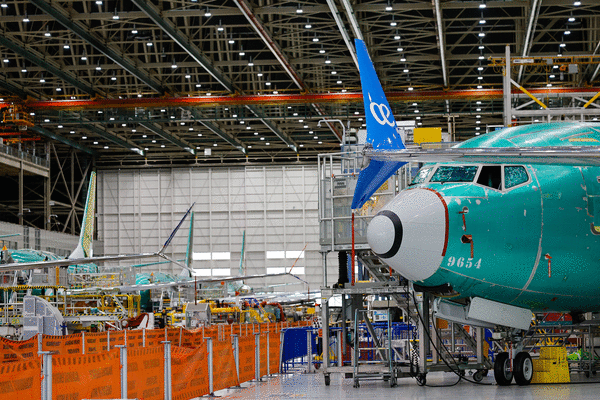
Boeing has hit another regulatory milestone in its effort to increase Max production, paving the way to build 47 planes per month this summer, CEO Kelly Ortberg said Wednesday.
Boeing recently completed its “capstone review” with the Federal Aviation Administration for the next rate increase, Ortberg said, and will now work to stabilize its production lines at that cadence over the next few months.
Before starting the final FAA review, Boeing tested its system at a rate of 47 planes per month, so the company is “highly confident” it will be successful, Ortberg said at a Bernstein’s financial conference Wednesday.
Though it will take a few months to consistently churn out 47 planes, Ortberg said “We’re off and rolling now.”
A spokesperson for the FAA said Wednesday the regulator supports Boeing's production rate increase."
"FAA safety inspectors conducted extensive reviews of Boeing’s production lines to ensure this production rate increase will be done safely," the spokesperson said.
The production bump marks the second rate increase since the FAA placed a cap on monthly Max production after a nearly catastrophic mid-air panel blowout in January 2024.
The FAA limited Boeing’s Max production to 38 planes per month in an effort to ensure Boeing focused on safety and quality over speed.
The FAA lifted that cap in October 2025, allowing Boeing to produce at a rate of 42 Max planes per month. Ortberg has maintained since then that Boeing will continue to increase production in increments of five, with about six months between each rate hike. Ortberg told investors in April during the company’s first-quarter earnings call that Boeing expected to move to rate 47 this summer.
On Wednesday he said Boeing will one day reach a rate of 63 Max planes per month, though he did not offer a timeline to hit that goal.
Boeing briefly reached a rate of more than 50 Max planes per month before two fatal crashes in 2018 and 2019 grounded the plane for nearly two years. The manufacturer was rebuilding its production cadence when the panel blowout in 2024 slowed it again.
This time, as Boeing moves into future rate increases, it will tap into a fourth Max production line in Everett, known as the North Line. That line has been in the works since 2023, but Boeing says it will be up and running this summer at a low rate of production.
Ortberg has said many times that Boeing needs the North Line to reach higher rates of Max production, but on Wednesday he acknowledged that the fourth line would help the company maintain the new manufacturing processes outlined after the panel blowout in 2024.
It cannot reach a rate of 57 planes per month in the Renton facility, something the company had at one point hoped to do, “with our current safety and quality processes,” Ortberg said.
“That’s why we brought that additional line on,” he said. “It gives us flexibility. If we have one [line] that has a problem, we can use the others to help offset what the problem line is dealing with.
Boeing’s China order
Doug Harned, an analyst with Bernstein's who interviewed Ortberg on Wednesday, asked how the CEO would respond to investors still worried about “the problems of the past?”
The only way, Ortberg said, is execution. He pointed to positive feedback from customers on Boeing’s transparency and the quality of its product, while acknowledging that it is still lagging on certification for new plane models.
But most of all, he said, Boeing’s customers want its planes. “The thing that the Boeing company has is a huge backlog,” Ortberg said.
At the end of April, the most recent count from Boeing, the company had more than 6,200 commercial planes in its backlog. New customers ordering a 737 Max or 787 Dreamliner wouldn’t get those planes until the 2030s, Ortberg said.
Adding to that momentum, China this month agreed to purchase 200 Boeing planes, the country’s first Boeing order in nearly a decade. The agreement, which Boeing and China reached during President Donald Trump’s visit to Beijing, was far smaller than rumors circulating before the visit. Those reports projected China might order 500 737 Max planes as well as 100 widebody aircraft, including the 787 and the yet-to-be-certified 777X.
Ortberg did not say on Wednesday which planes China had agreed to order. The official orders will come later in the year as Boeing works with individual airlines in China to iron out the specifics.
But, he continued, the trip was “super-successful.”
“My primary objective was to reopen that market to our narrowbody airplanes … and we accomplished that,” Ortberg said.
“I think people focused a little bit too much on the initial quantity,” he continued. The order is “a good start.”
©2026 The Seattle Times. Visit seattletimes.com. Distributed by Tribune Content Agency, LLC.




Comments