Boeing-maintained plane flaw found 10 other times, NTSB finds
Published in Business News
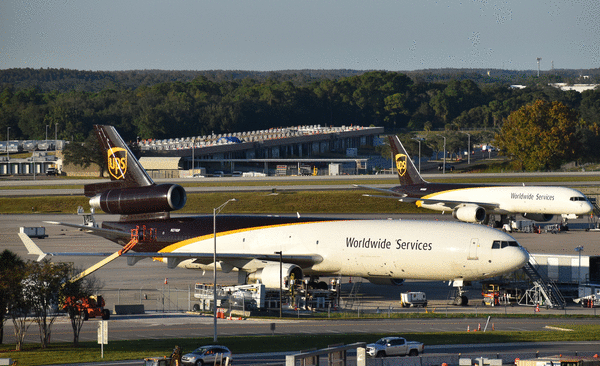
WASHINGTON — The airplane part that cracked and caused a UPS cargo jet's engine to fly off the plane’s wing had fractured 10 times in the past, aviation accident investigators said Tuesday.
After the fatal crash in November, UPS’ inspection of its remaining MD-11 fleet found another three instances of the same part shifting out of place, indicating it may have fractured or cracked in some way, or be at risk of breaking.
UPS retired its MD-11 fleet after the fatal crash, accelerating its plan to phase out the aging plane for newer, more fuel-efficient models. But the findings revealed Tuesday raise concerns about why those broken parts weren't identified sooner, National Transportation Safety Board member John DeLeeuw said Tuesday during the first day of NTSB's investigative hearing into the fatal UPS crash.
The unfortunate accident happened but we had three aircraft that were potentially in the same situation," DeLeeuw said, lobbing pointed questions at UPS about what changes the carrier would make to ensure a similar situation won't occur again.
Of the earlier-reported fractures, DeLeeuw said, "We had something there, we just didn't do anything about it."
UPS shifted blame to Boeing, which has been responsible for the MD-11's maintenance and inspection protocol since it inherited the plane when it merged with McDonnell Douglas in 1997. Boeing had told operators that previous failures of the piece did not pose a safety risk.
"The way our processes are set up, we're reliant on the data that's out there and what kind of determination" Boeing has made on the safety risk, UPS' Senior Director of Engineering David Springer said. If UPS had known more, as it does now, "we would have asked a lot more questions.
The findings of previous failures and new concerns in post-accident investigations indicate that damage to the part may have been more widespread throughout the MD-11 fleet than previously disclosed. The part, known as a spherical bearing race, is part of the hardware that attaches the plane’s pylon to its wing. The pylon, in turn, holds the plane’s engines.
In November, shortly after the UPS MD-11 cargo plane took off from Louisville, Ky., on its way to Honolulu, the plane’s left side engine and pylon flew off the wing and over the top of the fuselage. Fires ignited on both pieces, which then crashed into nearby buildings. The crash killed three UPS crew members on board and 12 people on the ground and injured more than 20 people.
The two-day NTSB hearing should provide more clarity on some of the questions that remain: Why did the cracking progress to the point of fracturing? And why didn’t the aviation industry’s protocols catch the damaged part before it turned deadly?
NTSB experts on Tuesday directed those questions at a range of parties: UPS; a vendor UPS hires to maintain the MD-11, ST Engineering — San Antonio Aerospace; Boeing; and the Federal Aviation Administration, which has oversight over aircraft manufacturers and operators.
The NTSB will continue its investigation after the hearing, before submitting a final accident report that outlines a probable cause for the MD-11 crash and recommendations for the future.
Of the 10 reported fractures that the NTSB identified, four were reported to the FAA through what's known as a service disruption report. It's not clear why the other reports did not result in a similar notification, Brian Knaup, a manager for the FAA’s continued operational safety branch, said during NTSB questioning Tuesday.
To put it into context, Knaup said Boeing aircraft are involved in more than 20,000 service disruptions every year. A report of smoke in the cockpit, which occurs about 100 times a year, would trigger the FAA to analyze the trend. But four instances over 14 years would not, Knaup said.
Boeing analyzed two reports of fractures in the bearing race from operators in 2007 and 2008 and found no safety risk, according to the NTSB. It issued a letter to operators in 2008, outlining a new inspection of the area, and revised that letter in 2011 to include a new design for the part. Operators were not prohibited from continuing to use the original design, according to the NTSB.
UPS reviewed those service letters and determined further action wasn't warranted, the NTSB said in its opening presentation Tuesday.
Responding to questions from NTSB experts later in the day, UPS’ Springer said he believed UPS’ inspection program for the MD-11 prior to the November crash was adequate because it followed Boeing's planning document.
Neither UPS’ program nor Boeing’s planning document would have required the bearing race to be replaced over the course of normal inspections, Springer said. “It would have flown to failure.”
The part that failed
The NTSB quickly identified that the spherical bearing race and two surrounding lugs had fractured from fatigue cracks and overstress failures, narrowing the scope of the NTSB’s investigation into what led to the engine and pylon flying off.
The crash killed three UPS crew members — Capt. Richard Wartenberg, First Officer Lee Truitt, and Capt. Dana Diamond — and 12 people who were at nearby warehouses.
In a presentation Tuesday, the NTSB explained how the MD-11 pylon attachment is meant to work — and where it broke down.
Two of the MD-11’s three engines are attached to the underside of a pylon, which then attach to the underside of the left and right wings. The third engine is attached to the vertical stabilizer near the airplane’s tail.
The pylon frame is connected to the wing at three separate points: a forward mount, an aft mount and a thrust fitting that transmits thrust loads.
The aft mount, the part of the pylon attachment that failed in the UPS crash, has two triangular plates bolted together, with two lugs at the top holding the structure to another part called a wing clevis.
The spherical bearing is housed within those two lugs and includes a ball that is housed within an outer race. The ball rotates within the outer race in order to reduce stress on the overall structure as thrust load and other forces fluctuate during the plane’s operation.
In the UPS MD-11 that crashed, the outer race of the spherical bearing showed fatigue cracking in several locations, the NTSB said. Eventually, those cracks caused the bearing to split into two pieces.
That left loads unevenly distributed across the two lugs, one in front of the assembly and one in back. Those lugs eventually cracked.
The aft mount of the pylon, one of the three points connecting the pylon to the wing, failed. The remaining connecting points followed, causing the engine and pylon to fly off.
©2026 The Seattle Times. Visit seattletimes.com. Distributed by Tribune Content Agency, LLC.








Comments