Inside Merck's lobbying of PA Gov. Josh Shapiro's office on pollution rules
Published in Business News

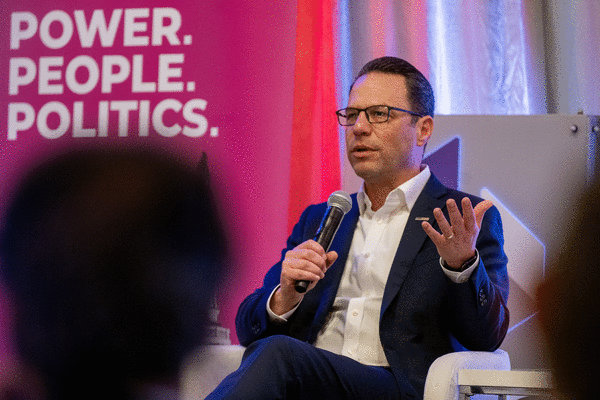



Shortly after Pennsylvania Gov. Josh Shapiro took office in 2023, pharmaceutical giant Merck & Co. sensed a new opportunity.
For several years after a costly chemical spill in Montgomery County, Merck had tried unsuccessfully to persuade lawmakers and other state government officials to ease what the company saw as overly burdensome water pollution reporting rules.
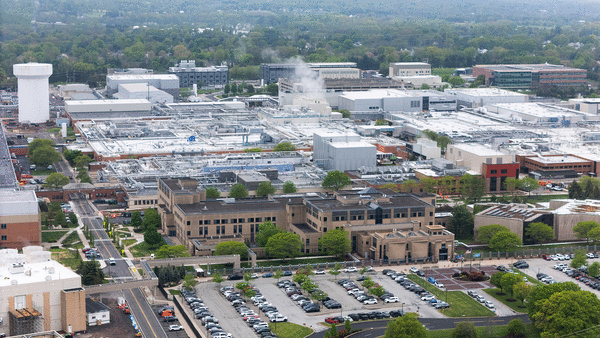
Then Shapiro promised to make Pennsylvania more business-friendly, and Merck — which employs 7,000 workers at its West Point plant — suddenly found a more receptive audience in Harrisburg.
“We would welcome the opportunity to talk about this issue in more detail with you and the appropriate people from the administration,” a Merck lobbyist wrote in an April 2023 email to Benjamin Kirshner, Pennsylvania’s inaugural chief transformation and opportunity officer, who reports directly to the governor.
At issue is Pennsylvania’s Clean Streams Law, which says it is unlawful to discharge substances resulting in pollution of streams, rivers, wetlands, and other waters.
Within months, Shapiro’s office directed the state Department of Environmental Protection to draft less stringent spill reporting rules on a “very expedited timeline” that did not adhere to the “usual process,” according to emails reviewed by The Inquirer. In turn, Merck representatives expressed gratitude. Administration officials said they followed proper procedures.
Soon after, in December, Merck reported a minor industrial waste spill at its West Point facility, and a DEP inspector found that the company had violated the law by failing to prevent pollution.
As governor, Shapiro, a Democrat who is seeking reelection in November and who’s widely seen as a potential White House contender in 2028, has built his agenda around “getting s— done” — cutting red tape to make Pennsylvania more competitive in courting businesses, for example. Shapiro often frames it as making government work for regular people.
The emails between Merck and the Shapiro administration show how that governing instinct has also meant an openness to lobbying from one of the biggest pharmaceutical companies in the world on an issue that affects public health and the environment.
That close collaboration with Merck — the largest employer in Shapiro’s home county — could raise questions in a 2028 presidential campaign from those in the Democratic Party who say big corporations have too much sway over public officials.
“I was really shocked that people in power were that willing to just give up our right to clean water — for nothing, for no good reason,” said Emma Bast, a senior attorney at environmental advocacy group PennFuture.
Merck contends that regulators have failed to define pollution under the Clean Streams Law, making it hard to know which spills must be reported.
The Shapiro administration says it aimed to address that by proposing new reporting standards, which critics warned would result in more spills going unreported.
Like many big companies subject to government regulation, Merck lobbies public officials for policies that promote their interests and donates to candidates from both parties.
Merck executives and other employees gave $2.4 million to federal parties and committees in 2024, according to OpenSecrets, a nonprofit that tracks money in politics. That included $287,000 to Democratic presidential nominee Kamala Harris.
They contributed about $16,500 to Shapiro’s campaign in 2022, records show. Shapiro aides said they aren’t influenced by campaign donations.
Following a yearslong regulatory process and significant pushback from environmental groups, water utilities, and members of the public — some of whom cited Merck’s history of advocacy on the issue — the Shapiro administration shifted gears.
Instead of moving forward with the relaxed spill reporting regulations, DEP last month discarded that proposal and instead said it would issue nonbinding guidance in an effort to provide clarity to industry and the public.
Environmentalists at the Sierra Club claimed victory but said they’d remain vigilant “to make sure there are no giveaways to industry” in the guidelines.
Administration officials said Merck is just one of hundreds of companies the state has tried to help amid Shapiro’s bid to make Pennsylvania more attractive to the business community.
Shapiro’s supporters say his pro-business approach was sorely needed in a state that often lost out on private investment as a result of excessive regulations, as when Pittsburgh-based U.S. Steel in 2022 announced plans for a $3 billion mill in Arkansas.
Kirshner says Merck had made a “compelling” case that Pennsylvania’s spill reporting rules could be clarified without sacrificing environmental protections. But when regulators solicited feedback, the public disagreed — of the nearly 1,200 comments submitted, just 11 approved of the idea.
“The public spoke loudly and clearly and we listened, and I think that’s how it should work,” said Jacob Finkel, Shapiro’s deputy secretary of policy and planning.
Rahway, N.J.-based Merck — which reported $64 billion in global sales in 2024, the third most among all drugmakers — said it “routinely engages with policymakers, along with many other companies and industry groups, on issues that affect our ability to operate responsibly and compliantly.”
“That engagement is conducted transparently and in accordance with all applicable laws, and Merck supports clear, science-based environmental regulations that protect people and the environment,” the company said in a statement.
State Rep. Greg Vitali, D-Delaware, chair of the House Environmental & Natural Resource Protection Committee, questioned how the Shapiro administration handled the matter.
“The purpose of the Department of Environmental Protection,” he said, “is to protect public health and the environment. It’s not a business development tool.”
A $20 million spill in 2006
Pennsylvania’s water pollution rules have been a source of frustration for Merck since at least the mid-2000s, when the drugmaker had a chemical spill at its West Point facility and had to pay millions of dollars as part of a civil settlement with the U.S. Justice Department.
At that 400-acre campus, Merck makes vaccines against diseases including hepatitis B and measles, mumps, and rubella.
The June 2006 spill occurred in a vaccine lab, where a chemical, potassium thiocyanate, flowed into a sewage treatment plant. The chemical, which is used to make vaccines and medicines, reacted with chlorine at the treatment plant and became more toxic to fish.
As a result, about 1,000 fish died, two of Philadelphia’s drinking water intakes on the Schuylkill were temporarily closed, and recreation along the Wissahickon Creek was canceled for almost a month.
Merck later agreed to spend $20 million on fines, plant improvements, and environmental projects.
The company took a week to discover and report the spill. DEP said at the time that Merck “repeatedly delayed or impeded” a state probe, a characterization the drugmaker disputed.
After the incident, DEP “came to Merck and said, ‘You have to report everything, even one molecule,’” Stephen Tarnowski, a Merck lawyer, told lawmakers during a 2020 Pennsylvania House hearing. “We said, ‘That’s impossible.’”
Environmental advocates say Pennsylvania’s Clean Streams Law, first enacted in 1937, is integral to ensuring residents’ state constitutional right to pure water and a healthy environment.
State regulations recognize that some pollution is acceptable, such as certain discharges from a factory pipe, and that systems can generally handle it as long as the water is adequately treated. Such spills are authorized by permits.
Other spills are considered “unauthorized” — like those involving toxic substances that are dangerous even in small quantities, or which otherwise occur outside the terms of a permit.
Under current regulations, a spill must be reported immediately if it would “endanger downstream users” or threaten pollution. Spills can sometimes result in penalties, but experts say DEP’s primary objective is to clean up any hazardous materials and protect public health and the environment.
DEP says it receives several hundred reports a year. Asked whether that imposes an administrative burden on the department, a DEP spokesperson said staff time “is most effectively spent responding to actionable violations and spills that could impact public health and safety.”
Bast, of PennFuture, said the purpose of existing spill reporting rules is that “you want to know what you’re drinking in, and you want to know what you’re playing in.”
“You want to know if your dog or your child is safe to go wading in the creek,” she said.
Merck has pushed the state to adopt standards establishing thresholds that trigger reporting — the amount of a given chemical that, when spilled, could result in pollution. That would allow companies to forgo reporting smaller spills that don’t meet the threshold.
Clean water advocates say such information is insufficient to rule out the possibility that a spill could cause harm.
Merck has spent $825,000 lobbying Pennsylvania government officials since 2016, records show. But on this issue, the company failed to gain traction — for a time.
Merck lawyer Tarnowski told lawmakers at the 2020 hearing that the company had been “thwarted” by regulators, and in another instance, a judge “basically punted.”
“That frustration led to a legislative effort,” he said, in which Merck tried to “explain our issue and ask for help with … having (DEP) define what really is a spill.”
But multiple pieces of legislation backed by Merck failed to pass the state legislature. In a 2021 statement, the Wolf administration said one such bill “makes it easier to pollute our waters by eliminating critical safeguards in the Clean Streams Law.”
‘Get s— done’
By 2023, the political environment in Harrisburg had begun to change.
A few months after Shapiro took office, Merck’s lobbyist contacted Kirshner, a digital marketing entrepreneur whom the governor recruited to serve as the administration’s de facto “business czar.”
“I told Ben that I thought we needed a point person for folks who wanted to do business with the Commonwealth — one office they could come to to get answers, cut through the red tape, get a deal done,” Shapiro told Philadelphia Magazine in 2024.
“What Ben brought is a private-sector, fast-paced mentality to the government — that aggressive mentality, our GSD approach to governing, our get-shit-done approach,” Shapiro said.
For Merck, that openness to private-sector input stood in contrast to its experience with previous administrations.
The DEP “has been historically resistant to meet with us,” Domenick Argento, a Merck lobbyist, wrote in an April 2023 email to Kirshner.
In Harrisburg, Merck-backed legislation had been dubbed “the Merck bill” by former DEP Secretary Patrick McDonnell, an appointee of Democratic Gov. Tom Wolf, Argento’s email said.
But the lobbyist said he noticed DEP had recently released a plan to speed up the permitting process — and suggested the spill reporting policy could use a similar revamp.
Merck wanted reporting standards that were “clear and easy for businesses to follow,” Argento said, adding that five of the six states in the Chesapeake Bay watershed had already adopted such rules. “The only watershed state that does not have such standards is Pennsylvania!”
PennFuture’s Bast said Pennsylvania has more streams than most states. “The sheer volume of surface waters that have to be managed in Pennsylvania, and the variance of them, really kind of eclipses everyone else,” she said.
The email between Argento and Kirshner, like others mentioned in this article, was obtained by PennFuture through a Right-to-Know request and shared with The Inquirer at the news organization’s request. The email was produced by the Shapiro administration alongside several redacted documents. Open records officers told PennFuture that some documents were withheld to preserve the confidentiality of deliberations and to protect attorney-client privilege, among other reasons.
That June, Merck officials discussed the matter with Kirshner and other Shapiro aides. “Thank you all for the time on Friday to talk about the spill reporting issue. The merck [sic] team felt like we made great progress,” Argento wrote in an email.
In reply, Shapiro aide Finkel said he agreed “it was a very helpful and productive conversation.”
By August, DEP was busy writing new rules. “The Governor’s Office has directed DEP to draft this proposed rulemaking on a very expedited timeline, so it has not followed the usual process for development of a rulemaking,” Brian Chalfant, DEP’s deputy policy director for water, wrote to colleagues.
In an interview, Finkel said that email referred to a 30-year-old executive order that effectively says regulators should give the public six months’ advance notice of a newly proposed regulation. “When something is fairly urgent, it doesn’t always make sense to sit on your hands for six months,” he said, adding that the administration followed procedures “by the book.”
Merck representatives expressed their support for the proposal. “Merck appreciates the department moving forward with the regulatory package,” Merck outside counsel Kenneth Warren wrote in an October 2023 email to DEP staff.
That December, Merck’s West Point facility reported to DEP that 80 gallons of a hazardous material spilled from a rooftop storm drain into a stormwater detention basin.
A DEP inspector cited Merck for violations of the Clean Streams Law.
“This incident will most likely become part of the discussions with Merck on incidents and reporting in the future,” Thomas Magge, environmental program manager at DEP’s Bureau of Clean Water, wrote in a December email to colleagues in the department.
DEP did not issue any penalties because there were no impacts to the nearby creek, and the spill was “promptly cleaned up” by a contractor, said spokesperson Neil Shader.
Kirshner, who runs Pennsylvania’s Office of Transformation and Opportunity, said he’s tried to change perceptions in the business community that state government before Shapiro’s administration had been “too slow on permits” and “hard to reach.”
He said his door is open to anyone “from the local conservation district to the person building one home all the way up to Fortune 500 companies.”
Since the office was formed in 2023, it has helped 600 businesses by solving permitting issues and other challenges, Kirshner said. And the Shapiro administration has closed more economic development deals in the past three years — totaling $40 billion in planned investment — than Pennsylvania saw in the previous 15 years combined, he said.
“The business community appreciates that they have an open door to the governor,” he said. “... We’re definitely not, you know, fixing everything that people want fixed, but we’re listening.”
Kirshner said he didn’t brief Shapiro on the Merck issue. The administration declined to make the governor available for an interview. Shapiro spokesperson Rosie Lapowsky said the administration “has worked to cut unnecessary red tape and deliver results while continuing to protect Pennsylvanians’ health and safety.”
‘Driving force’
When PennFuture’s Bast got wind of the proposal, she remembered the legislation that had failed years earlier.
“We knew what the threat was and we knew where it was coming from,” Bast said, “because we had seen this before.”
At the time, DEP said the proposed regulation was “intended to provide clarity as to which” spills require immediate notification to the state.
It incorporated a federal Environmental Protection Agency list of hazardous substances that, if released in certain quantities, must be reported. If a given chemical is not on that list, the proposal said, those responsible for a spill must consider a dozen factors — such as weather conditions, depth to groundwater, and the substance’s persistence in the environment — to determine whether to notify DEP.
Finkel, the Shapiro aide, said one aim was to focus DEP’s limited resources on “the really pernicious spills” — not, for example, a Diet Coke spilled in a parking lot.
Critics said this shifted the responsibility to determine whether a spill could cause harm from the government — a neutral party that’s supposed to serve the public good — to the polluter. Environmentalists said this would allow companies to delay notification or hide spills altogether, potentially endangering downstream users.
They noted that just a couple years earlier, DEP in 2021 had rejected the use of “reportable quantities” standards.
Back then, during Wolf’s administration, DEP wrote in draft guidance to regulated industry that basing notification requirements on substance-specific quantities “does not take into account the other factors which can affect the level of risk associated with spills,” such as proximity to surface waters and the size of such waters.
As an example, DEP said it doesn’t expect people to call the state if they spill a drop of milk on their paved driveway. However, if “thousands of gallons of milk” spill directly into a small stream, that should be reported, regulators said.
In November 2024, DEP recommended that the state Environmental Quality Board adopt the proposal — a key step in the rulemaking process.
Shortly thereafter, PennFuture — whose president is McDonnell, the former DEP secretary — filed a request under Pennsylvania’s Right-to-Know Law seeking the Shapiro administration’s communications with Merck.
When regulators started accepting public comments a few months later, PennFuture included in its submission one of the emails it had obtained from the state.
“It is beyond doubt that Merck is a driving force behind this proposed regulation,” Bast wrote in the June 2025 filing.
Environmental groups like the Sierra Club rallied their members to weigh in.
“It’s not hard to see why (Merck) would want weaker regulations, but it is incomprehensible as to why the Shapiro administration would be willing to jeopardize public health and drinking water supplies to accommodate the demands of Big Pharma,” wrote Jen Quinn, legislative and political director at the Sierra Club’s Pennsylvania chapter.
Environmental advocates say the real problem is the underreporting of spills, like the Energy Transfer pipeline jet fuel leak in Bucks County that was discovered by state DEP investigators in January 2025. Federal regulators have said a “slow drip” went undetected for at least 16 months.
Other interest groups raised concerns, too. A trade group representing water utilities said the proposal would encourage “more spills to go unreported.”
Municipal authorities asked about potential liability associated with reporting delays if a spill was later determined to have caused harm.
Business groups generally responded favorably. A trade group representing life sciences companies, including drugmakers, said the proposal “better informs the regulated community and the public of which spills must be reported.”
But even the American Petroleum Institute’s Pennsylvania chapter — a trade group representing the oil and gas industry — said that while it supports the idea of using federal standards, the proposal’s “extensive conditions are at times subjective, lack clarity and specificity, and require overly complicated assessments.”
DEP in April said it was dropping the regulation, citing “the competing perspectives from a diverse group of commentators.”
The department said it will instead issue guidance on when to report spills — which is not binding or enforceable — to provide “increased clarity” on the issue.
To PennFuture’s Bast, the lack of widespread support for the proposal was telling.
“This was not a broad industry push to address a real need,” Bast said. “This was literally just one company.”
©2026 The Philadelphia Inquirer, LLC. Visit at inquirer.com. Distributed by Tribune Content Agency, LLC.







Comments