An AI bubble? Not so, says this leading money manager
Published in Business News
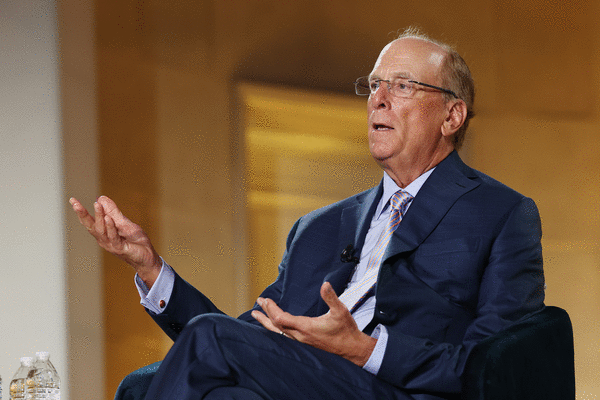
The world’s largest asset manager dismissed worries of an AI bubble and instead said that the industry is providing unrivaled opportunities to investors, in remarks Tuesday at the Milken Institute Global Conference.
Larry Fink, chairman and chief executive of BlackRock, said that despite concerns that AI is being hyped, there is legitimate need for trillions in investment for energy, chips and hardware.
“We have supply shortages. Demand is growing much faster than anyone has ever anticipated, and this is just a U.S. phenomenon. We have not begun the whole concept of exploring the opportunities of AI around the world,” said Fink, during a panel discussion at the annual Beverly Hills conference hosted by financier Michael Milken’s think tank.
Fink said that his New York company, with more than $14 trillion under management, has deep investments in hyperscalers — companies such as Google and Amazon that operate massive data centers — that will pay off.
“It’s a great return for a pension fund, for a 401(k) for a sovereign wealth fund, for an insurance company. Much of it is going to be financed by debt, and that’s going to be a big role of private credit in financing of this build out of America,” he said.
Fink was joined on the panel by Bruce Flatt, chief executive of Brookfield Corp., an alternative asset manager based in Toronto that host Michael Milken described as the world’s largest clean energy investor.
Flatt compared AI to other historic economic disruptions.
“We will be rewiring the global economy to lay the networks that we laid before, which were highways, utilities, railways. And now we’re laying cloud, artificial intelligence, factories and data centers — that’s what’s happening,” he said.
The two asset managers and Milken also highlighted how the AI investments would be played out over decades, providing a big payoff for investors willing to wait for compounded returns.
The idea of long-term investments providing secure and large returns — as well as minimizing the country’s growing wealth gap — also was the subject of a Monday panel featuring White House economic chief Kevin Hassett.
He was joined by Republican Sen. Ted Cruz and tech investor Brad Gerstner, the chief promoter of Cruz-authored legislation signed into law last year creating so-called“Trump accounts” for newborns.
“The battle over wealth taxes is deeply connected to this, because this is a battle for the soul of America,” Gerstner said. “ You can’t leave 70% of the people out of the upside of compounding and capital, and to think we’re going to get anything different.”
The pilot program establishes investment accounts seeded with $1,000 in federal money for babies born between Dec. 31, 2024, and Jan. 1, 2029. Parents and others can deposit $5,000 annually until the child turns 18, when it converts into a traditional IRA.
“If you want to see something grow up into an enormous amount of money, then, you know, that’s the way to do it,” said Hassett, director of the White House’s National Economic Council.
The program has been criticized by some for not assisting newborns when they are young and most vulnerable, while potentially exacerbating the wealth gap since higher-income parents would be most able to make contributions.
Also speaking Monday was another Trump administration official, Paul Atkins, chairman of the Securities and Exchange Commission, which is proposing allowing public companies, to make semiannual, instead of quarterly, reports.
He laid out the administration’s agenda for regulating Wall Street, including the streamlining of financial disclosures, allowing companies with mandatory arbitration clauses in their corporate bylaws to go public and ending the “weaponization of corporate governance” through shareholder proposals.
“That sort of thing to get away from special interest groups having an ax to grind then and then, abusing the corporate governance process for their ends,” he said.
The SEC’s proposals to limit such proposals have been criticized as a way to silence shareholders voices on environmental, social and governance issues, including diversity, equity and inclusion.
©2026 Los Angeles Times. Visit at latimes.com. Distributed by Tribune Content Agency, LLC.







Comments