UnitedHealthcare's mission control targets customer woes to build its brand
Published in Business News
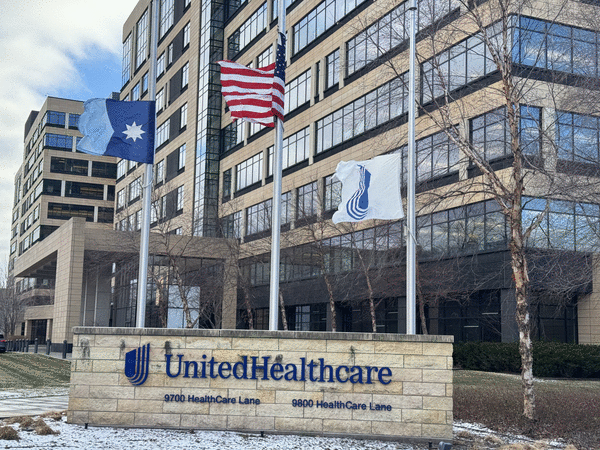
Mike Baker often calls up a dashboard on his computer and sees nothing but green gauges: No big customer service problems evident.
Then the chief operating officer walks down the hall at UnitedHealthcare’s Minnetonka, Minnesota, headquarters and finds all sorts of red: trouble spots highlighted on a wall of screens wider than two cars and taller than a basketball hoop.
This unique workspace is the COVE, for Consumer Operations Vitals and Experience, where analysts use AI tools to prevent, identify and fix problems, whether it’s excessive call transfers in Washington state, surveys pointing to prescription problems in Indiana or seniors sounding upset while talking with a Medicare call center.
The ultimate goal is an ambition some would consider impossible for a health insurer: becoming a beloved brand.
“What the team has done is used the technology at their disposal to identify a needle in a haystack that you wouldn’t otherwise see,” Baker said. “And they have narrowed in on that needle, to see how bright red it is. ... Two years ago, we never, ever would have seen that.”
Frustrations over insurance coverage and medical expenses clearly have the potential to boil over.
Healthcare, overall, records the highest “brand I hate” scores across all sectors, according to Brand Finance, a United Kingdom firm that conducts market research on more than 6,000 global brands. The ratings likely stem from high costs and the fact that healthcare usage is driven by necessity rather than choice.
Anger with UnitedHealthcare was evident in the online response following the killing of former chief executive Brian Thompson in December 2024. Yet colleagues say Thompson was instrumental in launching the COVE so the insurer could do better for customers.
There’s no public data showing exactly how often people have customer service problems at UnitedHealthcare, but issues impacting even a small percentage of subscribers can have a large impact, given the insurer’s 49 million members.
“This wouldn’t be here without BT — it is 100% a part of his legacy,” Baker said, using Thompson’s nickname among colleagues.
“I think we have waterfront property to becoming the most beloved service experience in this country, specifically because we support people in the most delicate — often most difficult [and] scary — moments in their lives,” Baker added during an April interview at the COVE, which launched in early 2024.
This spring, UnitedHealthcare and its Eden Prairie-based parent company, UnitedHealth Group, are talking a lot about change.
The turnaround message was front-and-center during an earnings release Tuesday, April 21, when executives highlighted leadership shifts since CEO Stephen Hemsley returned to the company’s top job almost a year ago.
Executives also touted their spending on AI, which is central to work within the COVE.
UnitedHealthcare manages a vast operation, providing insurance coverage and prescription drug benefits to tens of millions of members nationally. COVE analysts use artificial intelligence systems to monitor vital signs across dozens of customer service metrics. If something seems to be going wrong, they will intervene.
During an open enrollment period last year, analysts noticed workers at one large employer were clicking on the company’s website at a higher volume, said Liv Murphy, senior director at the COVE. Workers were spending a lot of time on certain pages, including repeated attempts to refresh and revisit certain parts of the website.
From a digital perspective, Murphy said, it looked like they were looking for something and were confused about how to find it.
Analysts further zeroed in on the problem by turning to survey results. UnitedHealthcare subscribers fill out a lot of surveys — more than 15,000 per day, at times — which can make locating distress signals difficult. In this instance, Murphy said, AI tools helped analysts discover a few workers were telling the company via surveys they couldn’t find online plan documents.
UnitedHealthcare made quick changes so those online materials were easier to find, Murphy said.
Roughly one-quarter of insurers say better customer engagement is one of their top goals with AI technology, according to survey results released April 27 by rating agency AM Best. About 8% of insurers surveyed attributed to AI a significant improvement in customer satisfaction over the past 12 months.
In another case, the COVE picked up on confusion over a change in medical suppliers that was meant to make benefits easier to use. One of the early hints of a problem, Murphy said, came from technology that assesses speech patterns, word choice and tone to assess the mood of patients phoning into the company’s call centers.
“We can see certain frustration signals,” Murphy said. “We’re monitoring not just one channel of engagement, but all of them.”
Some problems displayed on the COVE’s screens stem from factors outside the company’s control, such as inclement weather or government changes to public health insurance programs.
In those cases, the COVE works with other parts of the company to alert patients to issues and monitor whether the messages are being received. Altogether, the COVE prevented more than 3 million points of friction last year, said Baker, the insurer’s operations chief.
The vast majority of experiences people have with UnitedHealthcare are exceptional, Baker said, but workers at the COVE are focused on solving the outlier troubles.
“This team gets their juice out of finding problems,” he said. “The harder you look at those, the better you’ll be.”
While workers in the COVE hunt for pain points to ease nationwide, CEO Hemsley has changed nearly half of the company’s top 100 leadership roles, the company said, through a combination of external hires and job shifts by current executives.
Several top leaders have left the company along the way, such as former Chief Financial Officer John Rex and Heather Cianfrocco, who announced in February she would step down as CEO at the fast-growing Optum business for healthcare services.
UnitedHealth Group, which owns Optum and UnitedHealthcare, is trying to turn a corner after more than a year of poor financial performance — a stunning reversal for a company that consistently delivered profitable growth for at least a quarter century.
Wayne DeVeydt, the company’s new CFO, told an investor conference in March that deployment of AI technology is going to be a big part of UnitedHealth Group’s future, including about $1.5 billion worth of AI investments this year.
Some company functions, DeVeydt said, should be anywhere from 70% to 90% automated from start to finish. AI is a big reason, he added, that UnitedHealthcare in January had probably its best enrollment and call center experience in company history.
“In one single day, we answered over 3 million calls,” DeVeydt said. “We had over 45,000 of those happen simultaneously. The average speed of answer was 18 seconds, and first call resolution was north of 90%.”
UnitedHealth Group has always had an audience on Wall Street, but the company is starting to tell its story more broadly, as well. Tim Noel, the executive who succeeded Thompson as UnitedHealthcare CEO, mentioned the COVE in a Harvard Business Review article this month.
“There is much room for improvement in the ways our company, our industry and U.S. healthcare in general are run,” Noel wrote.
Talking publicly about the COVE is one example of how UnitedHealthcare is trying to open up a bit more these days and show a softer side. A new brand campaign features UnitedHealthcare employees talking about why they work for the company.
It’s a nod to perception challenges for health insurers.
“It’s not a treat to buy yourself a health insurance product,” said Hugo Hensley, the valuation director at Brand Finance.
The market research firm’s data show that, in the U.S., brands like Reese’s, Snickers and Doritos rank high in terms of “brand I love” sentiments, as do media and tech brands like Netflix and Google.
Even with recent controversies, UnitedHealthcare has the 24th most valuable global brand this year, according to Brand Finance, and recorded higher likability scores than its direct competitors.
Among health insurers, Hensley said, strong brands have more to do with things like awareness and familiarity — measures where UnitedHealthcare has very high scores.
“What it means to be a strong brand in that sector is much more complex,” he said, since individuals who use coverage often must rely on insurance companies selected by the government or their employer.
Baker, the UnitedHealthcare chief operating officer, acknowledged why some might be skeptical about health insurers becoming beloved brands. He’s taking a shot at it, nonetheless.
Standing this month in front of the big screen inside the COVE, Baker explains the metrics on display here change constantly as analysts elevate certain indicators at different times to help them connect dots.
They might zoom in on how long it’s taking to answer calls from certain customers, and then also look at satisfaction scores from those callers plus the current up-time for certain digital tools. By triangulating, analysts might find people are upset about having to call for information because something’s not working with an app or website.
The massive display can show the sentiment of people talking with the call center based on their tone, word choice and inflection. This technology, Baker says, can provide a more sophisticated measure of satisfaction than clicks on a survey.
He points to a map showing a potential problem in the state of Washington, where 8% of calls about ID cards are being transferred compared with just 1% in other states. Someone in the COVE is likely working right now, he says, to understand what’s going on.
If people must call, they want it answered quickly “by somebody who knows what they’re doing (so) we don’t want to get the runaround,” he says. “Insurance is an invisible product, essentially. We are going to be judged by the human and digital experiences that we provide.”
©2026 The Minnesota Star Tribune. Visit at startribune.com. Distributed by Tribune Content Agency, LLC.







Comments