UnitedHealth has changed nearly half its top 100 executives in a year
Published in Business News
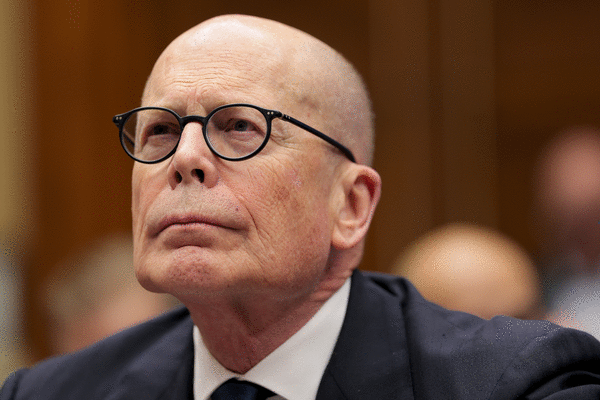
Strong financial results show UnitedHealth Group is making headway on turnaround plans, alongside sweeping leadership changes under CEO Stephen Hemsley.
The Eden Prairie-based health care giant raised its profit outlook and reported quarterly revenue and earnings that beat Wall Street expectations on Tuesday, April 21.
The company also pointed to a series of changes since CEO Stephen Hemsley returned to the role in May amid weakening confidence in its Medicare business and a falling stock price.
Hemsley has changed nearly half of the company’s top 100 leadership roles, while moving to exit non-U.S. operations and expand investment in the United Health Foundation.
UnitedHealth, which operates the nation’s largest health insurance business, said on a call with investors that it better controlled medical costs from January through March while continuing to invest in artificial intelligence to improve efficiency.
Shares rose 7% in Tuesday trading.
“Hemsley appeared to see the need for fresh ideas at the top to turn around this top-tier managed care organization in a tough regulatory environment,” said Julie Utterback, an analyst with Morningstar.
During his previous stint as CEO, Hemsley presided over a period of unprecedented growth at UnitedHealth Group, between 2006 and 2017.
Since his return, Hemsley’s leadership changes have included both internal moves by executives and outside hires, including a new chief financial officer who previously worked at private equity giant Bain Capital.
The shifts were evident in the lineup of executives fielding questions from investors Tuesday — four of the eight top leaders on last year’s first-quarter earnings call have since changed jobs or left the company.
UnitedHealth Group is on track to invest $1.5 billion in AI technology this year alone, Hemsley said. The application of technology, he said, has long been central to operations.
“This is not just a matter of being more productive at what we already do, but a reimagining of how we organize, operate and work going forward,” Hemsley said. “Few if any large organizations have ever done things like this at this scale, so we match our desire for speed with prudence and humility.”
It appeared to be a rejoinder to a recent comment from famed entrepreneur and investor Mark Cuban, who has launched businesses in recent years to disrupt large health care conglomerates like UnitedHealth.
Earlier this month, Cuban commented on a LinkedIn post about UnitedHealth: “Any company, in any industry, that has thousands of subsidiaries that are tangentially connected at best, will never be able to fully implement AI.”
During the first quarter, UnitedHealth Group sold its Optum UK business, with $400 million in net proceeds committed to the United Health Foundation.
The company’s charitable arm will do more, Hemsley said, to improve rural health care, expand the health care workforce and strengthen maternal/child health and behavioral health.
“We are invested in the notion that the foundation can be used as a means to really advance the health care system, be part of the responsibility we bear for that,” he told investors Tuesday. “We did that in the past, and have kind of strayed from that in the last few years.”
UNH’s slide
It’s been a rocky road at UnitedHealth Group since November 2024, when the company’s stock was trading at more than $600 and setting records.
Rising medical costs and surprisingly poor financial performance drove a stunning sell-off during the first half of last year. The decline followed the December 2024 killing of UnitedHealthcare CEO Brian Thompson as he walked on a public sidewalk to an investor conference in New York City.
For much of the past year, UnitedHealth Group shares have languished at less than $350.
In January, the company forecast its first annual revenue decline in more than a decade, but the outlook Tuesday improved considerably.
Beyond health insurance, UnitedHealth Group runs a fast-growing health care services business called Optum that includes one of the nation’s largest pharmacy benefit managers (PBMs).
The Federal Trade Commission announced in February a large settlement with another of the nation’s largest PBMs, Express Scripts, that requires the company to change business practices to increase transparency and lower out-of-pocket costs for patients.
Asked about the settlement and related legislation, Jon Mahrt, the Optum Rx CEO, said recent record growth in the company’s PBM business stemmed in part from “a compelling 15-part transparency guarantee” to customers.
During the first quarter, UnitedHealth Group reported a medical loss ratio of 83.9%, significantly lower than forecast by analysts and better than much of the past two years. Among the blizzard of quarterly financial data available about the company, the medical spending figure is closely watched by investors because higher ratios tend to indicate cost increases are outpacing premiums and profits.
“We are seeing early signs of improved alignment between pricing and medical cost trends,” said Wayne DeVeydt, the company’s chief financial officer.
Higher Medicare payment rates
Tim Noel, the UnitedHealthcare CEO, said the company saw “modest favorability” with costs in government programs including Medicare Advantage during the first quarter, but he cautioned against seeing this as an inflection point.
“Utilization patterns [are] continuing at the high elevated levels that we experienced inside 2025,” Noel said.
Going into 2026, UnitedHealthcare said it would increase premiums to better cover costs, even though a significant number of subscribers might jump to other insurers as a result.
Medicare Advantage enrollment fell by 965,000 people during the first quarter. About 49 million people in the U.S. had UnitedHealthcare coverage at the end of March, down from about 50 million a year earlier.
Overall, the numbers released Tuesday amounted to a second win this month for the company, coming just over two weeks after the federal government announced payment rates for Medicare Advantage health plans in 2027 will be higher than first forecast in January.
UnitedHealthcare is the nation’s largest seller of Medicare Advantage health plans to seniors. The government’s initial rate notice drove a one-day 20% decline in the company’s share price in January.
Minnesota’s largest company by revenue, UnitedHealth Group ranks tenth among large employers in the state, with about 18,000 workers.
Overall, the company employs about 390,000 people, down from peak employment of 440,000 in 2023. The headcount decline has stemmed in part from the company’s decision two years ago to sell its large hospital, clinic and insurance business in Brazil.
During this year’s first quarter, UnitedHealth Group posted a profit of $6.28 billion on $111.7 billion in revenue, better than $109.7 billion in revenue expected by analysts. Adjusted earnings per share came in at $7.23, far surpassing analyst expectations of $6.61.
The company said it now expects adjusted earnings per share of more than $18.25 this year, up from the $17.75 forecast in January.
©2026 The Minnesota Star Tribune. Visit at startribune.com. Distributed by Tribune Content Agency, LLC.





Comments