Colorado meatpacking strike begins with thousands of workers walking off job
Published in Business News
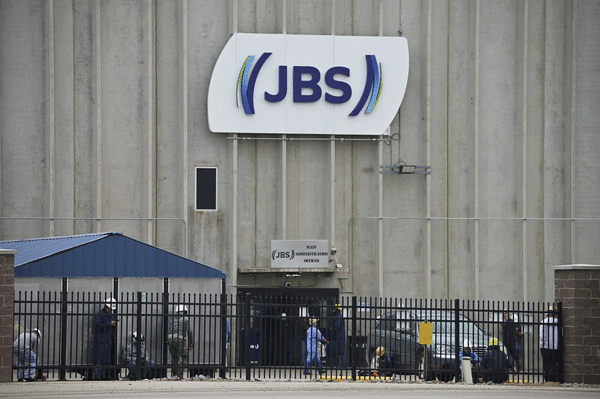
GREELEY, Colorado — Thousands of workers at the JBS meatpacking plant walked off the job Monday morning for what’s planned to be a two-week strike as they seek a new contract with higher pay and better workplace protections.
United Food and Commercial Workers Local 7, the union representing 3,800 JBS workers in Greeley, has been negotiating for months with the company but has been unable to secure a deal. Union officials say JBS has refused to budge from minimal wage increases and has committed a host of unfair labor practices during negotiations.
JBS, in turn, has called the union’s contention that the company is seeking a labor dispute “frankly absurd,” saying the company has made “meaningful movement” on economic and other issues throughout the process. The union, JBS officials said, abruptly walked away from the negotiating table without providing a response to their updated offer.
“JBS practiced intimidation and they push fear on every employee,” said Anthony Martinez, a UFCW Local 7 representative who was helping lead chants on the picket line Monday morning. “They threaten us with our jobs at all costs. No baño (bathroom) breaks, write-ups for being late, the misuse of knives. They buy us the less expensive knife and then complain about the performance. If we only have a certain amount of people, they don’t slow down the chain. It’s still the same and they still complain.”
UFCW Local 7 President Kim Cordova said JBS has been offering less than 2% in annual wage increases and “putting all the risk of rising health care costs on workers.” She said JBS refused to meet with workers over the weekend.
“Make no mistake, JBS chose this strike in an effort to lower worker wages nationwide, just as the company has squeezed entire communities of ranchers across this country,” Cordova said in a statement early Monday.
JBS officials, in a statement Monday, said many laborers chose to report for work rather than participate in the strike — and the company said it expects that number to increase in the coming days.
“Our team members want stability, they want to support their families, and they deserved the opportunity to vote on the company’s historic offer — an opportunity the union leadership has denied them,” JBS officials said.
Ninety-nine percent of unionized members in Greeley voted last month to authorize the strike. Workers told The Denver Post after the vote that they routinely get injured on the job and lack adequate medical treatment. Wages, meanwhile, have not kept up with rising costs, they say.
Striking employees gathered outside the plant in Greeley on Monday morning, wearing signs around their necks — some in English, some in Spanish — that said, in part, “Please do not patronize JBS.” They chanted slogans including: “What do we want? Contract! When do we want it? Now!” and “Get up, get down. Greeley is a union town.”
“I’ve seen every single shift out here,” said Garret Rhodes, who has worked at JBS for two-and-a-half years. “A shift, B shift, C shift. It’s crazy. This is close to, if not, every single department.”
Fernando Pitone, who has worked at the plant since June, said he was acting in solidarity with all of his co-workers.
“We’re out here standing for what we believe is being neglected,” Pitone said.
The strike represents a major work stoppage at one of the country’s largest meatpacking facilities. Some 5,000 to 6,000 head of cattle are processed every day at the Greeley plant, representing roughly 6% to 8% of America’s beef production.
JBS officials have said they plan to shift production to facilities in other states with more capacity while the workers strike. Experts say they don’t expect major increases in beef prices at the grocery store, but that JBS will likely want a resolution to the stoppage sooner rather than later.
U.S. Sen. John Hickenlooper, in a statement last week, backed the union’s fight for a new contract.
“The right to bargain collectively is how working people win fair deals, and that’s exactly what JBS workers are doing,” he said. “They are the backbone of this company and deserve to share in its success. A fair agreement is within reach. Both sides should stay at the table until the deal is done.”
Workers, many of them refugees or immigrants, for years have complained about poor working conditions at the Greeley plant.
The U.S. Department of Labor last year found JBS relied for years on migrant children to work in its slaughterhouses.
Children as young as 13 were hired through an outside sanitation company and worked overnight cleaning shifts at slaughterhouses in Colorado, Iowa, Minnesota and Nebraska, federal investigators found. Their jobs included cleaning dangerous powered equipment, labor officials said.
The company agreed to pay $4 million to assist individuals and communities affected by unlawful child labor practices.
In 2024, UFCW Local 7 called for federal, state and local law enforcement and regulatory bodies to hold the company accountable for substandard labor practices.
The union accused the company of human trafficking via social media; charging workers to live in squalid conditions; threatening and intimidating workers and their families; operating with dangerously high production line speeds; and withholding mail from workers.
Three Haitian workers in December sued JBS in federal court, alleging their experience in Colorado has been marked by injuries, discrimination and inhospitable living conditions.
©2026 MediaNews Group, Inc. Visit at denverpost.com. Distributed by Tribune Content Agency, LLC.










Comments