Cook says Fed may not be able to counter AI-driven job loss
Published in Business News
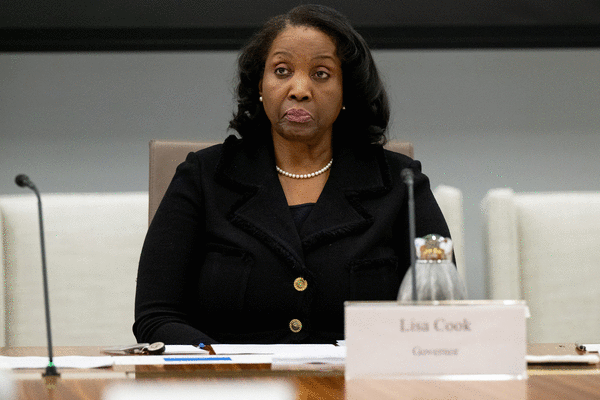
Federal Reserve Governor Lisa Cook warned the U.S. central bank may not be able to counter rising unemployment driven by adoption of artificial intelligence.
“If AI continues to raise productivity, economic growth could remain strong, even as churn in the labor market leads to an increase in unemployment. In a productivity boom such as this, a rise in unemployment may not indicate increased slack,” Cook said Tuesday in Washington.
“As such, our normal demand-side monetary policy may not be able to ameliorate an AI-caused unemployment spell without also increasing inflationary pressure,” she said.
Cook’s comments are the latest in a string of recent speeches by Fed policymakers on how AI could influence monetary policy in the coming years. A few of her colleagues have recently suggested that a productivity boom spurred by AI could boost the so-called neutral rate of interest that keeps the economy stable.
In her remarks, Cook offered some factors that could push it in the other direction.
“With investment contributing to strong aggregate demand, it is possible that the current neutral rate is higher than before the pandemic,” she said.
“This could reverse when the AI productivity gains are more fully realized or if the labor market transition leads to a rise in income inequality, such that well-off consumers receive a larger share of income, which could lower the neutral rate, all else equal,” Cook said.
The Fed left its benchmark rate unchanged at its last policy meeting in January, citing signs of stabilization in the labor market, following three straight rate cuts to close out 2025. Investors currently don’t see another rate cut until at least midyear, according to futures.
Cook didn’t comment on the outlook for monetary policy in the near term in her prepared remarks, though she pointed to the latest labor-market data released after the January meeting, which reinforced the view that conditions were stabilizing.
“The unemployment rate for recent college grads has increased over the last few years at a time when some employers are deploying AI for what had been tasks previously performed by entry-level workers,” she said. “Nevertheless, the overall unemployment rate is still at a low 4.3%, and recent measures of layoffs remain subdued.”
In a panel discussion following her speech, Cook said it may take five to 10 years for the impact of AI to appear in economy-wide productivity statistics. She added the Fed is already incorporating AI into its forecasts, citing its possible effects on the neutral rate and the impact of data-center investments on economic growth.
The stock market was roiled on Monday after a little-known firm called Citrini Research published a report outlining risks from AI to various segments of the global economy.
Fed Governor Christopher Waller, speaking Tuesday at a separate event, said the report overstated the potential impact on employment.
“AI is a tool. It’s not going to replace us as human beings,” Waller said. “This is kind of an overstated thing.”
(With assistance from Maria Eloisa Capurro.)
©2026 Bloomberg L.P. Visit bloomberg.com. Distributed by Tribune Content Agency, LLC.










Comments