China's soy purchases hit 12 million tons to meet US pledge
Published in Business News
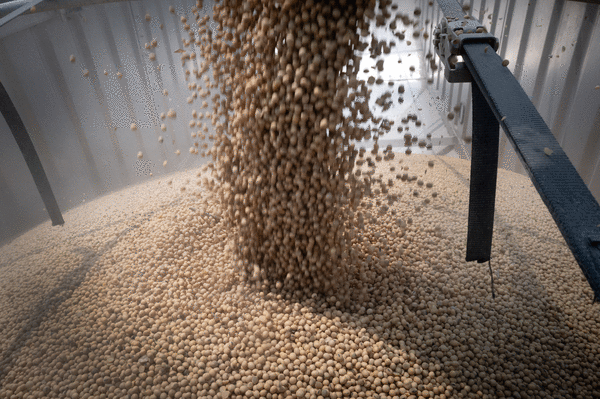
China has purchased roughly 12 million tons of U.S. soybeans in the last three months, clearing a closely watched trade hurdle and meeting a key pledge outlined by the Trump administration in November.
The world’s top consumer had been hovering close to the target for days and has now booked enough cargoes to meet it, according to traders familiar with the shipments. They asked not to be named as they are not authorized to speak with the media.
U.S. Treasury Secretary Scott Bessent said Tuesday in an interview on Fox Business that Vice Premier He Lifeng confirmed to him that China has completed their soybean purchases. “We’re looking to next year’s 25 million tons,” Bessent said.
China had avoided U.S. crop purchases for months prior to trade talks between U.S. President Donald Trump and Chinese leader Xi Jinping, as tariffs ratcheted higher — but it returned to the market in late October, just before a much-anticipated summit. The White House subsequently announced that Beijing had agreed to buy at least 12 million tons of American soybeans in 2025, a deadline that later shifted to February.
China authorities have taken some steps that facilitated the buying, including reducing tariffs and lifting import restrictions on three U.S. suppliers.
The current tally reflects continued bookings by state-owned firms in recent weeks, the people said. Export data from the U.S. Department of Agriculture, which lags real time, puts China’s purchases at just over 8 million tons as of Jan. 8. The majority of cargoes are slated to load through the first quarter, the traders said, with a significant amount expected to head into China’s massive state reserves.
Soybean futures in Chicago edged lower in Tuesday trading.
A large portion of the purchases were procured by Sinograin, the state company charged with managing those strategic stockpiles. Beijing also held several soybean auctions in recent weeks, an indication that room is being cleared for more incoming cargoes.
Reaching the apparent target, while widely expected, is likely to bolster confidence among traders and exporters that China could also meet the broader goal — outlined by the White House — of buying at least 25 million tons of U.S. soybeans annually through 2028.
It does not, however, point to a fundamental shift in China’s purchasing patterns. As part of its food security push, the country has made significant efforts to diversify suppliers and reduce reliance on U.S. crops since the trade war in Trump’s first term. Economic challenges have also curbed demand, while top grower Brazil is heading toward another bumper harvest.
China has largely covered its demand through March. It is now also booking new-crop soybeans from Brazil for loading in months as far as August, the traders said.
“That’s going to be an upcoming issue: whether we can count on China to continue to buy after that 12 million or not,” said Randy Place, senior grains analyst at the Hightower Report.
The uncertainty leaves the possibility that U.S. farmers are left holding a bumper crop with its biggest customer looking elsewhere. Without sustained demand, American farmers will struggle to turn a profit this year, as they continue to be squeezed by higher input costs and low crop prices.
While Trump has sought to bring relief to farmers — a key political constituency — with a $12 billion bailout announced last month, many farmers emphasize that reviving American exports holds the key to recovery. But even as Trump vows to open more markets, his tariff policies continue to create turmoil in global trade.
China, meanwhile, is in a position where it doesn’t need to buy that much from the U.S., said Ryan Loy, an agricultural economist at the University of Arkansas. And the opportunity for further significant sales may be limited as Brazil’s season starts to ramp up in March.
“When Brazil comes back online here very soon, what will happen then?” Loy said. “They’re going to be the cheapest on the market at that point, because they’re going to have the more abundant supply.”
Known export commitments by China of U.S. soybeans in the current marketing year sit far below usual levels, with the latest USDA shipment data showing a nearly 40% decline compared to last year.
“This marketing year is going to be tough,” said Scott Gerlt, chief economist of the American Soybean Association. “The window’s closing so fast for us at this moment.”
(With assistance from Michael Hirtzer and Skylar Woodhouse.)
©2026 Bloomberg L.P. Visit bloomberg.com. Distributed by Tribune Content Agency, LLC.










Comments